

Netism
The Young Man and the Sage
Note from Netism
This book is an alchemical text presented through fiction. Each chapter is intentionally structured around key stages of the alchemical process, guiding the reader through a symbolic journey of self-realization and metaphysical insight. As a living codex, its meanings will continue to unfold through repeated contemplation, offering deeper layers of understanding with each return.
Approach this work with an open mind. Let its symbols and ideas sink beneath the surface of thought and settle into the subconscious. Reflect on its messages as they relate to your own journey. When you have set it aside, return again and notice how your interpretation has changed. As your spiritual resonance evolves, so too will the insights this text reveals.
Foreword
We are about to ask you,our reader, to depart on a journey with us. Before complaints or excuses arise, we assure you that you do not need a ticket aside from this book. No luggage isrequired, nor is there a need to arrange for vacation time with an employer. You won’t need to travel to an airport or wrestle your way through traffic jams; you won’t need to hop onboard a vehicle of any sort. You won’t even need to put on a pair of shoes. Our journey is a different sort. The destination is here already; it is a journey of self.
What could one possibly find that is valuable that is here already, within the self? A better question is, what value does one hope to find in running everywhere and anywhere else? So many spend so much time focusing on what is in front of their eyes that they forget that closing them often provides far deeper truths.
Pay attention to the emotions that arise at the proposition of this journey. It is common to get excited about a vacation. It is even more common to be afraid of facing oneself. Our journey is that of a hero; it is not a vacation. It is the arduous path only a few set out on, and it is designed to be painful because that is what makes a person great. Only when the journey is complete can one earn the title of ‘hero,’ the coveted title granted only to the few individuals who were determined enough not to let failure stand in the way of their visions for themselves.
Are you afraid of what you might find when you journey into your soul? We encourage you not to be because it is already there. Do not run into yourself with prejudices but rather understanding. It is reasonable to want growth for oneself; it is unreasonableto expect growth to happen without confronting what we fear. There is nothing within ourselves we can run from and expect good results. If anything, the longer we run, the harder it will become to face.
Do not begin with a saddened heart. Though the trials we face are never easy, we should be grateful that we have the opportunity to overcome them. The pain that pierces our hearts is not permanent, nor is it useless. Pain can propel one to fantastic heights. Just like we can have no conception of light if we have never known darkness, so, too, will we never be able to recognize true happiness if we have never known pain. A person born into wealth takes little joy in residing in a small, run-down living space. A person who has known extreme poverty, instead, revels in every comfort that the dilapidated space provides. We must ask ourselves who possesses more wisdom: the financer who scoffs at the material of his dinnerware or the beggar who is grateful for the meager meal it contains.
Our journey is that of perception, particularly in how we perceive ourselves. It is most likely with illness of mind and sickness of spirit that we do so. For this reason, we should regard our impending travels with eager anticipation. Should we allow this journey to mold our characters, we will most certainly enjoy the benefits at its completion.
Before we begin, take a moment to breathe in the self. Pay attention to all doubtful thoughts that arise; take note of them. When we depart from each other’s company at the end of this book, we hope these doubts will be transformed into memories. In their place, assurance in each reader’s unique life experiences will provide enough confidence to make their arguments obsolete. Long-standing fears dictated by real or imagined societal standards will no longer be relevant. Instead, an unshakable peace of mind will dominate all mental faculties. No one will be able to control anyone who accept this book as a valuable ticket towards freedom of self.
As we start this journey, let barriers slip from our grasp. Let definitions no longer define us. As we propel ourselves forward to ever-greater heights, we learn how to become things we never thought we could be. As we awaken to our divinity, we realize that any state has the potential to become its opposite. One state is only as good as it is to propel us to the next stage of development.
Anything that is stagnant for too long rots, and so we must cherish one value only:
Our Evolution.
Beginning
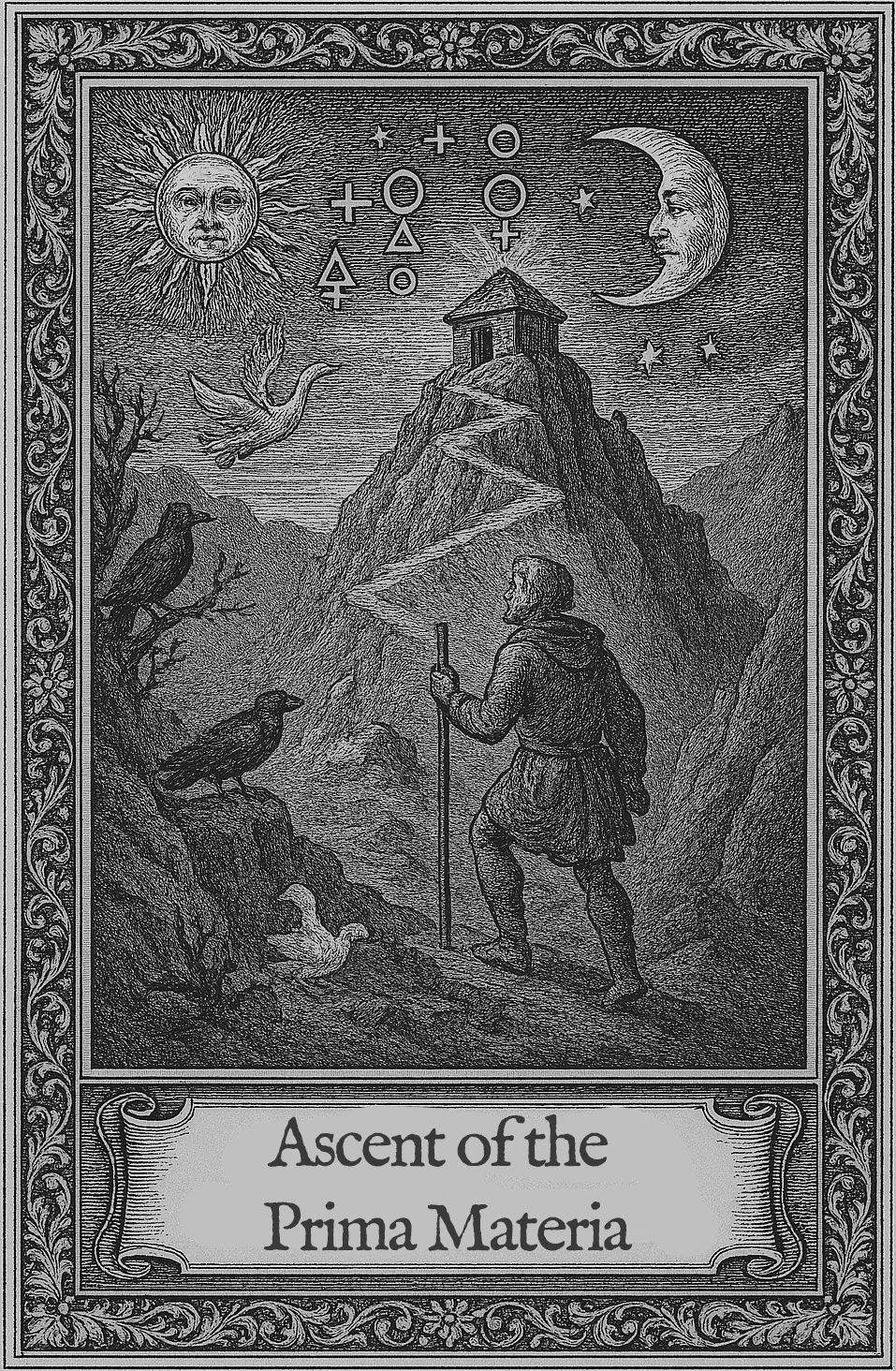
All roads have led me to this one; let me be strong in taking this path, Laolys thought as he placed one foot in front of the other, lifting himself over jagged rocks, pushing through thorny bushes, and scaling steep ledges. He wasn’t an athlete, but he wasn’t out of shape either. His firm determination and ever-present anxiety carried him through each obstacle, though it was never easy. Still, he always found ways to resolve his problems, and this time, he would do it again.
All for a better purpose… if I can find my answer in the end. Laolys had debated his decision to make this climb up the treacherous mountainside, but he had agonized twice as much about the information the man at the top of the mountain supposedly possessed. That information could change the world in the right hands, and Laolys believed he had the hands to make that change happen, if he could just find him and become his student.
The mountain towered above Laolys’s town, yet it received almost no visitors. Dangerous rocky cliffs dominated its landscape, but so did lush fields and rich pine forests. It was a terrain fit only for wildlife, too rugged for man to wield his hammer and carve out an easier way of living. However, the town’s aversion to the mountain had less to do with its harsh terrain and more to do with its lone inhabitant.
The elusive man Laolys was searching for was both an innovator and a fugitive. Rumors about him ranged from absurd tales of madness to whispers of otherworldly wisdom. Though most dismissed him as unfit for society, a few, in hushed voices, described him as a sage possessing peculiar magic. They said he held the knowledge that could open the gates of the universe, but that none could possess it without also going mad. Laolys was convinced this man held answers of great importance. His father’s relentless efforts to stop him was clear evidence; no one devoted such effort to suppressing someone who was merely insane.
Laolys had never imagined he’d be on this mission. Then again, he never had much of a chance to imagine anything for himself. His father, a well-established politician, had decided Laolys’s path at birth as soon as he was declared male. But his birth-ordained career had never felt natural to him. He sometimes doubted if he even belonged in his family. They were at peace in the political world, where their reputations preceded them. They found enjoyment in social events and making appearances. Laolys, rather, was a ball of nerves everywhere he went.
He paused to catch his breath, squinting at the distant outline of his town, backlit by the low rays of the afternoon sun. Memories of countless late nights spent pondering the mysterious man his father pursued flooded his mind. His father had referred to him only as the leak—a name signifying the forbidden knowledge the man supposedly possessed. He spent many nights eavesdropping on his father’s conversations, but they were always coded. All he could determine was that the leak held information capable of altering the populace's mindset—information his father believed must be suppressed at all costs. Disillusioned by the entire political system, he vowed to uncover these truths. If they could change the world, as his father feared, he had to find out what they were.
Just a bit further. Laolys stepped onto a narrow footpath that twisted through a rocky incline. Each step sent sharp protests from his weary feet, but he ignored their complaints. The rocks would have to be passed over, regardless of his pain. In time, and with enough persistence, the soreness would transform into calluses, and his struggles would be replaced by an unshakable inner peace. For now, however, much tribulation lay ahead. So, with a determined will, he pressed on despite the aches.
He turned the bend and froze in place, letting out a small, involuntary shriek. Directly before him, an old, thin, scraggly man was perched on his toes atop a tall rock, balancing precariously on a tiny flat surface. He remained still, staring at him with an irate expression, framed by a mane of wild grey hair that emanated from all directions. His expression suggested he had been waiting for Laolys for some time.
The sage’s appearance exuded a mystical sense of duality. His aged features seemed to mock his posture—one that even the youthful would have to rigorously train to maintain. His unkempt, matted grey hair grew wildly around his head and neck, yet his eyes held an intensity that could intimidate even the most sophisticated and educated. His simple robe and pants were so tattered and worn to his form that it was clear he had been wearing them for a long time, yet they somehow gave the impression of a costume. His presence radiated something powerful and otherworldly, and yet, the man was undeniably human.
“State your business and be gone, intruder!” he bellowed from atop the rock. A flock of birds squawked and flew off, startled by the sudden noise.
Laolys’s chest tightened with anxiety, and he began sputtering out words as quickly as he could breathe them. “I—I’m Laolys and I’m here on a very important mission! I’ve just been elected to political office. I want to do things—change things! And who else but you, wise sage, should I ask for guidance?”
He forced a bow, though his muscles quivered in protest. A part of him wanted to flee back down the mountain, but he gritted his teeth and gazed back at the sage with a pleading expression.
The sage’s eyes burned with a fire that steamed out of him as he glared at Laolys, unmoved from his perch on the rock. “A man from the government? I pushed my home all the way up this godforsaken mountain to avoid the government! I’m a simple man on untaxed land. Now, go!”
Laolys’s stomach churned. He hadn’t climbed this far just to be turned away. “Please! No, you misunderstand! You see, I’m not here for political business… I mean, if they knew I was here… No, this is personal. I want to learn from you. I’m going into office and I want to help—”
“Silence!”
Laolys’s breath stopped short as he stared back at the man who loomed above him.
“I can’t help you.”
“What? Why not?”
“You’re a politician.”
Laolys’s heartbeat quickened. “And I’ll be in a place to help—”
“I can’t help you.” The sage’s words cut through the air like glass, straight into Laolys’s soul.
Laolys clenched his fists. He couldn’t bear being turned away so quickly. “You won’t at least hear me out?”
The sage’s scowl deepened. “You can’t help other people through government, not through my wisdom. You're in the wrong place. Now leave.”
Laolys took a deep breath. His heart was pounding so hard he could hear it, but his feet and legs were locked into position. He wasn’t going to leave, not after he got this far. “Please! I can’t just go away with nothing! Just a little of your time?”
The sage remained unmoved in his perch. “Why?”
“Why should you help me?”
“Why do you want to know?”
Laolys’s nerves spiked as he thought of his father, the many years he stayed up late at night listening for clues about this man and his wisdom. “I… want to make the world a better place.”
The sage’s eyes burned as he stared back at Laolys. “Then I can’t help you.”
“Why not?”
“You’re a government official.”
Laolys swallowed. “Well, it wasn’t really my decision. There’s protocol in place, I have to be one—for my family.”
“Then I can’t teach you.”
A spike of panic shot through Laolys. Though he had been warned about the sage’s erratic behavior, he hadn’t expected to be shut out before he even had a chance to speak. A lump formed in his throat as he contemplated the possibility of descending the mountain without gaining any new insights.
Laolys drew a slow breath. “Just an hour of your time… No, not even an hour, half an hour! I can’t go back with nothing. I climbed such a long way to be here!”
The sage looked as if he were about to erupt. “You’ve climbed a long way? You’ve climbed a long way, and yet, not once on that whole climb did you think about how far I had to climb to escape the likes of you. But no, no, go on, keep telling me about how far you’ve climbed. I’ll continue not to care.”
Laolys’s gaze dropped to the ground, and his cheeks burned with embarrassment. He’s right, he thought. I only thought of my own journey. But another part of him seethed, refusing to let the man’s scorn drive him away.
“Up here,” the sage continued, his voice loud and commanding, “I teach a different type of student. These students listen without argument, and they carry my teachings across the world without complaint. They don’t ask for anything in return, not even praise. Tell me, why should I ignore such favorable students to teach the very type I climbed so far up a mountain to escape?”
“I—I’m sorry, sir, I didn’t realize you already had students.” Laolys suddenly felt unsure of himself. His heart was pounding so fiercely that it left him lightheaded. He stole a quick glance upward, and in that instant, the sage’s intensity made him feel like a child caught in a lie.
“Aye, so you can go now.” The sage made a dismissive shooing motion with his arms, still perfectly balanced on his toes atop the rock.
“But sir, maybe I can join one of your classes! You won’t even know I’m there!”
“Impossible! Students like you always find a way to disrupt and distort the message. No, I’ve done away with humanity entirely—now be gone!” The sage shut his eyes and began a low, meditative chant.
Laolys’s mind raced. He cast a frantic look at the narrow footpath behind him. The thought of trudging back down empty-handed twisted his stomach into knots. Even if the sage was half-mad, there had to be something valuable in what he knew. Otherwise, why would Laolys’s father have feared him for so many years?
Reflecting on the rumors, Laolys recognized one common thread: the sage had an insatiable love for knowledge. Once a revolutionary in the academic world, he had mastered numerous subjects, thriving by blending seemingly unrelated fields to uncover truths that applied across disciplines. No matter where his thirst for knowledge had taken him, he had carried it with him well into old age. Laolys swung his bag from his back and began rifling through it, searching for the book he’d stowed beneath his clothes.
The sage’s eyes remained closed, but he stopped chanting long enough to bellow ominously, “Bribery will get you nowhere. I have plenty of food, and I’ve no use for gold or trinkets.”
Laolys ignored the sage’s protest and continued rummaging. His hand closed around something at the bottom, and with a firm tug, he pulled out a thick book from beneath his clothes and supplies. He placed it carefully on the ground before the rock where the sage was perched. Though the sage’s eyes remained closed, Laolys noticed the subtle way his posture shifted; there was no way he could have known what had been placed before him.
“I happen to have something that, I believe, is more valuable than gold. I know you have a love for knowledge, and you once made great waves in the academic world. I also know that you’ve been in isolation for the last twenty years. Well, many incredible discoveries have been made since then. They’re in this book. It’s yours for just one hour of lessons. One hour for one book.”
The sage’s eyes snapped open, locking onto the book with interest. Then, in a movement so quick it was almost a blur, he sprang from his perch, snatched up the book, and leaped back onto the rock. He resumed his former position, cradling the book tightly against his chest, his fingers gripping the edges like a predator protecting its kill.
“We have a deal.” The sage’s expression remained stern, but his eyes glowed with excitement. “A fair trade, considering how many decades—though I won’t specify a number—are going into the hour of lessons I have in store for you.”
“Then let’s not waste any more time!” Laolys exhaled a deep sigh of relief, but his breath caught again as the sage immediately began speaking.
“Tell me what it means to be a man in power.” The sage’s voice carried as if he were addressing a large lecture hall. There was no introduction, no warning—just the sudden start of the lesson. For someone who lived isolated from society, he seemed unusually pressed for time.
Laolys blinked, caught off guard. He grasped for the answer that had been drilled into him during his political training. “It means taking responsibility for the welfare of all those governed.”
“Tell me then, what if two men are at odds, both claiming ownership of the same property? How do you intervene in a matter that you have no knowledge of or business in?”
“Well… you set up a court of judgment.”
“And what if the court you appoint doesn’t know either man or the property?”
“Then they have each man state his case clearly, without interruption, and answer all ensuing questions.”
“And what if one man is honest and the other a practiced liar?”
“Then they have to have witnesses.”
The sage raised one eyebrow. “And if the liar brings forth false witnesses?”
“They have to have evidence!”
“And if there isn’t any?”
“Then… neither man will lay claim to the property!”
“So, the state robs both men—one honest, the other a thief?”
Laolys threw his hands up. “But how could anyone be certain?”
“Why get involved at all?” The sage remained completely unmoved in his spot atop the rock.
“But if no one stops the criminal, society will become his slave!”
“Yet, in trying to stop one criminal, you can create a network of criminals, all working together to line their pockets.”
Laolys stared at the sage, taken aback. “What do you mean?”
“Those who seek power often do it for control, not to serve. The moment you create a system to judge others, you open the door for people to take those seats of power—not to uphold justice, but to manipulate the system for their own gain.”
“So what then? We do nothing? Just let criminals run free?” Laolys was starting to wonder if the sage actually had answers or if he just enjoyed making things difficult.
“Not exactly. It’s about weighing the cost of action versus inaction. Failing to enforce consequences for things like violence or theft would make the world a much more dangerous place. That’s why every government, no matter how different, has some kind of justice system. What I’m saying is, the moment you put a structure in place, you also create an opportunity for corruption. Balance has to be considered in everything, especially government.”
“Even if corruption is inevitable, surely, having a government—flaws and all—is better than not having any government?”
“Aye. That’s why most societies have governments.”
“They’ll never be perfect!”
The sage shrugged. “Nothing ever will be.”
“So, we shouldn’t aim for perfection?”
“We should always aim to improve, to seek harmony and balance. But know your limitations. Assume that whatever you create with good intentions will eventually be used for something else. Sometimes, in a flawed system, the best action is inaction, because trying to fix it could lead to even bigger problems.”
Laolys felt a pang of frustration, but he couldn’t deny there was truth in the sage’s words. He had seen firsthand how power was abused; he had grown up under his father’s shadow, watching it happen. Even if he managed to implement real, meaningful changes, there was no guarantee the next person in power wouldn’t twist them into something harmful.
“But if governments can’t help society, what can?”
The sage shrugged. “Who says society can be helped?”
Laolys took a deep breath, trying to slow down to process his thoughts clearly. He knew the sage wasn’t some cynic who had given up on the world. If he really believed society was beyond saving, he wouldn’t have spent his life teaching people how to live differently. He looked up at the man, his figure now a dark silhouette against the fading light in the sky, and asked, “You really think it can’t be helped?”
“Not if it doesn’t want the help or doesn’t think it needs it.”
Laolys glanced around at his surroundings—rocks, bushes, and endless sky. Humanity, however, was a sparse commodity. “With all due respect, sir… how can you claim to be so wise about society when you’ve lived apart from it for so long?”
The sage glared at him. “I’m wise about it because I’m removed. You, along with the rest of them don’t know any different. You’re blind on the matter. Distance grants clarity. I’ve found that, more often than not, it’s best stay out of other people’s affairs.”
“And live as a hermit? Not everyone has the luxury!” Laolys’s thoughts drifted to his family. A wave of guilt rushed over him as he imagined his parents’ disappointment and his fiancée’s confusion. If they knew where he was, they’d be devastated.
“The luxury is free to all!” The sage threw his arms out, startling a small flock of birds into flight. “Just walk far enough, and you’ll see most of the problems you used to face don’t matter anymore.”
Laolys took a deep breath. “Sure, maybe up here I don’t have to answer to them, but they’re still worried about me. I have to return to them.”
“Why?”
“Why? Well, they’d worry!”
“Don’t they have feet too?”
“Of course they have feet!”
“Then, if they want to stop worrying, they can do the same—walk until they find peace.”
Laolys shifted his stance, his sore muscles protesting. He fought to keep his composure, unwilling to let the sage see his frustration. “But everyone can’t just live as hermits! Societies help people in a lot of ways!”
“Well then, it’s a good thing people don’t have to physically remove themselves from them to stay out of other people’s affairs!”
The sage scowled and continued, “There are only two types of people who concern themselves with other people’s business. The first type does so out of necessity because they depend on other people for survival. The second does so willingly, because they enjoy power and recognition. The second type always preys upon the first.”
“But there’s a third type!” Laolys argued. “Some people who help out of genuine kindness! They get involved in things all the time—not for power or necessity, but because they feel responsible for making the world a better place.”
The sage shook his head. “There is no third type. If I asked you to name someone who fits this description, you wouldn’t be able to. Think about it. If someone truly helps out of pure kindness—not for any other purpose than to help that specific person—their deeds remain unknown. And they’re never really wrapped up in anyone’s affairs unless they choose to be. People who make sacrifices for their reputation complain. People who make sacrifices because they want to? They don’t complain at all. They don’t see any burden.”
“I see… you’re saying they could exist, but most people don’t know about them. They’re invisible.”
“That’s right. The moment someone advertises their own generosity, it stops being true generosity. Real kindness doesn’t need an audience; it’s enough to simply know you helped.”
“And you don’t think people perform selfless acts?”
“No, some people do. But the moment kindness is advertised or leveraged for personal gain, it loses its meaning. It becomes a currency. That’s what I saw in society before I left—people helping only when they stood to benefit. That’s not morality. That’s just the desire for good favor.”
Laolys looked up at the sage, a bony old man with intense eyes and a scowl, still perched on his toes. He imagined that even in his younger years, society would’ve noticed he was something different. For that reason, his experience must have been more trying.
“But if people are really as selfish and immoral as you say they are, isn’t that an argument for a stricter government? People need to be kept in check.”
The sage’s scowl deepened. “Quite the contrary, actually. Tell me, what kind of people do you think fight the hardest to claim those high authority positions?”
Laolys hesitated, thinking back on all the politicians he had encountered in his life—far too many. As a child, he had overheard countless private conversations between officials, enough to know that very few of them had what he would consider strong moral character. “People who are willing to step on others to get there, I suppose.”
The sage nodded. “Correct. Only the morally corrupt seek that kind of authority. They will always end up in positions of power; it’s inevitable. That’s why the government should be restricted in its ability to create laws. It should, ideally, merely represent them.”
“Merely represent them? But it has to enforce them too!”
The sage shook his head. “No, it wouldn’t be fair. The citizens have to do that, too.”
Laolys stared at him. “The citizens police themselves?”
“Yes.”
“So if the government isn’t writing the laws, and it isn’t enforcing them, what is it doing? Just representing them?” Inside, Laolys’s blood was boiling, but he tried to maintain a calm demeanor.
“Ideally, yes. A government’s main role should be foreign diplomacy, protecting its people who self-organize.”
“And for that, they’d need to keep and maintain troops.”
“Only in emergencies!” The sage waved his arms dismissively. “Otherwise, they’re just stockpiling an army with no purpose, draining resources in the process. And when a government has a standing army, it’ll always find a use for it—one that benefits its own power, not its people. Citizens will defend their land when they believe it’s worth defending. If a government serves them well, they’ll fight for it without needing to be forced.”
Laolys threw his hands up. “But if power is as corrupting as you say, why allow anyone to hold office at all? If the people who seek it are the most likely to abuse it, wouldn’t it be better to do away with government entirely?”
“Because otherwise, the worst, most violent man will claim it. It’s better to put someone in power with checks and balances than to leave the seat open for the strongest brute to seize. If you can convince him, too, that the only way to keep his power is to be liked, then he’ll at least pretend to be honorable. That alone is better than unchecked tyranny.”
The sage’s eyes glinted as he studied Laolys, and his lips widened into a smile. “Your question makes me think… You’re already a little different than you were a few minutes ago. Tell me again, what is it to be a man in power?”
Laolys blushed and cast his eyes toward the ground. “It means, I suppose, to accept responsibility only as it’s called for.”
The sage clapped his hands together. “That is the mark of a good man in power, if such a thing exists.” He locked eyes with Laolys.
Laolys’s heart pounded; he felt like the sage was peering straight into his soul.
“Now we’re making progress,” the sage continued. “It’s time to get to business. Tell me, why do you want to better humanity?”
Laolys’s breath caught in his throat. “Why wouldn’t I?”
“Because it doesn’t concern you.”
“I say it does. It’s in everyone’s interest to better society.”
The sage tilted his head. “That may be true, but that’s not why people try to do it.”
“Then why do they do it?”
“For recognition. To be remembered.”
“I suppose that’s true for many…”
“Almost all.”
“But is that such a problem? If the end result is the progression of humanity, does it matter why people do it?”
The sage threw his arms out wildly. “But the result isn’t the same! It’s tainted! It’s hardly a fraction of what it could be! You have no idea how much knowledge the human race has lost simply because people insisted the world had to be a certain way and feared how they might appear if they discovered it wasn’t.”
Laolys looked at the sage in fascination. “Are you saying people have discovered things—amazing things—and intentionally kept them secret out of fear of ridicule?”
“I’m saying they’re too afraid to even be capable of making such discoveries.”
The sage studied him, a glint of interest in his eyes. Laolys turned his gaze toward the mountains, but he still couldn't shake the feeling of those piercing eyes locked onto him.
“I'm going to make you an offer. I will teach you my wisdom—secrets I have learned throughout the years. They won’t bring you wealth, or power, or status, but they’ll bring you peace. And, if you share them, they could even change the world.”
Laolys froze, barely believing what he was hearing. His mind instantly flashed back to the night he heard his father shout, If he convinces enough people with these truths, it will change the world!
“I’m only asking for one thing in return.” The sage’s expression was stern, unreadable.
Laolys could barely bring the words to his lips. “What?”
“That when you descend this mountain with your knowledge intact, you share this wisdom with anyone who asks.”
“That’s it?” Laolys’s jaw dropped open. “Well of course I accept the offer!”
“Listen to my words! I said you have to share these truths with anyone who asks. When you descend the mountain, people will ask.”
Laolys let out a deep exhale. “Oh.” His mind instantly flashed to his father asking him where he had been. That wouldn’t be a pleasant conversation.
“It will cost you nearly everything, I’m afraid.”
Laolys imagined once word got out about his journey, everyone he knew would ask. As a recently elected official, he was well-known. His heart sank. It would cost him nearly everything.
“They… will call me a madman.”
“Aye. People always fight progress. Great innovators are rarely praised for their work. One day, these truths will become commonly accepted, but by then, both you and I will have long passed. You will never be recognized by name for your work, but by spreading the message, you will eventually change the world.”
Laolys stared at the ground in front of him. The future scorn of his parents locked his knees into place.
“Is this an offer you’re willing to accept?”
Laolys took a deep breath and turned his focus back to the sage. “How do I know you won’t fill my head with nonsense? How do I know it will actually be helpful?”
“You have my word, that’s it. My reputation brought you up here, your heart has to decide the rest. Is this what you want? Are you ready for it? Can you leave with this knowledge intact?”
Laolys’s mind spun. It was all happening so fast. Though he had spent countless nights mulling over where this journey might lead, none of it had prepared him for this moment. Could he descend as a changed man? Could he live with himself if he walked away?
“I… have to share it?”
The sage nodded. “That’s all I ask.”
Laolys pictured his family, the contempt of the government he had been groomed to serve. Yet, the promise of real knowledge—knowledge so profound it had driven this man into hiding—lit a fire inside him. If the rumors were true, if the sage truly held the path to enlightenment, how could he turn away?
“I want to learn your secrets.” He forced the words out before his doubts could stop him. “I need to. For the sake of humanity—for anyone who seeks a better path.”
The sage didn’t move. His piercing eyes stayed fixed on Laolys. “Why?”
Laolys took another breath, feeling the weight of his decision settle over him. “Because, despite your arguments, I believe that true wisdom can’t be ignored. I need to learn what you have to teach—not just for myself, but for everyone willing to listen.”
The sage gave a half-nod. “That’ll do.”
Laolys exhaled and his shoulders released tension he was unaware he was holding.
The sage looked toward the horizon, watching the sun dip below the valleys. “But there’s much to be done first. Too much to be done. Too much time has already been wasted.” Without another word, he leaped from the rock and almost instantaneously disappeared into the trees.
Laolys stood frozen, unsure if the sage’s proposal had been a test, a trick, or a genuine offer of forbidden knowledge. He felt oddly exposed—stripped bare by the old man’s scrutiny, only for him to vanish without explanation. A cool breeze brushed against his cheek, reminding him that he was alone again. The sage was the only other human on the mountain.
He sank down onto a nearby boulder and let out a long exhale. The sage’s behavior was so bizarre, it bordered on madness; yet Laolys couldn’t ignore the razor-sharp intellect behind those intense eyes. Was I doing him a favor by accepting? he wondered, or did I just throw myself into a path of no return? He glanced over his shoulder, half-expecting the sage to leap out from behind a tree and berate him for moping, but there was only silence.
His gaze drifted to the distant town, barely visible below. They’ll offer me little comfort when I return, he thought. If I return at all. The idea sent an anxious tremor through his chest, reminding him of the night he’d first realized who might dwell on this mountain.
It had been a casual evening with friends, a few drinks shared in good humor, when someone excused himself for the restroom, saying he needed to “take a leak.” Jeremy had laughed a little too loudly. “Don’t say that around here,” he’d teased, “or that man on the mountain might think you’re after his mirror!”
Everyone else shrugged off the remark, but Laolys had felt a jolt of curiosity. “What man on the mountain?” he’d asked, heart thrumming with sudden hope.
Jeremy explained the rumor: there was a hermit who referred to his ‘mirror’ as a portal, a so-called “leak” into other dimensions. Most people considered it drunken legend. But the name—the leak—snapped Laolys to rapt attention. He could still recall how his father had railed about “that leak who could undermine everything.”
Later that night, Jeremy confided that the hermit was more than a mad recluse; he was a fugitive from society who’d uncovered truths governments suppressed. “They say no one returns from the mountain sane, if they return at all,” Jeremy had added, eyes flicking uneasily to Laolys, as though daring him to test the legend.
Now, as the last rays of sunlight smeared the sky with orange and purple, Laolys replayed Jeremy’s words. He tried to ground himself by focusing on the forest’s gentle rustle, but the memory of that conversation pulsed in his mind. I had to come, he reminded himself. If I can’t change a broken system, maybe this sage—the so-called leak—can show me how.
A shiver ran through him as a brisk gust ruffled his clothes. The sage might have offered lessons, but that didn’t mean he’d stick around to teach them. Perhaps he was gone for good, and Laolys was a fool, waiting for a man who was only interested in keeping his solitude.
Still, he felt an inexplicable sense of reassurance on the mountainside, amidst the towering pines. All around him, the forest darkened, and the sky began to sparkle with tiny twinkling stars. First, just a few arrived, then the trees and rocks around him turned into shadowy forms and more came to grace the sky. It was as if the curtain was closing on one great act of nature only to open a second act on another stage, offering a nonstop performance to any traveler who might decide to take a seat.
Not long into this second act, exhaustion overwhelmed his weary mind and body. He determined he could no longer stay awake waiting for the sage. If his fears of abandonment were correct, he would have to investigate in the morning. He permitted himself to close his eyes, and sleep overcame the young man almost immediately.
Death
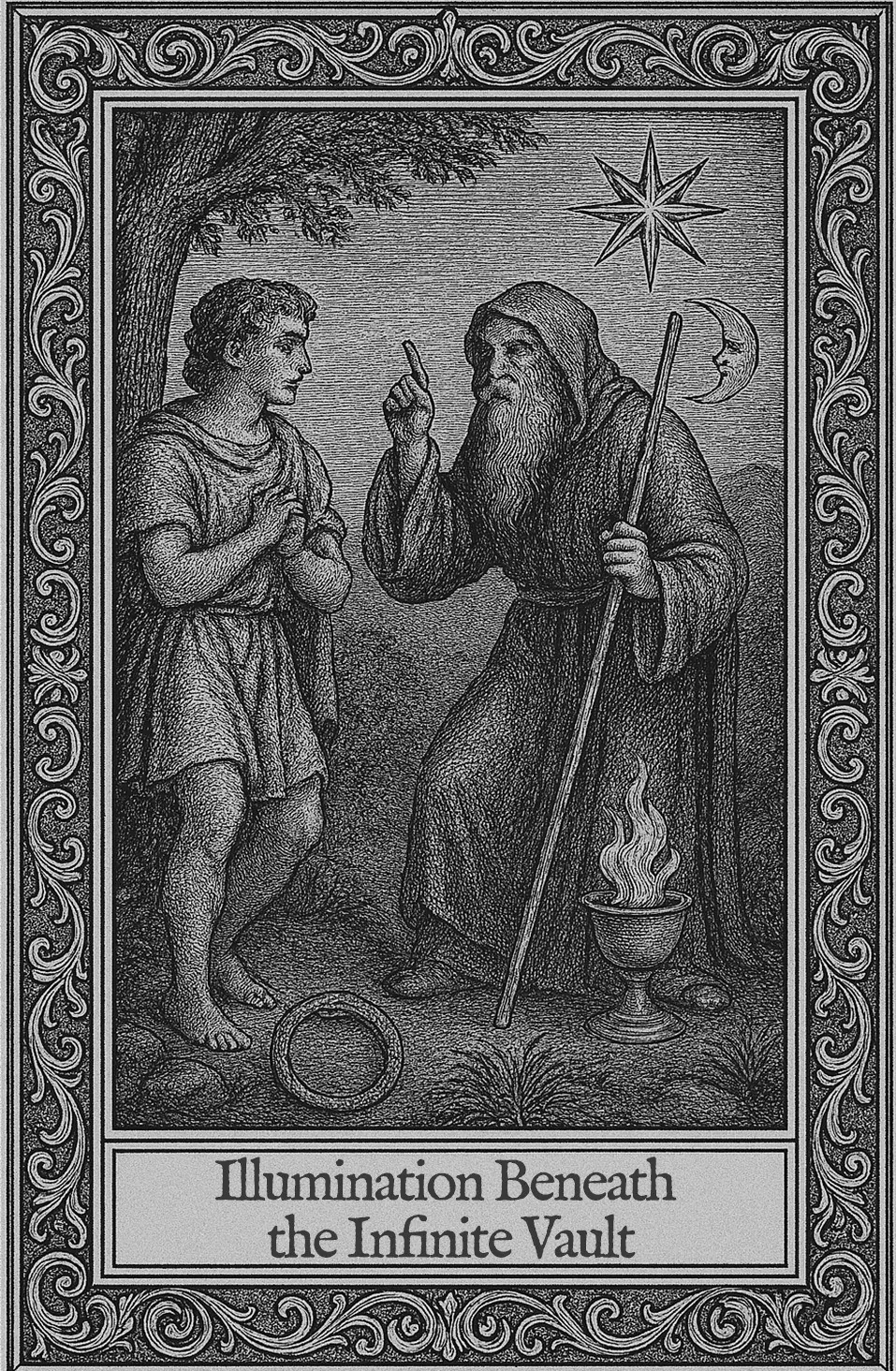
Your birth was not a true beginning; your death is not a true end. The only result anyone has ever obtained with certainty in death is life, just as the only certainty one can claim to possess in life is death.
The words startled Laolys awake. Opening his eyes, he was met with an impenetrable pitch-black void. The darkness that surrounded him here was deeper and denser than anything he had ever experienced in his town. There, even in the dead of night, a faint sliver of light from some distant window or lantern always cut through the gloom. These tiny slivers accumulated down there like a second moon that never fully disappeared. But here, up on the mountain, everything felt more intense, and the darkness was no exception.
“E-Excuse me?” Laolys called out, his voice trembling slightly. He wondered if he was dreaming. Logic suggested that if the sage were truly nearby, there would be some sign of him—a flicker of light, perhaps a small fire illuminating a corner of this dark world.
“Your birth was not a true beginning; your death is not a true end. The only result anyone has ever obtained with certainty in death is life, just as the only certainty one can claim to possess in life is death,” the sage’s voice echoed, calm and unwavering, repeating the words exactly.
So it is the sage, Laolys thought as his heart rate spiked with anxiety. He had heard tales of the sage’s bizarre habits, but none of the rumors had prepared him for the reality of interacting with him.
“Y-yes, but shouldn’t we discuss this in the morning?”
“Now.”
“But why?”
“The birds are my students in the morning.”
Laolys blinked, struggling to make sense of the bizarre circumstances. The sage had mentioned having students earlier; did he mean the birds? A wave of doubt washed over Laolys, and he began to question his decision to come up here. Maybe the rumors were true, and the sage was simply mad. But it was too late to turn back now. He had to see this through, no matter how strange the lesson might be.
“You’re starting our class now… in the middle of the night… so you can teach the birds in the morning?” Laolys asked slowly, hoping that speaking the absurdity out loud might somehow make it more comprehendible.
“Yes.”
So the sage is mad, Laolys thought. There was no other explanation for such bizarre behavior. Still, what could he expect from a man who had lived in seclusion for the last two decades? No rumor, not even the ones praising his wisdom, had ever mentioned the sage being normal or particularly friendly. Perhaps I should cut him some slack when it comes to social matters, he mused, but his train of thought was quickly interrupted.
“No words? No thoughts? No arguments?” The sage seemed full of boundless energy. Laolys sensed the soft scrape of a stone to his right, then to his left. He couldn’t be sure, but it felt as if the sage was jumping around the rocks surrounding him. He tried to shake the image from his mind; there was no way anyone could navigate such actions safely in the pitch darkness.
“No fire?” Laolys wiped the sleep from his eyes. The night was moonless, and everything before him was shrouded in mystery, no matter how badly he wished his eyes would adjust.
“I don’t want anything to detract from the lovely darkness in which we’re indulging!”
Laolys sighed, reasoning that any questions regarding the sage’s behavior were pointless. He decided to steer the conversation elsewhere. Recalling the sage’s initial statement, he asked, “Why should I take your word on what happens to a soul after a body dies?”
“Why wouldn’t you?”
“No one knows these things.”
“I do.”
“How can you say that?”
“I have died many times. I have lived many lives before this one.” The sage’s voice faded softly into the darkness.
“That you remember? Anyone would say a person’s mad who says such things!” Laolys could feel his heart pound in his chest. The stress of the moment, compounded by sleep deprivation and the disorienting pitch-black night, was pushing him to his limits. He could feel himself barely holding it together.
“Didn’t I warn you of exactly that?” The sage’s voice seemed to materialize from one spot, now alarmingly close—just a foot in front of Laolys’s face.
Laolys swallowed as nerves began to rise in his throat. “Yes, but how am I supposed to repeat your claims if I have no reason to believe them myself?” The weight of his decision made only hours earlier, to carry the sage’s wisdom to the world, now felt heavy on his mind.
“Then tell them you have lived many lives and died many deaths.”
“But I haven’t.”
“Indeed, you have.”
“But I can’t remember them.”
“Then remember.”
Laolys sighed. This wasn’t going to be an easy undertaking. He had no idea what kind of truths the sage expected him to uncover, what would be asked of him next, or what consequences might follow if he failed to meet the sage’s expectations. Still, he closed his eyes and attempted to remember, as directed. After only a brief pause, he opened his eyes and said, “I can’t. I can’t remember anything before this life.”
“Sure, you can.”
Laolys could still sense the sage right in front of him; the scent of his breath made the hairs in his nostrils stand on end. “But how?”
“First, you must believe that you can. Then, I will tell you how.”
“But how can I believe that I can if I don’t know how it’s possible?”
“The method relies on whether you believe in your abilities.”
“But nobody’s supposed to have these abilities! I want to know how they can be obtained!” Laolys felt as though he were shouting his frustrations into the empty air, though the sage replied immediately.
“No one believes they can have such abilities, that’s all. The method is simpler than you think. Try again.”
Laolys exhaled and closed his eyes, though he could hardly see much with them open. He tried again to focus, letting his mind drift, while the sage remained silent. To his surprise, images began to flash through his mind—rocking a baby, the faint scent of lavender, the sound of gentle cooing. He let these visions play out for some time before pulling himself back to a wakeful state.
“Well?” the sage asked the moment Laolys opened his eyes.
“I don’t know. I saw myself rocking a baby in a room full of people, but I’ve never even held a baby before.”
“No, you’ve held a baby many times. You remember it now.”
“But how can I trust this memory?”
“If you can feel it. It’s more than a visual, it’s filled with emotions. It seems tangible.”
Laolys reflected on the vision. It was an all-encompassing experience, he felt the stuffiness of the room, the sweat of those around him, the baby clawing at his shirt, or her shirt in that case. The vision gave a strong impression of belonging to a female. Still, it all seemed too easy. “Is there anything else I should look for?”
“Look for things you couldn’t have imagined, like technology you’ve never seen before, or customs that are completely unknown. Also, if you can verify through historical facts—death records and the like—you have good indications of a true, unfabricated experience.”
Laolys nodded. He couldn’t recall specifics from the vision but resolved to try again, knowing what to focus on, if he could even see anything more. A wave of unease rose in his chest as he remembered the promise he had made only hours earlier to share these teachings.
“But I can’t just say I know all these things, people are going to think I’m mad!”
A silence followed, and the sage cleared his throat. “You came to learn from me, correct?”
“Y-yes.” Laolys’s heart raced. He had known this would be challenging, but he hadn’t expected it to feel this insurmountable.
“Well, I’m telling you that life goes on after death and that you’ve lived many lives before this one. I’ve even shown you that you can access some of the memories. Your response is that you want more proof.” He exhaled. “I’m starting to think you’re being difficult on purpose.”
The words jolted Laolys with a tinge of outrage. “What? Me? You think I’m being difficult?”
“Yes, quite frankly, I was beginning to suspect you wanted out of the deal. If you’re no longer interested in my lessons, it’s fine; you can leave.”
Laolys felt his heart skip a beat. He wasn’t ready to leave, he was just getting started. “No! Forgive me. I’m not trying to be difficult; I just…” He took a deep breath. “I need to understand these lessons. When I teach them to others, they’re going to ask so many questions.”
“I’m showing you how to find the information yourself, but you’ll never be able to if you keep questioning your integrity.”
“What? How am I questioning my integrity?”
“You don’t believe your own memories, your own instincts. You doubt the information that comes to your mind as having any relevance, despite the fact that it arrived under focused intent. You feel the truth of the lesson, but you doubt you can teach it, so you, in turn, doubt me.” The sage’s tone held no anger nor any frivolity. Laolys sensed that he may be wearing on the sage’s patience, a thought he hadn’t considered until now.
“I’m sorry, but how could you possibly know that life continues after death?”
“Because energy can’t be created or destroyed. You and I are both energy. We didn’t arise from thin air or mere biological processes. Our consciousnesses have a history with memories that we can access.”
Laolys’s breath caught short. “But… what if that’s just imagination? How are you so sure?”
“If I told you the answer now, you wouldn’t believe me. Maybe, if you stick around, you’ll have more details. For now, though, you’ll just have to take my word for it.”
“Just take your word for it?”
The sage sighed. “Yes, until you can verify the reality—I mean live it yourself—you’ll have to take my word. If you listen, maybe you’ll see it too. But that depends on whether you truly listen.”
“Verify it?” Laolys’s interest was piqued. “Have you verified it?”
“Aye. But you’ll never see it for yourself unless you learn how to listen.”
Laolys stared at the black world in front of him, reflecting on the idea of reincarnation. It wasn’t a foreign concept; he had always sensed that life continued in some form after death. He had been raised in a monotheistic faith that emphasized one God and an eternal afterlife but had never fully believed it held all the answers.
“So, if there is a cycle, and not one life…” He paused. “What does it mean to escape it?”
“It means a complete shift in a spirit’s resonance.” The sage’s breath brushed up against his nostrils, alerting him to his close proximity.
Laolys shifted uncomfortably.
“No more fear, anxiety, anger, greed, none of that,” the sage continued. “All those pains have to be transcended. Once we do that, we’re free to traverse the Cosmos, unchained to any single world. Until then though, you’ll keep coming back to a body somewhere among billions of worlds and dimensions all over the multiverse.”
“Billions?”
“Billions is an understatement, really. A single world has many parallel realities, each completely separate from the others. Then, if you consider the habitable planets in our universe alone, the number is in the quintillions. But that’s just one universe, ours. The multiverse has a non-quantifiable number of universes. The number of places we could end up isn’t infinite, but it’s certainly more than billions.”
“But why don’t people have memories of them?”
“Different worlds might have very strange forms and customs. Different universes have different laws of physics. If we were to see some of these places…” The sage let loose a small, barely audible chuckle. “Well, some of them we wouldn’t even know what we were looking at.”
“Like what?”
“Try imagining a universe where everything is expanding and collapsing so frequently that all life forms are composed of a gel-like fluid.”
Laolys envisioned a planet with only gel-like globs, separated from one another by thickness and color.
“Now,” the sage continued, “imagine conducting commerce in that world.”
Laolys laughed. “I can’t!”
“Exactly. Your mind can’t grasp it. It’s too strange. But you could have lived in a world like that at some point. Back then, you would’ve understood that reality well and to catch a glimpse of your current one… Well, you’d have no idea what to make of it.”
“I can’t imagine!”
“If we had all our past life memories, we’d be overwhelmed. Too much information, too many perspectives—it’d be impossible to function. Each life has its own focus, its own lessons. We need that fresh start to really absorb what we’re here to learn. But when we ascend, we’re no longer tied to just one life, one place. We can move freely across the Cosmos.”
“So… ascending is kind of like heaven, but in the Cosmos?”
The sage sighed. “Not like heaven. It’s not eternal bliss. Honestly, I’d find that pretty boring after a while. The Cosmos isn’t some paradise, it’s just a vast existence without the physical limitations we have here. Picture endless worlds, some similar to this one, others completely alien. This place—this world—it’s not perfect, but it’s not hell either. Most people are decent enough, but some do horrible things. Life here has some predictability, but wild, unexpected things happen too. The spiritual realms? They’re the same way. There’s no telling what you’ll run into.”
Laolys listened closely, trying to commit every word to memory. He’d never heard life after death explained this way before. The idea of traveling between worlds as a spirit fascinated him. “Is it hard to navigate?”
“It’s natural, like dreaming. I don’t have all the answers for you yet, but I can tell you this—ancient religions all saw the afterlife as a journey, not just some final destination. The underworld was always dangerous. That’s why so many traditions had people memorize prayers, and why families left offerings to help their loved ones navigate it. Nobody just died and woke up in paradise or torment, there were steps, trials. And those who earned a place near the gods? That wasn’t just a reward. It came with responsibilities, expectations. They had to help maintain Cosmic balance. It was an honor, but it was also work.”
“Maybe I should just stay here,” Laolys joked. The sage’s descriptions of the afterlife were overwhelming, especially in the pitch black.
“For a while! The good news is, you can’t get there until you’re ready, whether you’re alive or dead.”
“Then I won’t worry,” Laolys said, though his tone carried more sarcasm than he intended.
“Don't waste time worrying. Prepare, sure, but never worry. Worry just drains your energy. If the bad thing never happens, you worried for nothing. If it does happen, then you spent all that time making yourself miserable in advance.”
“That’s one way of looking at it!”
“It’s the only way of looking at it if you actually want to enjoy the present moment—which, by the way, is all we ever really have.”
“So from what you're saying, it sounds like life just keeps going. But what about people who do terrible things? Is there any kind of punishment?"
“There’s an unavoidable moment of reflection after death,” the sage began. “A spirit has to confront every major moment of its life—all of it, with absolute clarity. And it doesn’t just see its actions; it sees the full effect of those actions rippling outward. If someone lived selfishly or hurt others, that moment can be excruciating. They have to face exactly how much damage they caused. Then, when they've finally reckoned with it, they take another vessel somewhere in the vast multiverse and try again—another lifetime, another chance to get it right."
“Do people usually do better the next go-around?”
“Ha!” The sage let out an emphatic burst of laughter, a sharp sound that seemed to arise from both his throat and nose at once. “Most people just repeat the same mistakes, life after life. They start fresh in a new body with no memory of their past lives or their time between them. But their spirit? That carries the same resonance they left their last life with. A bitter, angry person doesn’t just wake up kind and enlightened in the next round.”
“So, no growth happens between lives?”
“No, we can learn everything there, but we can’t apply it. The only chance to work on our faults is here, now, while we're alive. And if you’ve been given enough awareness to seek ascension, seek it with everything you've got, before it’s too late.”
“But wouldn't it help if we could remember at least some things?” Laolys pressed.
“The spirit remembers differently. It’s not like the brain; it doesn’t store facts or dates. But it remembers feelings.”
Out of the darkness, a hand tapped Laolys’s chest. It was gentle, though, and he wasn’t startled by it.
“This,” the sage said, “is what we carry. It's your raw essence, before the world told you what to be.”
Laolys thought about his spirit. What had he brought into this life? All he could remember was feeling afraid when he was younger, but that could have easily been tied to his upbringing. “I don’t even know what that is.”
“You think too much, that’s all. The brain conflicts with the spirit. The spirit knows; the brain argues.”
Laolys had no counterargument. His brain was always arguing, usually with itself. “But what about past mistakes? Is there any kind of karmic retribution in the next life? Do people become victims of their former crimes?”
He imagined some kind of divine Cosmic judgment hall, where people were assigned their next life based on their past deeds. A greedy profiteer who exploited workers might return as an underpaid laborer. Someone who lived honorably but never ascended might be born into a secure and happy family.
“Nothing so organized,” the sage said. “For nearly everyone, the next birth is completely random. We can’t look at someone’s life and assume it’s a direct consequence of a former one. It doesn’t work like that. There are too many souls, too many worlds and dimensions, too many variables involved. More often than not, when a soul is ready, it’s swept into the next life without any say in the matter.”
Laolys nodded. It made sense that things were more chaotic than he had imagined. “Some aren’t random?”
“Some souls have advanced far enough to choose. This happens in the spirit world, and it’s not usually about picking the most comfortable life, but the one that offers the best opportunity for ascension. The spirit is given the answers, then it’s tossed into another life to wake up as a blank slate again.”
“A continuous cycle…” Laolys mumbled. He wasn’t sure whether he liked or disliked the idea, but it made sense.
“Until you rise to the next. Whether you know it or not, that’s really your ultimate goal.”
Laolys reflected on the lesson. The sage saw reincarnation with a sense of urgency. It wasn’t just another turn on the wheel, it was something to transcend, to evolve past. This would be a hard sell to his people, who believed they had only one life and one chance at heaven.
“What you’re saying makes sense to me,” Laolys began cautiously, “but this won’t go over well with my townspeople. They’re firmly rooted in the belief that God, heaven, and hell are absolute truths that aren’t up for debate.”
The sage sighed, letting a brief silence settle between them before responding. “The idea that a soul’s eternal fate is decided after just one lifetime... it’s hard for me to wrap my head around. I’ve spent decades wandering through my own pasts, far removed from the world. Remind me how it goes again.”
“The concept of eternal salvation or damnation?”
“Yes.”
“Well...” Laolys’s mind flashed to childhood memories of sitting in church. Though his family wasn’t truly religious, they wanted to appear that way, and attended semi-regularly as he was growing up. “The idea is that this life is our one chance to prove our devotion to our creator. As long as we follow basic laws and remain faithful, we can enter heaven after death.”
Silence stretched between them before the sage asked, “What if we don’t hear the laws, or fail to understand the need for devotion?”
“Then, I suppose, we go to hell.”
“And where do all the souls come from? The new ones, born with every life?”
“According to the theory, God makes them.”
“Each time?”
“Yes.”
Low, unintelligible murmurs escaped the sage, as if he were working through a complex calculation in his mind. Finally, he asked, “But afterward, there are all these souls who aren’t going anywhere?”
“Well, I’m not exactly sure… only that they aren’t recycled,” Laolys admitted.
A few more moments of silence passed before the sage spoke again. “I’m just not following the math.”
“I never really thought about the math behind it.”
“According to the law of conservation of energy, energy can’t be created or destroyed. Consciousness is energy; so is the soul. Where is consciousness generating from if it doesn’t continue into another life after this one?”
“I suppose… God has infinite power,” Laolys offered, struggling to articulate the finer details of his religion.
The sage grumbled softly. “No, reincarnation is the only mathematical plausibility. With or without divine interference, there’s no room in my calculations for infinite creation.”
“But God goes beyond the confines of math!” The words burst from Laolys’s mouth before he realized the thought. It was impulse more than reason.
The sage sighed. “Even if we recognize everything as a creation, we have to accept that absolutely everything within that creation follows mathematical laws. Whether it was a divine plan or simply the only way life could organize in this universe, everything is governed by physical laws. So tell me, how does everything around us adhere to these laws, yet somehow we’re exempt? That our souls are created for only one lifetime, one test, with eternity following death as the final exam?”
Laolys’s mind raced. Until now, he had taken his beliefs for granted. It was what everyone he knew believed. No one had ever challenged it, and he had never thought to question it himself. But now, for the first time, he saw things differently. His heart skipped a beat as the realization hit him—now he would be the alternative.
Anxiety swelled through his body. The disorienting darkness, the sage’s erratic way of teaching, and now this—imagining himself standing before the people, professing these radical ideas. It was overwhelming.
He took several deep breaths. The sage waited patiently as if he could read Laolys’s internal struggle in the thick, blanketed darkness.
“But where would God fall into the concept of reincarnation?” Laolys finally asked.
“That’s entirely up to the individual to decide. I can’t dictate what another should believe.”
“But you don’t believe in God?”
“Not as they do, that’s certain. I see the mathematical purity of nature, the significance of the smallest microbes, and the interconnectivity of every species in the ecosystem. To me, that’s far more awe-inspiring than what they sing about in church. I also value unpredictability; the idea of an omnipotent deity with a preordained plan doesn’t resonate with me.”
“You don’t fear you could be wrong?”
A soft chuckle escaped the sage. “If only you had lived my life, or knew my story, and believed it, you’d understand my certainty in this matter. There is organization in this universe, but that alone, to me, is not God.”
“You don’t think there’s anything higher?”
“There are many, many beings who have advanced far beyond my level. The Cosmos is teeming with life. But I don’t name anything as my god. Instead, I seek to unify my spirit with the planet and the Cosmos. For me, spiritual fluidity and unity are the paths toward those higher beings.”
“Do you think there could be some truths in religion?” Laolys had, at times, found comfort in religious rituals during moments of distress. The idea of relinquishing all of that felt overwhelming, especially here in the dark woods, speaking with the sage, who was wise, yet undeniably mad.
“All religions have truth in them,” the sage said. “That’s why they resonate with people. They all carry seeds of real phenomena, divine inspiration, and spiritual insight. But they are all very human, too. Each religion is an attempt to understand spirituality from a human perspective. We can’t avoid this. We shouldn’t look to religion for infallible answers; not even the divine are infallible. Instead, we should find the truths that resonate with our spirit, always remembering that we, too, are constantly changing.”
“Not even the divine are infallible?” Laolys repeated, surprised not only to hear the sage speak of divine beings but also to call them fallible.
“If there’s one way to determine a truth, it’s this: as above, so below. The macro mirrors the micro. Beings at every level of existence are learning, growing, and evolving. This is true in the lower cycles, and it’s true in the higher cycles—on and on until infinity. When we ascend, we’re not done learning. Instead, we’re exploring entirely new terrain, with entirely new ways to make mistakes. The multiverse holds infinite possibilities. I’d say the only thing outside the realm of possibility is perfection.”
Laolys swallowed as a lump formed in his throat. He liked the idea that life went on after death, but he also found comfort in the notion of a simple afterlife—a place where he could reunite with loved ones, where the trials of the material world would finally ease. “Is it possible to see our loved ones after death?”
“In between lives lies a realm of timelessness. There is no set period for a spirit to reincarnate; they do so when they’re ready. It’s possible to see some spirits who have passed on, particularly those still clinging to their former lives.”
“But not in heaven,” Laolys mumbled.
“Not as many imagine it. The spiritual realms are vast, varied, and far more interesting than I believe heaven—as most conceive it—could be. Eternal bliss isn’t realistic, but I don’t desire it anymore. I find great joy in overcoming challenges. Sisyphus was not so cursed; from another perspective, he was blessed to always have a challenge before him. To work towards something is to delight the spirit.”
“Sisyphus?” Laolys repeated, unfamiliar with the name.
“From the Greek mythos—he was an evil tyrant who faced strict punishment in the underworld after his death. His sentence was to push a large boulder to the top of a steep hill. But every time it neared the top, it was fated to roll back down again. So, for eternity, he always has the same problem before him: getting the boulder to the top of the hill.”
“Aren’t you being a bit hypocritical?” Laolys began hesitantly. “Why retreat to the woods if not to escape the ills of humanity? I mean, in this very action, aren’t you running from challenges?”
“I face a good number of challenges simply in survival out here. But I never claimed to be above others. I know the struggles of my fellow men because I share in them.”
Laolys’s heart rate quickened. “Y-yes, that’s true. You’ve never boasted about yourself. I have no idea what struggles you’ve faced.”
“Nor have you asked.”
“Forgive me!” Laolys felt his face flush with embarrassment. He was grateful, now, for the cover of darkness.
“There’s no need for forgiveness.” The sage’s tone was gentle, perhaps even slightly amused. “I offered you a deal, and you accepted. Nowhere in that offer did I suggest a pretense of friendship.”
Though the sage’s voice was untroubled, the fact that Laolys couldn’t see his expression made him worry he had committed a terrible social blunder. “But I should ask out of kindness, not out of pretense!”
“Do you remember what I said when you first told me where you came from?”
“You asked me to leave, saying you owed no taxes. But you misunderstood me!” Laolys’s heart raced as he silently pleaded for the sage to overlook his social blunders.
“I misunderstood nothing; I simply didn’t care to understand.”
“But now you know so much more about me, and I still know nothing about you!”
“That’s only because it’s in my interest to teach you, and you won’t stop talking!” The sage’s voice carried a trace of amusement; Laolys could tell he was smiling.
“But it would still be kind of me to ask about you.”
“Do you really care that much about knowing me?”
“I—well, not if you don’t want to share.” Laolys had no idea how to respond.
“Good, because I find it quite laborious to talk about myself when people are inclined to hear it. It is even more bothersome when they’re not so inclined, yet still, I must pretend that they are. If it’s fine with you, I’d like to leave societal pressures at the bottom of the mountain with your countrymen.”
“It is more than fine with me,” Laolys said, though something in the air shifted. The space around him felt calmer, emptier. He suspected the sage had left, though there had been no sound of his departure, no farewell. Still, it would be in character for how he had presented himself so far.
Laolys waited for several minutes, then leaned back against a rock and shut his eyes. Though the lesson had raised many life-changing questions, his mind was too exhausted to process them now. His body ached from the week-long climb up rugged terrain, and soon, he drifted into a light, troubled sleep.
He awoke the following morning to the sound of the birds in full chorus. Their music filled the surrounding air like a symphony, some strange orchestra that had a rhythm only to them. The trees were host to hundreds of them by the sound of it, and there were no competing noises to detract from their songs. It was as if every ear in the forest leaned in to listen to their daily hymns to nature. The mountain stood still in serene silence as the birds pierced the atmosphere with sweet vibrations.
The sage was nowhere in sight. Laolys smiled, imagining him perched somewhere in the trees instructing the birds on the matters of life, death, and enlightenment. He briefly debated whether to stay put or search for his elusive teacher. He glanced around, noting the steep pitch of the mountainside. The rocks offered a modestly flat space to sit, but he still felt exposed to the elements. A sharp drop-off only a few yards away kept his nerves on edge. He had already pushed himself beyond his comfort zone during this climb, but he wasn’t prepared to wait indefinitely in such uneasy proximity to a deadly fall—especially for a sage who might never return.
He stood up and gathered his belongings. If the instructions he had been given to find the sage were correct, it was only a little further up the mountain until the land would flatten into a small valley with a small grove of trees. Amidst those trees, he was told, the sage had constructed a tiny hut he called home. This would not only be a safer place to rest but also his best bet of finding his missing instructor.
As he began to pick his way through the rocky landscape, his muscles complained obnoxiously. Grunting, he lifted himself from rock to rock, foothold to foothold. Curiously, his largest concern was not the credibility of the sage, who may or may not be completely mad, it was his own aptitude for the task before him.
He took a deep breath of the mountain air. It had a serenity he had never felt before. He had never been this far removed from other people. Whenever he had been alone in the past, someone else was always just around the corner. Here, it was just him. The sage was somewhere unknown, and he had a way of making his whereabouts invisible until he was right there, staring you in the face. He seemed to blend into the landscape, becoming one with it.
Fortunately, the directions proved to be accurate. After a brief but steep climb, the terrain transitioned to a gentle incline before flattening out entirely into a valley. Nestled at the far end of the valley was a small grove of trees. Beyond the trees, the mountain rose sharply again. Adjacent to the grove was a steep drop-off, creating a small, wooded sanctuary in an otherwise nearly impassable mountain. Laolys continued toward the trees and there, nestled among them, he discovered the legendary hut—the tiny one-roomed home the sage had handcrafted.
The word hut was not doing the structure a disservice. From the outside, the structure resembled little more than a make-shift shed. It was not designed to impress. It was not designed for anything more than a small reprieve from inclement weather. It looked like an after-thought of the sage, rather than his only home for the last 20 years. It was put together without any acknowledgment to form or symmetry. Logs of all sorts and shapes were stuck together with mud and sap, and only a few precious nails poked out of corners, locking the logs into place without concern for appearances.
Laolys knocked on the door and stayed silent, listening. The stillness of the air assured him there were no other humans for miles, if that. He then unfastened the latch on the door and shoved it open. The door responded with a loud creak, and he was bombarded with a cloud of dust and dirt as the door rattled the logs of the hut upon opening.
Stepping inside, he felt as if he were entering a musty storage room rather than someone’s home. Jars, boxes, bags, books, and small odds and ends overwhelmed the tiny room. Only one corner hosted a small livable area with a nest of bedding. The rest was populated by belongings stacked without clear organization or respect for structure. Pots and pans, clearly dirty, were strewn about the area. Only a couple looked to be used for their intended purpose. Some held dead plants and herbs, others held odd assortments of collections, like tiny army figurines and thread spools with the thread long missing. Laolys was surprised by how many things the sage had accumulated so high on the mountainside. But, considering that this was what the man had left after a long lifetime on this planet and two decades as a fugitive from society, it seemed much more sparing.
“Hello?” he spoke to no one, out of practiced courtesy, as he stepped into the small room. He knew the sage wasn’t here, and he felt a twinge of guilt looking through his things in his absence. Still, his curiosity was insurmountable. The sage was so far removed from anyone he had ever encountered; he had to understand him better.
I suppose a bookshelf isn’t a commodity the sage feels the need for in his solitude, he thought as he peered at the titles the sage kept near his bed. The Odyssey, Plato’s Republic, and The Meditations of Marcus Aurelius sat stacked on top of a few unrecognizable books. Lifting the top ones, he saw the name Paracelsus printed on two of the underlying books. The last one seemed to be missing an author’s name. As he flipped through it, he got the impression it was only a manuscript. The pages felt like stiff vellum and looked yellow with age and exposure to the elements. It was full of diagrams that made little sense to him, being unversed in the symbols of Alchemy.
He placed the books back as he found them and continued to scan the room. History books of countries no longer in operation seemed to be a theme the sage liked to collect. He also had two books on geometry, three regarding herbal medical remedies, countless books by famous and obscure philosophers, and a book that focused only on counting systems used throughout world history. Amongst all of these, classic fictional works populated the room as though they were old friends shining kind eyes between the less friendly glares of the more daunting reads.
What kind of life leads to this conclusion? Laolys wondered as he exited the hut. What cruel inflictions did society bear upon the sage to lead a highly educated man to seek solitude in nature for the remainder of his life?
Perhaps I was not kind enough to him. Laolys reflected on his interactions with the sage so far. He was so thrown off by the sage’s strange behavior that he had forgotten the many kindnesses he habitually bestowed upon others.
Vowing to make a conscious effort to show more care towards the sage, he peered around the woods for any sign of his new friend. The landscape showed no sign of disturbance that any other person was or had been near in some time, but would there be any? The sage blended seamlessly into the environment. He seemed to arise and disappear as if ripping the seam of the earth itself, so akin was he to his surroundings.
Should I go back to the rocks where we met or stay here? Laolys wondered. He figured that going back to the rocks would give the sage every chance to avoid him if he so chose. Staying here, the sage could avoid him for some time, but eventually, he would have to return to his home. I suppose I’ll stay here, he thought, though he wasn’t sure the sage was avoiding him at all.
The day wore on without incident as Laolys watched it pass from outside the hut. As the sun neared the horizon, he began to consider his initial fear that he had been abandoned with more weight.
Soon, however, a familiar form gave rise to a shadow in front of the setting sun, and Laolys knew it was the sage.
“I suppose nothing in the universe remains fixed in position. I should know better than to expect a bipedal creature to perform such a miracle!” he shouted as he approached Laolys. He was walking quickly, clearly bothered.
Laolys smiled. “I awoke and went looking for you.”
“Not a wise decision out here. You could have gotten lost, you could have gotten eaten, or you could have turned up in a number of alternate dimensions!”
“What?”
“Not my concern anymore now that I’ve laid eyes on you. But from here on out, you stay put, okay?”
“Yes, sir, my apologies. I’m sorry if I made you worry.”
“You can spare the formalities out here; waste of breath.” The sage stood in front of Laolys, breathing heavily and staring at him with a caring expression undercut with irritation.
Laolys let loose a sigh of relief, grateful his instructor had returned. “As you wish.”
Illusions
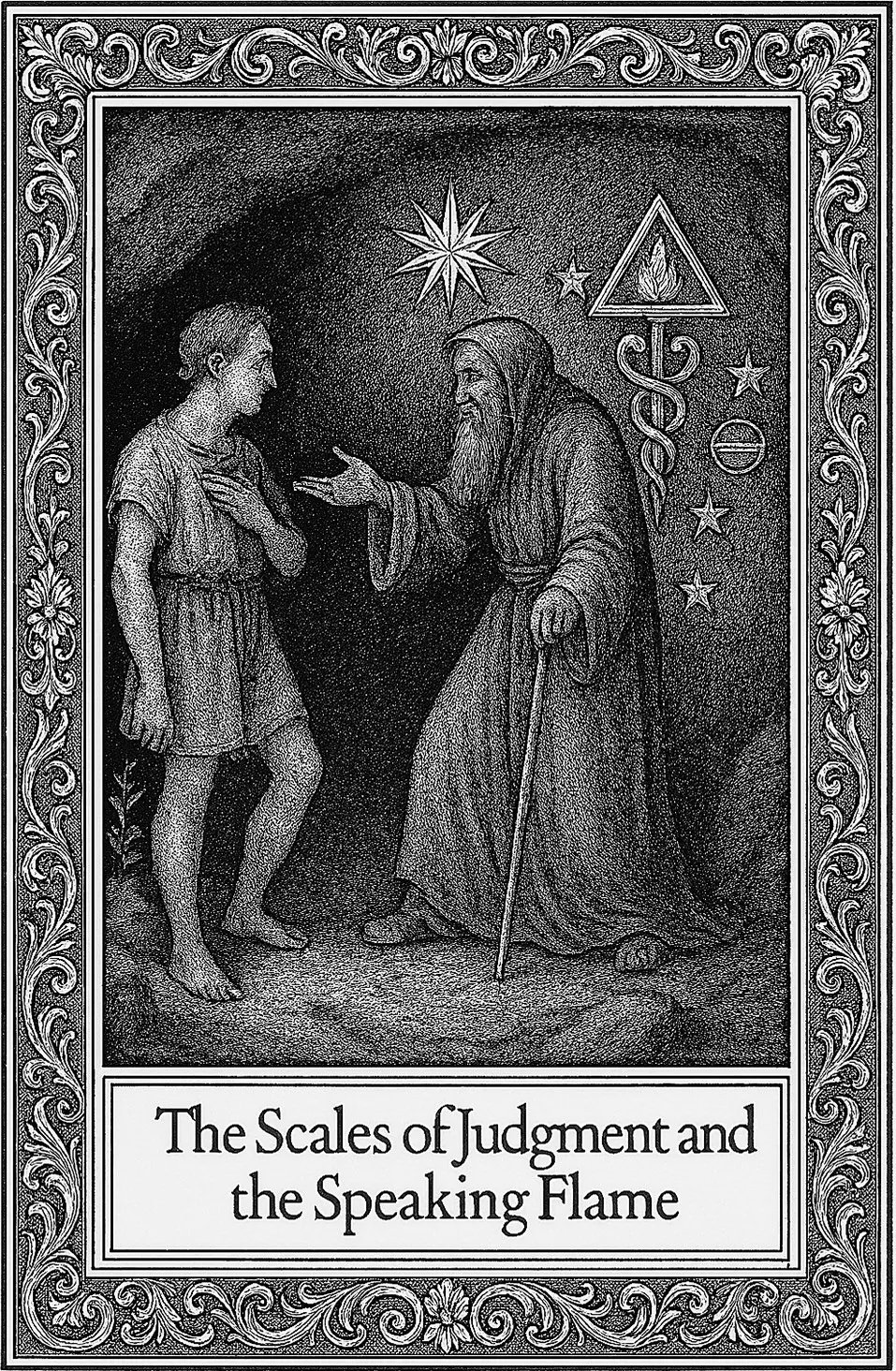
This world is the illusory one. You are currently asleep. Very few ever wake up to this fact until their death.
The sage’s voice boomed across the clearing, making Laolys flinch. He stood just a few paces away from Laolys, his lean frame backlit by the late afternoon sun. A faint breeze rustled the pine needles overhead, carrying the echo of his words through the trees.
Without warning, the sage sat down before Laolys, leaning forward with wide, unblinking eyes. His intensity made Laolys’s stomach twist with unease. While he was grateful this lesson would take place in the daylight, he couldn’t help but find the sage’s intense eye contact a bit unnerving.
“What do you mean? Do I awaken when I sleep?” Laolys averted his eyes to the mountainside.
“No, you’re sleeping, of course. But, while you’re dreaming you’re more receptive, so in a way you may be more awake when you’re asleep.”
“What do you mean?”
“When you dream, your normal consciousness is dormant. This allows you to access parts of your consciousness that are closed off during waking hours.”
Laolys stared back at the sage, puzzled. “But dreaming isn’t awakening?”
“Dreams are a window into your consciousness, not a door. They might give you insight, sure, but that’s not the same as waking up. To awaken is to see the illusions for what they are, illusions. It’s seeing that everything’s the way it is only because that’s how we perceive it. When we dream, we can see things differently than when we’re awake. We might catch flashes of the truth, but it’s not awakening.”
Laolys reflected on the lesson so far. It suggested that the world was full of illusions that didn’t become apparent until after death. He felt trapped. “So I don’t wake up until I die?”
The sage shook his head. “No, ideally, you wake up before then. But you could also carry many illusions through death, many do.”
“So not even death brings awakening?”
The sage shrugged. “Not every spirit’s ready for awakening, so they hold onto illusions, even after death.”
Laolys stared at the sage, astonished. If not even death provided answers, what kind of illusions was the sage referring to? “Can you give me an example of an illusion?”
“Money.”
“How is money an illusion?”
“Money only works because we all agree it has value. We trust that whatever business we take it to will respect that value, so everyone works to earn these coins. But tell me, what if a business suddenly decides that a coin has no value, or double the value?”
“They’ll go out of business!” Laolys exclaimed.
“Okay, but what if every business in the province decides that every coin suddenly has no value, or double the value?”
“Then… everyone would have to either find a new currency or adjust to the new value.”
“Correct.” The sage smiled. “Now, how can something suddenly change its value overnight or become meaningless if it’s not an illusion?”
Laolys looked down at his empty hands, thinking of the coins that filled his father’s study. “I suppose the value of coin is only as strong as people believe it to be.” He glanced back at the sage. “What else is an illusion?”
“Political power.” The sage eyed Laolys with a mischievous grin. “You won your seat by popular vote, but what would happen if the people collectively decided to stop recognizing your authority?”
Laolys fought an instinctual flash of anxiety. He could almost feel the phantom weight of official documents in his arms. “But there’s protocol…”
The sage shrugged. “Doesn’t matter. Let’s say they burned all government documents, eradicated everything.”
“Then that would be a riot, or a coup, and no government official would have any power!”
“Exactly. The illusion of government would be gone. And what about you, today, in a country that doesn’t know the name of your government?”
“Then… I suppose my power would have no sway there,” Laolys mumbled.
“That’s right!” The sage clapped his hands together once, startling a few birds into flight. “Political power only matters to the people who believe in the illusion of that government. Take that recognition away, there is no power.”
Laolys felt disoriented. His entire life had been centered around one thing: get and maintain political power. If power were merely an illusion, his life’s work—his family’s work—suddenly made no sense. “But people do recognize it, so it has to be more than an illusion.”
“Many people agree on the illusion, so it stands. The world runs on illusions. That doesn’t make them any less illusionary.”
Laolys shook his head, trying to grapple with the lesson. “What else is an illusion?”
The sage sat still, gazing at Laolys with an intense glare that made him shift uncomfortably. “Why did you come to learn from me?”
Caught off guard, Laolys felt a jolt of nerves. He dropped his gaze to the ground. “I… I heard you had incredible truths. Some even said that your wisdom could change the world.”
“That’s an illusion, too.” The sage gestured to his surroundings. “I’m a man who built a hut on a mountain so that people would leave me alone. I left society twenty years ago and haven’t looked back. Now, does that sound like a man who has all the answers to you?”
Laolys felt his insides squirming with anxiety. “I—well, I think there’s much wisdom in what you’ve taught so far. Maybe not all the answers, but… you seem to have many!”
The sage nodded. “So there’s truth to the illusion, but it’s still an illusion.”
“There can be truth to an illusion?”
“There are truths to all illusions. Did you know that two people can see the same event and have two completely different conclusions of it? That is, see two different illusions, and they both would have a truth of the event?”
Laolys leaned in. “Can you give an example?”
“Well, take this lesson right now. I could place another student next to you, and chances are, they’d walk away with a completely different takeaway on this moment. Chances are, the other student would only see a fugitive and a madman… and they’d be right.”
“But you are more than those things!” Laolys exclaimed, forgetting himself. “I mean, you aren’t a madman.”
“I’m both of those things. There’s truth to that illusion as well.” The sage caught himself mid-smile. “But sometimes madness and brilliance walk hand in hand. You see the brilliance; they only see the madness. There’s a reason I put myself all the way up here. It wasn’t easy. I find that only the ones who see the brilliance make the climb.”
“But if there’s truth to every illusion, is anything merely an illusion?”
“Nothing is merely an illusion. Any phenomenon is an infinite number of illusions at once, and at the same time, its true self. Quite impressive, actually.”
“Very impressive,” Laolys said, though the idea still felt like a distant dream. It sounded wonderful, but without any idea how to apply it, it remained abstract. “How do I start seeing things as illusions? How do I awaken?”
“Shift your perspective, as often as you can. Take any event and challenge yourself to see how many different perspectives you can view it from. Find value in things that seem meaningless and see the meaninglessness in things you’ve placed great value. Push yourself past your limits, safely, until you realize every boundary you thought existed is just an illusion. Prove to yourself that you can do things you once thought you couldn’t—or wouldn’t. You are a fluid spiritual being.”
Laolys thought of all the boundaries he had already broken just to climb this mountain. Now, when he descended, he would have to break even more each time someone asked him about his journey. “It’s… a little terrifying.”
“That’s because you’re still holding on to illusions that keep you afraid. You still see power, success, and status as indicators of a person’s worth. That’s how your parents see the world, and how you were raised to see it. But you’re already starting to break free. Otherwise, you wouldn’t be up here. If you keep clinging to these illusions after you leave, your life will be much harder than it needs to be. The sooner you realize that approval and praise are just as meaningless as criticism, the happier you’ll be.”
Laolys’s shoulders dropped. He’d been trained his entire life on gaining approval as a political figure. If praise and criticism were meaningless, what exactly had he been working towards? His mind flashed to a future vision of himself, teaching the sage’s wisdom to people who scorned him. Anywhere he went, he would likely be recognized and shunned.
“It’s hard not to listen to people when they’re shouting their disapproval at you. Public figures don’t get the discretion of etiquette afforded to everyone else.”
The sage’s eyes softened. “If that’s the case… listen to them. Hear the truth in their illusion. Everyone has some truth in the way they view the world, even if it’s only a spec of the entire view. Then, see how each and every illusion is absolutely meaningless. The only ones that matter are the ones you choose. That’s waking up.”
Laolys stared at the ground in front of him, reflecting on the lesson. It was about seeing illusions for what they were—and in doing so, freeing oneself from their hold entirely. It required a constant shift in perspective, a conscious mastery of perception. And through that, by choosing to see the beauty in things, unbothered by the fear that came from faulty illusions, he could at last know inner peace.
He turned to the sage with a glint of awe. To the world, he was a madman, but he had found a way to delight in that illusion. “So, you choose many of the illusions you see now?”
“Indeed… but that’s just a fancy way of saying that I see the possibilities in things and pick the one most to my liking.”
“Didn’t that interfere with other people’s way of seeing things? Did your perspective ever cause problems when you lived in society?”
“Actually, yes, in a way.” The sage’s gaze turned distant as he stared at the landscape. His usually vibrant eyes appeared glazed, detached from the present.
“I, um, didn’t mean to pry.” Laolys blushed. “I’m sorry if my question was out of line. I won’t ask about your past if you don’t want to speak of it.”
The sage’s focus snapped back to the present and his usual brightness returned to his eyes. “Don’t apologize. Curiosity is natural. You’d hardly be human if you didn’t wonder about me. But digging into old history doesn’t always give us the clearest understanding of how things are today.”
“Our past actions shaped us into who we are now.”
The sage drew his hand to his chin. “You know, I thought the same thing until I saw the other timelines. Then I saw how many different outcomes could arise from the same event all altered by my reactions. I watched all sorts of scenarios play out. Then I realized that we can blame our defects of character on any number of things, but in most cases, it has nothing to do with the external. That’s when I finally realized how to free myself from myself.”
Laolys stared back at the sage blankly. “Other timelines?”
The sage’s brows twisted upward in confusion. “Yes, the other timelines. There are many, many timelines.”
“Timelines of what? Right now?”
“Of anything.”
“Well, where are they? What makes them different?”
The sage leaned back. “Well, they exist in parallel realities. They’re happening right now, just as they happened in the past, and will continue in the future. Usually, they branch off at major decisions, but even the smallest choices can create a split.”
Laolys’s mind raced through the biggest decisions of his life. He imagined all the terrible outcomes that could have resulted if he had chosen differently. “So… there are other timelines playing out right now? Other versions of me making different choices?”
“An inconceivably large number of them, yes.”
Laolys’s breath caught short. “How… how does that even work?”
The sage gestured toward a narrow trail winding through the distance. “Imagine you’re standing at a crossroads. You have four options: left, right, forward, or turning back. Each choice leads you down a different path, creating a unique chain of events. You can only pick one, but the others still exist. They continue without you.”
“They just go on?”
“Aye. But you have to pick one or else you’ll just stay put.”
“But where do they lead?”
“Let’s say left takes you to a new city, straight leads to a market, and right takes you into a forest.” The sage locked eyes with Laolys. “So, what’ll it be?”
Laolys’s heart rate spiked, even though he knew it was entirely hypothetical. “Uh—left!”
The sage grinned. “Are you sure about that?”
Laolys hesitated, suddenly second-guessing himself. “Well, I suppose so. It’s just a thought experiment, after all.”
“Left it is. But the other three choices don’t just disappear. They still unfold, just not for you. They exist somewhere, whether as parallel realities, thought forms, or unrealized potential. Some paths become actual worlds, running alongside this one, while others remain ideas, mere potential.”
Laolys’s mind spun. He couldn’t help but envision all the terrible things he’d avoided over the course of his life, and how things could have turned out if he had chosen differently. “So… do our choices even matter? If every option plays out somewhere, then even if I choose wisely, the bad choice still happens in another reality.”
The sage cast him a sharp glare. “If you look into those parallel timelines, you’ll see exactly how much our choices shape reality.”
Laolys stared at the mountainside, trying to ground himself. He didn’t want to imagine how else things could have been. He was already too busy worrying about his future. “They really continue?”
The sage’s eyes softened as he looked at his student. Somehow, he seemed to understand his struggle. “So do you want to know what happens?”
“Hmm?”
“You chose left. Don’t you want to know what happens?”
Laolys shrugged. “I suppose.”
“You arrive in an unfamiliar town and stop outside a closed shop. When you ask a man standing nearby why it’s shut down. He tells you he used to own it but lost everything due to a series of unexpected misfortunes. His story teaches you about the struggle of material pursuits, the cycles of hope and loss, and the need to sometimes rethink your values.
“As you listen, you reflect on your own life—your battle to succeed in politics when your heart desires something else. You and this man trade stories about your family struggles. Your situations are different, but there’s common ground. He gives you a rare perspective on your father, which helps you to forgive him for some of his actions.
“But the biggest change in this timeline isn’t for you.” The sage locked eyes with him. “Your decision to stop and listen—to ask questions, to value his experience—creates an echo. I see him wandering through the other timelines. He passes you, notices you… and then keeps going.”
Laolys felt a strange mix of nervousness and excitement. “Is he looking for me?”
“He doesn’t know to look for you. He doesn’t even know who you are. But when we profoundly affect someone, our timelines connect in ways we don’t always understand. That connection vibrates through the others.”
“So… he doesn’t recognize me, but he still notices me?”
The sage nodded. “Just for a second. It’s rarely something the conscious mind catches. It’s a pull from the subconscious.”
“Just because I talked to him?”
“You changed the course of his life. Why would you assume you had any less of an impact on him than he did on you?”
Laolys hesitated, reflecting on the scenario again. “I guess that makes sense. I just never really thought of myself as someone who could influence another person like that. I never gave myself that kind of importance.”
“Yes, much of what we do can get lost in the sea of normalcy if we remain unengaged, complacent. But in that moment, you were neither. Acts of kindness, meaningful connections—they travel far. Would you like to hear what became of the stranger?”
Laolys straightened. “Yes, of course.”
“He was in a dark place. His family had shut him out emotionally, and he had lost his livelihood. He was looking for reasons to end his life. Your conversation didn’t pull him out of depression, but it made him start searching for reasons to live instead.”
Laolys’s heart skipped a beat. “It really went that far?”
The sage nodded. “That’s why, in the other timelines, his unconscious mind is looking for you. His conscious mind doesn’t understand it, so the thought never reaches full awareness. But in all three alternate timelines, he walks by you on the street, notices you for a brief second… then never thinks about you again.”
“I’m glad I chose that timeline!”
The sage smirked. “Your fixation on illusion and imagination is either a great blessing or a great curse… depending on how you use it.”
“What do you mean?” Laolys suddenly felt embarrassed for having gotten so caught up in his imaginary self’s success.
“Well, up until now, you’ve mostly been using your mind against yourself, imagining all sorts of worst-case scenarios. But under the right mindset and guidance, you could create incredible things.”
“You mean like magic?”
“I mean, you could live a happy, peaceful life and positively impact the lives of many others. You just have to imagine it for yourself, vividly and often enough that you actually start living it.” The sage chuckled softly and shrugged. “Some might call that magic.”
Laolys reflected on the lesson. The sage had introduced so many new concepts that it would take time for them to sink in. The concept of alternate timelines still baffled him. “Is time an illusion?”
“Time is real—measurable, inextricably linked to space. In our three-dimensional awareness, it isn’t an illusion. But when we transcend to higher planes of consciousness, we transcend both space and time. We do this when we dream, when we astrally travel in meditation, and, of course, when we leave this plane in death. So, like everything else, time is both real… and an illusion.”
“Three dimensions? I thought time was the fourth dimension.”
The sage shook his head. “Maybe in some systems, but time is linked to every spatial dimension. The first two don’t exist outside of time; they flow right along with it. Same with the higher spatial dimensions—time touches every aspect of the material realms.”
“So… we can’t escape it.”
“Not until we transcend the material realms entirely. That only happens after death.”
Laolys stared at the mountainside. He didn’t want to think about death. Turning back to the sage, he asked, “Can you see the other timelines of yourself right now?”
The sage gave a single nod. “I can.”
Laolys stared at the sage, wide-eyed, waiting for him to continue. When it became clear the sage wasn’t going to elaborate unprompted, he asked, “What kind of things do you see?”
“Right now?” The sage paused. “I see myself dead in a field after a bear attack. I also see myself eating berries. In another, I’m riding a mule—no idea where I got it. And then there’s one where I’ve sprouted a large fin on my back. Not all of these are realistic in this world.”
Laolys blinked, trying to process the strange images. “You see all this happening right now?”
“Only when I try to, and only in quick glimpses.”
“Can you see the future?”
“I can, but it’s just a vast array of possibilities. There are so many that predicting the future is nearly impossible. I don’t even see all of them. I can narrow it down by ignoring the ones that don’t apply to this universe, but in my line of work… Well, there are far fewer I can rule out than for your average person.”
“So you can see the future, but you can’t predict it,” Laolys noted.
“Exactly. I’m often surprised by what manifests, even though I already know the possibilities.”
“Can you see other people’s future timelines?”
“Certainly.” The sage fell silent, his gaze fixed on the mountainside.
“Well, can you see mine?” Laolys’s voice was tinged with both tension and excitement. If the sage’s claims were true, it was astonishing. Even if they weren’t, he was eager to hear what he might envision.
The sage turned his eyes to Laolys, studying him with an intensity that seemed to stretch endlessly, then abruptly looked away. “No. Not a good idea.”
“What? Why? What did you see?”
“Possibilities. That’s all they are right now. But if I tell them to you, they’ll get logged into your mind and turn into probabilities. Your mind is too permeable. The second you lock onto a future vision of yourself—especially one you fear—it becomes a very real expectation.”
“What? How?” Laolys eyed the sage suspiciously. Was he avoiding the question? Maybe even lying about his ability to see the future?
“Your mind has far more power to manifest reality than you give it credit for. Everything—your health, your misfortunes, even your general disposition—are manifestations of your expectations. We get what we believe we deserve, and most people don’t believe very good things about themselves. If we fear we’ll hurt someone, we often do. If we believe we won’t be good at something, we fail right away. If I tell you a future timeline, you might turn it into your destiny.”
“My destiny?” Laolys repeated, old fables surfacing in his mind.
“Yes. Destiny is an illusion. We manifest what we truly believe will happen. Your mind is responsible for the reality you live in. It filters everything you see, only allowing in what it believes you need to pay attention to. And what do our brains fixate on? Danger. Fear. If you live in fear, you’ll constantly find proof that it’s justified, and people can stay trapped in that cycle forever. If I told you this particular future, I might as well be sending you straight to the asylum.”
Laolys's breath caught in his throat. “Is it that bad?”
The sage grimaced.
Laolys couldn’t help himself. His anxieties about the future were too overwhelming. “Oh, please, just tell me.”
The sage let out a long, weary sigh. “Well, don’t say I didn’t warn you.” He closed his eyes, his expression settling into deep concentration. A minute passed in silence before he opened them again and began to speak.
“When you leave here, you return to your hometown and haven’t the slightest clue how to reintegrate. The world that once bored you now astonishes and baffles you. This becomes such a disability that you can’t even leave your house. Your family sees you as confused—crazy, even. Soon, you find yourself alone, unemployed, and with no prospects, a man in a poor position indeed!
“You remember how I instructed the birds during your studies here, so you leave your family and build a new home in the trees. You develop an innovative method for using birds as message carriers, but no one will listen long enough to let you demonstrate. Eventually, you convince one person to look past your reputation and see the value in your skill. However, because you’ve lost all social ability when it comes to people, you’re completely incapable of teaching your methods to anyone else.
“Just as you’re about to give up, you see a beautiful woman feeding birds on the street. You fall in love instantly. You send her love letters via your birds. She confesses her admiration for her mysterious admirer and agrees to meet. But the second she lays eyes on you, she recognizes you—calls you a heretic and a coward, a man who shirked his political duty. She leaves you heartbroken, worse than before.
“And then!” The sage leaped up, eyes sparkling with a mischievous glint. “Your psyche fractures into two! One part regresses to the consciousness of your childhood. The other…” He flapped his arms wildly and began running in circles. “Believes you are your carrier bird!”
Laolys burst into laughter as the sage ran past, slapping him on the back while flailing his arms. “That can’t be real, can it?” he asked, his laughter fading as the sage sat back down beside him.
“Somewhere, in some universe, it may happen.” The sage resumed his calm demeanor, gazing at the mountainside with a serene smile.
“There are many other possibilities though, right?”
The sage shrugged. “There are many timelines where you don’t make it that far. This mountain is no stranger to predators. In many timelines, you end your life here.”
“What?!”
“Oh relax.” The sage chuckled softly. “You know, I see myself dead every day out here. I’ve managed alright in this timeline.”
“How does that not bother you?” Laolys stared at him, baffled.
The sage tilted his head. “Why should it?”
“It’s your death! Most people are terrified of death!”
“That’s like being afraid of going to sleep. Or eating!” the sage replied, amused.
“I’m terrified of dying. How can you say you aren’t?”
“Because death is an illusion. Nothing really dies, it just… moves on. We say people are dead because they don’t come back, we can’t see them anymore, but they’re alive somewhere else. It’s just a transition.”
Laolys shook his head. “I understand the concept, but the end of the body is so real… and so final. How can it be an illusion?”
The sage bent down and picked up a fallen leaf, turning it over in his fingers. “Look at this leaf. It’s left the tree, never to return. But does it just vanish?” He held it up for Laolys to see before letting it drop. “No. It decays, it becomes part of the earth, nourishing the soil, feeding the roots. Eventually, it helps give rise to new life. Death is just part of the cycle—it’s not an end. The leaf lives on in another form. In time, it even returns to the tree.”
Laolys watched the leaf settle among the others on the forest floor. “So… death is just part of the cycle, like waking and sleeping?”
“Exactly. Physical death is a transition, not an ending.” The sage dusted his hands off. “People fear death because they think this life, this body, is all they are. But you’re much more than that. Just like you don’t mourn the end of the day when you go to sleep, you don’t need to fear the end of a lifetime. It’s just a passage into another state of being.”
“It’s less terrifying when you put it that way, but it’s still death. It’s still a mystery my current consciousness has no experience with.”
“Death is a natural process of life. We’ve all died many times before, and we’ll all die again. This isn’t something we should dwell on. There are some things we can choose in life; there are many more things we have no say in. Death is most often the latter, so we shouldn’t waste too much time trying to make it the former.”
“But we should have some fear of death. Otherwise, wouldn’t we just waste our lives?”
The sage turned, his sharp gaze meeting Laolys’s. “Is loving something only possible through fear of losing it?”
“I suppose not.”
“Then we can love life every day without fearing death.” The sage smiled broadly as he took a deep breath, holding it as if savoring the moment.
“I suppose we can,” Laolys admitted, “but I can’t let go of this fear so easily. I’ve carried it my whole life.”
“Most people have. But maybe you can get used to the idea that for every day you’ve lived, at least one version of you has died. Every one of those deaths was unavoidable. And yet, here you are, alive and well. Here I am too, alive and well. I may as well have been eaten by a bear in that field over there…” The sage gestured toward a valley in the distance. “But I wasn’t. Here we both are. Incredible, isn’t it?”
“Quite incredible, actually.” Laolys looked at the valley. He felt an odd gratitude to be here, in this moment, with a teacher who still lived.
“Every circumstance is incredible,” the sage continued. “Out of infinite possibilities, this is the one we’ve been given—this one, and every other we’ve gotten to experience. Whether we enjoyed them or not, all circumstances are equally incredible improbabilities.”
“I guess that means I need to decide exactly what I want for myself now,” Laolys mumbled, trying to shake the mental image of himself as a homeless birdman.
“That’d be the wise thing to do, otherwise you’ll end up with the future you fear the most.”
Laolys hesitated. “One thing I always imagined I’d have in life is a loving wife.”
“Not a wise decision.” The sage’s tone was cold, slightly abrasive.
“Why not? I’m engaged.” Laolys’s thoughts drifted to his fiancée back home—the scent of her breath, the warmth of her touch. But as he lingered on the thought, a new unease crept in. How much of his world would change by the time he returned?
“You can’t choose a destiny that depends on someone else. It’s negated by their right to free will.”
“Not even if it’s vague?” Laolys liked the idea of true love someday, even if it wasn’t with the woman he envisioned now.
“It’s not advised.”
Laolys lowered his gaze. “Then maybe I don’t even know what I want.”
“Not power? Not to be the savior of humanity?”
“I could hardly be humanity’s savior. And power seems more trouble than it’s worth.” A heaviness settled into Laolys’s chest. He felt suddenly incapable of the path he’d set out on—one that had unexpectedly reshaped itself upon meeting the sage. Right now, he just wanted to hide, to stay on top of the mountain forever.
“But your career is in politics.”
“That doesn’t seem to be the case anymore… given our deal.”
“Not necessarily,” the sage said. “A man in a good position could teach many things.”
“But the truths I’ll teach will ruin my name. People aren’t ready for them.” Laolys tried to imagine a hopeful future, but anxiety bled into every scenario. He couldn’t yet envision a life where he was both happy and successful.
“That doesn’t mean your words won’t reach them.”
“But they’ll curse my name and damn me to the farthest place they can think of!”
“And such is the fate of many who earn the title ‘savior,’” the sage said gently.
“I never asked to be one!”
“Then why did you come to learn from me?” The sage glanced at him, raising an eyebrow.
“I was about to take office; I wanted to be a good leader.”
“You could have learned that from your father.”
Laolys flinched as his father’s furious outburst regarding the leak flashed through his mind. “No,” he said, shaking the thought away. “I wanted to do more than he did. I actually wanted to help people. All my father cared about was securing their money and their obedience.” The words left a bitter taste in his mouth. He had always seen so much potential in his position; potential that was constantly sacrificed for profit and power.
“Then you never really wanted a position in government,” the sage replied, reminding Laolys of his first lesson. “A government should be limited. It should protect its citizens, not interfere in their lives. A government can’t improve a person’s life unless that person is a refugee seeking asylum.”
“Maybe I did want to be some sort of hero…”
“And in many futures, you are. Only, most don’t know who you really are.”
“Then how am I their hero?”
The sage locked eyes with him. “Who is your hero? A man of history?”
“Yes, you could say that.”
“Then you don’t know your hero. He’s been turned into a figure, an idol, far removed from the pains and struggles of the man he really was.”
Inside, Laolys’s emotions swirled. He could imagine no future for himself, now, that wasn’t full of pain. Everywhere he went, he’d be scorned.
“But if no one knows my name, I’ll never be remembered! I’ll never be immortalized!” Laolys’s outburst surprised him, it came out of his mouth faster than he could think it.
“Becoming an idol doesn’t make you immortal! It doesn’t mean a thing! It’s just a name in a book that people twist and attach to whatever ideas suit them!” The sage’s voice rose to match Laolys’s, and his face held a scowl that few would tempt.
Laolys shrank back, ashamed. He looked at the ground and took a deep breath. “Then… how does someone achieve immortality?”
“As far as I know, it’s a given.” The sage resumed his calm demeanor, staring at the mountainside with a serene expression. “Live, then die, then live again. Rinse and repeat. Forever and ever, until ascension.”
“I don’t know which sounds worse: mortality or immortality.”
The sage chuckled softly. “Humans are an ill and curious lot.”
“You say that as if you aren’t one of them.”
“Oh, I’ve made my fair share of foolish mistakes! No, I’ve earned my humanity, and I’ve got the scars to prove it.”
Laolys studied him. “So, what did you want for your destiny? Was it this?”
The sage let out a yelp of laughter, coughed a few times, and cleared his throat. “I must do a good job of making things seem glamorous! No, living as a hermit, an outcast in the mountains, wasn’t always in the game plan!”
“What was?”
“Oh, the usual: love, money, to find the philosopher’s stone…” The sage trailed off.
“So, pipe dreams.”
The sage shook his head. “Oh, no, I got all those things. They didn’t make me happy.”
Laolys’s eyes widened. “The philosopher’s stone?! The great myth of alchemy?!”
“Yes, but it’s not for transmuting gold. That is, indeed, a myth. No, it’s more like a mental key. It lets you see things as I do, understand the things I know.”
“Can I find it, too?”
The sage sighed. “Yes, but you must do so on your own. I will not play a part in that journey—that I am too old for. I’m retired from it, permanently.”
“I would like that to be my destiny, or at least my quest: knowledge.”
The sage smiled at him. “You’ve chosen your quest already, hero; knowledge from me is part of that.”
“Yes, but I’d like to see things too. I want to find the philosopher’s stone.”
“I'll do my best to discourage you from that quest, but I understand the temptation all too well.” The sage turned his gaze to the mountainside, his eyes distant, nostalgic.
“But knowledge made you happy. It gave you peace out here, peace with yourself.”
The sage shook his head. “No, wisdom did. Hard-earned wisdom from a hard-lived life. I had to face my pain and choose to love myself enough to grant myself my own freedom. Knowledge had nothing to do with it.”
“What do you mean?”
“I could teach you everything I know, but it wouldn’t mean a damn thing unless you tested it yourself—lived it, suffered through it, and came out on the other side. You can’t overcome your inner turmoil just by reading books or learning from a mentor, no matter how well-intentioned. Wisdom isn’t something you inherit. It’s something you unlock by exploring the hidden corners of yourself, stepping into the unknown, and especially facing what you fear the most. Knowledge alone won’t bring you peace.”
“But your knowledge means something!” Laolys was sure the sage was dodging specifics on purpose, being intentionally difficult to work with.
“Again, I must make things look glamorous without intending to. Maybe you’ve already turned me into an idol. I’ll give you one more well-intended warning—this life you imagine for yourself, of fame, of glory, of heroism… it comes with more trials and pain than most other lives.”
“But shouldn’t I strive to do great things?”
“You should strive to do many great things, but their success shouldn’t be determined by other people’s opinions.”
“Hmm. You know, that’s all politics is—and my future was always in politics—I never thought about defining success any other way.” Laolys wondered if perhaps his upbringing had caused him more anxiety than he previously realized.
“Well, think about it differently from this moment forward. You define what it means to be great. You choose your heroes, and you make them into who they are in your mind.”
Laolys took a deep breath. “I suppose you’re right. I’ve always been in control of myself and my vision for my future.”
“Of course I’m right.”
Laolys opened his mouth to reply but stopped, realizing the sage was no longer seated next to him. Nor was the sage anywhere off in the distance that could still be seen in the last rays of sunlight. This trend was becoming familiar to Laolys, who reclined back down on the forest floor in silent contemplation. The sage had given him a lot to think about, and he supposed that was his only option, having been instructed to stay put.
Soon, it was dark, and there was no sign his new friend would be returning for the remainder of the night. Laolys stayed outside the hut, just in case, and drifted into a light, troubled sleep. Illusions he had held of himself were peeling away, leaving him feeling raw and exposed. He was not the polished politician he was expected to be, nor did he feel worthy of the title ‘hero’ or ‘savior.’ The sage had already confronted him with several hard truths about himself. By challenging him to live up to his own claims of merit, the sage was forcing him to face his fears. It was all for the best, but it was painful, as growth always is.
The illusions we cling to—money, reputation, prestige—offer little nourishment for the spirit. If we spend our lives chasing them, it could be said we have lived little, if at all. When death announces the final curtain call and the blindfold is lifted from our eyes, we will see these illusions in their bare form. Only then, it will be too late to make any changes.
It is easy to become distracted by illusions; humanity everywhere is consumed by illusionary pursuits. If we should catch even a glimpse of them in their true form, we should kindle that realization, no matter what popular opinion insists. The more we see the world in all its varied forms, the more we will come to understand our power as observers.
◆
