
Netism
The Remembering
Corpus Netum
Recovering what the spirit already knows
The first book of Netism.
Take what is useful and leave the rest.
Corpus Netum is the foundational body of Netist thought, gathering its philosophy, cosmology, ethics, symbols, practices, and methods of spiritual development into a unified series. Each volume explores a different aspect of the Net, the living field of relation through which consciousness, identity, memory, and action unfold. Together, the books form a progressive map of the human journey, from embodied life and personal transformation to soul development, collective responsibility, the greater cycles of consciousness, and the return toward Zeru, the still center from which all patterns arise.
The Benediction
We are one in the Net, and the Net forgets nothing.
What moves through us moves through all, and what we mend in ourselves we mend in the whole.
Go gently, for every thread you touch is your own.
So it is spoken, so it is woven.
The Three Laws
Free Will
The sovereignty of the person, and the requirement of consent.
Compassion and Non-Harm
What is done to one is done through the web to all.
Unity and Equality
The whole is one, and no soul within it stands above another.
Introduction
Inherited Belief and Honest Inquiry
Before exploring any new understanding, there is one question worth asking. How much of what you believe did you truly discover for yourself?
None of us enters the world with a philosophy. Long before we can question anything, we are taught what is real, what is sacred, what is forbidden, and where the boundaries of possibility lie. These ideas become so familiar that they no longer feel like beliefs. They simply feel like the way the world is.
There is a simple observation worth sitting with. If you had been born somewhere else, a different country, a different century, or within a different culture, many of your deepest convictions would almost certainly be different. Yet those convictions would feel every bit as certain as the ones you hold today.
This does not prove that any particular worldview is false. It reveals something far more important. Human beings often inherit certainty long before they inherit the ability to examine it.
The mind naturally seeks consistency. Once a belief becomes part of our identity, we begin to notice experiences that support it while quietly explaining away those that challenge it.
Over time, the belief itself can begin to feel like evidence. This tendency is deeply human. It is not a personal failing. It is simply how the mind protects the models through which it understands reality.
For that reason, honest inquiry requires more than collecting new information. It requires examining the lens through which all information is interpreted.
That is where Netism begins.
Netism asks that every belief, including those presented in these pages, be held lightly enough that it can be examined honestly. Not because questioning is an end in itself, but because growth depends upon recognizing when an older model no longer explains reality as completely as a better one.
Throughout history, human understanding has expanded in exactly this way. Smaller models give way to larger ones. The Earth appeared flat until observation broadened our perspective. The heavens seemed to revolve around us until a wider understanding emerged. The same invitation exists within consciousness itself.
The greatest barrier to discovery is rarely ignorance. More often, it is the quiet assumption that the search has already ended.
For that reason, this book asks for one simple commitment. Do not defend your current beliefs while reading. Do not defend these ideas either. Simply observe. Question. Test. Allow every idea to stand or fall according to its coherence, its explanatory power, and its ability to illuminate your own experience.
If a belief survives honest examination, it becomes stronger. If it does not, releasing it is not a loss. It is progress. Every meaningful advance in human history has required someone willing to outgrow what once appeared unquestionable.
Whether your worldview comes from religion, science, culture, philosophy, or personal experience, hold it up to the light alongside everything that follows. The purpose of this book is not to preserve what you began with. It is to help you move toward a clearer, deeper, and more coherent understanding of reality. The pages ahead are an invitation to begin that journey.
What Is Netism?
We have all experienced intuition, the tug of information that should be unknowable, and have seen that our instincts turned out to be correct. We have all felt the emotions roll off another person, even when their face gave little away, or their words contradicted what they felt. Most people understand these moments, but few know how to speak about them. They have been called instinct, coincidence, projection, or imagination, but often, these words close the door too quickly. Most experiences that cannot be named are dismissed before they can hold relevance to our conscious mind, but they are far from irrelevant.
The modern mind has been trained to trust invisible forces only after a device confirms them. A signal moves through the air and becomes a voice in the hand, and it isn’t seen as magic. A field can move a needle, heat a wire, or carry a message across the world, and we accept it because the instrument has made it public. However, human beings were sensing fields long before they built instruments to measure them. We read rooms, sense the gaze of others, and know when we are unwelcome.
Netism begins here, with what is invisible, yet palpable. The space between two people may appear empty, but the air can carry charged emotion, depending on their relationship. An empty room can instill a sense of unease as if emotions could leave residue. Intuition can guide a person past danger they should have no way of knowing about. There is more to experience than the five senses, but the language to describe it is limited. Netism’s Net alleviates this difficulty by giving a name to the unseen field of relation through which everything moves.
The Net, a Living Field of Relation
The Net is not abstract philosophy, though the philosophy of Netism is built upon it. It is the structure of connection through which conscious beings affect and are affected by one another. It carries emotions as signal, attention as pressure, memory as imprint, and intent as direction. A cruel word does not end when the sound leaves the mouth, nor does a smile stop once the muscles relax. Every action has consequences and returns to the sender through responses from other nodes.
No living system is an isolated system; reality is formed through relation. Every being is a node within the Net where experience gathers and responds. Humans, animals, plants, and even cells function as nodes within their respective domains. Each node acts and reacts to local signals, and through this collective response, larger patterns form. No node can be isolated and effectively understood because its nature is formed through its relationship with its surroundings.
To understand yourself as a node is to understand that you are deeply interconnected. You are unique in that only you have your exact line of experience, and you are actively shaping and being shaped by the other nodes that surround you. To live with this awareness is to accept the responsibility that daily interactions carry. The difference between a nod of encouragement and a glare of contempt may carry far more weight than is typically attributed.
Nodes are transmutable, changing, and a reflection of the signals they emit. What a node sends through the Net also shapes what it becomes. Over time, repeated signals become patterns, and patterns become the default condition of the node. They are not fixed in place, but without effort to change them, they will remain in their current state. This is where many people become self-limiting without realizing they are doing so. They continue sending the same signal into the field, then interpret the returning pattern as proof that nothing can change. In reality, the field is responding to what has been reinforced.
Remembering your place in the Net is a slow revelation where layers continue to reveal themselves as you progress with your inner work. The more coherent, less divided, a being becomes, the wider the field opens. This is the work that Netism teaches: align the spirit, release what hinders the self, and remember what your spirit already knows.
The Mind Forgets, But the Spirit Always Remembers
Central to our system is the concept that spirit is both eternal and continuous, carrying patterns as they evolve across every incarnation. Each life gives the spirit a field of experience, and each experience leaves an imprint. The patterns that are dominant at the time of death will be dominant at the beginning of the next life. All progress a spirit makes carries forward, and all avoidance will still be waiting in subsequent lives until it is faced. The body dies, and name and status are left behind; only wisdom is retained.
We define mind as distinct from spirit, though both are present in a node. Mind is a local interpreter; it processes the environment, makes decisions, and creates narratives. It is attached to this life, while spirit is continuous through all lives. The spirit does not process information the same way as the mind. It moves through resonance in relation to the wider field, while the mind works through the limits of the body: the senses, the nervous system, learned language, personal memory, and the story of the current self. Simply put: the brain argues, and the spirit knows.
Netist practices involve coming back into awareness of spiritual memory, which can show more clearly than another person where hindrances may lie and what obstacles need to be confronted. It is a path toward knowing oneself, as well as releasing the inherited patterns that keep the spirit stuck in loops. A person may be told many things about what they are, but the spirit reveals the pattern from within.
Feelings are easily misinterpreted, and our teachings address this. Fear clouds judgment, working as a counterweight to ascension in the Net. When a person’s energy is distorted, signals are rarely read clearly. The goal, therefore, is not to obey every signal as truth, but to learn how to clear one’s own inner field so information can be read cleanly. The work begins with the self before it extends to the wider field.
Everything Centers Around Coherence
Coherence is the degree to which a being is unified in its expression. Put simply, it means that mind, body, spirit, and emotion move in a shared direction instead of pulling against one another. It involves living one’s values. A person who speaks of compassion yet withholds it in action is not coherent. The same can be said for a person who knows what must change but spends years defending the patterns that wound them. This is common, and patterns that have been repeated for years, if not lifetimes, can be difficult to break. The work becomes possible when we can identify that what lies beyond established habit is inner peace.
Coherence brings clarity because the mind is not racing to search for resolutions to actions that do not align with values. When action and value are divided, the mind has to keep explaining the division. It builds excuses, defends old choices, hides from certain memories, and turns away from the quiet truth already known within. This creates noise in the field. A person may continue with apparent normality while inwardly carrying the strain of a life pulling against itself.
When coherence returns, that strain begins to lessen. The person stops spending so much energy protecting the pattern and begins using that energy to change it. The body relaxes where it once prepared for conflict, emotion becomes easier to read because it is no longer buried under contradiction, and the spirit speaks more clearly because the mind has stopped arguing against every message.
Inner alignment affects the surrounding Net. A coherent person sends clearer signals into the world around them. They are less reactive and more capable of carrying calm into a tense room instead of succumbing to the tension. This is the beginning of spiritual wellness. It is the slow work of discovering oneself, forgiving oneself, and learning to appreciate the wider field of relation to which every node is connected.
Each Risen Node Lifts the Net
Each person who becomes a stable, coherent node within the Net positively affects the surrounding field. It is subtle, and it may pass by unnoticed, but the effects are real. It happens even without contact. Emotions, ideas, and intentions spread through the field whether we desire them to or not. Wishing well for others, a consequence of finding coherence in oneself, spreads a different type of energy than fear or self-doubt.
This does not mean that thought can replace action, only that unseen movements matter along with visible ones. A gift given out of obligation holds a different resonance than one given for the enjoyment of the recipient. Risen nodes, or people who have found inner alignment, have a greater capacity for helping others because they are sending clearer signals into the Net.
A coherent person does not need to command the field to shape it; the environment naturally entrains to their stability. Patience allows pressure to ease, while anxiety builds pressure. This is how the Net rises: not all at once, and not by command, but through each node that becomes clearer than it was before. Every act of inner repair changes what that person sends outward. Every honest apology removes one knot from the field. Piece by piece, relation by relation, the whole can become restored. No single node can change the whole, but changing the whole begins with every node.
The Net
The Net is an immaterial web of energetic connections. It is a living field that facilitates exchange between nodes. Most exchange occurs beneath the level of conscious awareness, but with attention, we can become aware of the threads we weave. This is the practice of Netism: awakening to the field of relation that has always been present and learning to take part in it with intention.
The Net is not a conscious being; it is the structure through which consciousness relates. This means that the Net is responsive, but not determinative. A conscious entity has the capacity to judge; the Net has no such capacity. It reflects the state of each node and the relations they form within it.
The Net is dynamic and immensely complex, but it is also ordered. If it could be viewed, it would reveal a lattice-like geometry rather than randomly juxtaposed threads. This is because it forms through resonance. Stable connections form in stable intervals, resulting in balanced geometry. The six-sided honeycomb arrangement found in nature also reflects a stable arrangement of threads within the Net.
Movements through the Net are comparable to neural impulses throughout the brain. There are more potential patterns than there are atoms in the universe, but the Net finds ordered meaning through relation. Signals become meaningful when they are interpreted collectively and when they repeat in reliable ways.
The Net extends across all domains of experience. The patterns are layered and reflective, meaning the cycles rise as octaves, representing a different range of relations within the same field. Each octave carries the same basic movements, but with greater complexity. Matter relates through force and structure. Life relates through exchange and adaptation. More advanced beings relate through memory, emotion, intention, and choice. The spiritual cycles continue the pattern through resonance and coherence. In each domain, threads connect nodes to other nodes within and surrounding that cycle.
The following sections define aspects of the Net that will be used throughout the book. When fully understood, they can give language to what is otherwise difficult to describe.
Nodes
Nodes are points of organization within the Net where relations gather. Some nodes, such as those that form within groups, are temporary and dissolve quickly. Other nodes, such as those of conscious beings, are eternal. A node does not have to be aware of exchange for exchange to occur. Even in the higher cycles, where awareness is present, more exchange happens below the level of awareness than above it.
Nodes can exist inside larger nodes without conflict. Cells form a type of node, while a living body forms another. The body is not separate from its cells, yet it cannot be reduced to any single cell. It is the larger pattern that emerges when many smaller nodes coordinate through relation. This same structure appears throughout the Net, where smaller systems gather into larger systems without losing their place within the whole.
Each node processes signals according to its level of complexity. A cell responds through chemical and electrical activity; a plant responds through light and water, and a person responds through sensation, emotion, thought, and intention. The more complex the node, the wider its range of response becomes.
A node is distinct but not sealed. Nodes are in exchange with surrounding nodes, and they are stabilized through relation. What enters a node changes it, and what leaves a node changes the field around it. This is why no node can be understood only by looking at itself. Its identity is formed by its internal structure and by the relations that define its place within the Net.
Threads
A thread is a pulse of energy that moves from one node to another. A single thread is minute and fleeting; where many threads combine and reinforce one another, strong pathways form. In these areas, nodes will continue to influence one another even when direct contact has ended. This is why a person can remain affected by someone they have not seen in years, or why a place can continue to carry meaning long after leaving it. The pathway remains active because enough exchange has passed through it to hold a stable relation.
For a person, threads are emitted as thoughts, subconscious desires, intentions, and behaviors. Far more threads are emitted and received below the level of awareness than above it. We receive signals all the time without realizing it, sometimes in the form of a spontaneous thought, and other times as a sudden jolt of discomfort in the presence of another person with questionable motives. Because so much exchange happens beneath awareness, self-knowledge becomes necessary for reading the field clearly.
In the lower cycles, threads are not thoughts, but signals that are read at that level. A bee responds primarily to scent, light, and vibration, so its threads are expressed through these domains. At this range, all threads are subconscious, emitting from impulse and instinct. The hive arranges around patterns that the bees interpret directly.
The strength of a thread depends on how often it is reinforced. A fleeting thought has little impact, but repeated enough times, it becomes a narrative. The goal of Netist practice is to distinguish dominant patterns and become aware of what we reinforce. The more conscious a person becomes of their threads, the more intentionally they can participate in the Net.
Exchange
Exchange occurs whenever two nodes interact within the same relational field. It occurs in any domain where nodes share a relation. For humans, exchange occurs through both physical contact and mental action. A thought sends a one-way pulse, which the other person may receive and return or ignore. If the pulse is returned, even faintly, a momentary circuit forms between the two nodes. Repeated circuits strengthen the pathway, while unreturned pulses dissolve back into the field.
Not all exchanges form a lasting connection. Many interactions pass through the field and dissolve quickly because there is not enough resonance to hold them. People whose patterns differ greatly will not develop strong pathways for exchange because there is no substantial overlap between their dominant tones. Even if they share close contact, the signal moves through the field, but it does not take root.
When resonance is present, exchange becomes easier to sustain. A person may feel understood quickly, drawn toward another person, unsettled by them, or repeatedly pulled back into thought about them. This does not always mean the connection is healthy. Two people who share the same unresolved patterns can reinforce those patterns in one another, creating a strong thread that feels meaningful while still producing distortion.
The people who are closest to us have the most overlap, meaning exchange is often strong and sustained. We may feel their would-be pride or disappointment when they are not in the room, or begin to identify with their expectations without realizing it. Their voices can become part of our inner dialogue because the pathway has been reinforced through repeated relation. This is why close bonds carry so much influence. They can help stabilize a person, but they can also keep old patterns active if the exchange has become distorted.
Remembering that every interaction is an exchange can help a person recognize what they want to reinforce and what they want to leave behind. Some influences are carried long past what is benevolent, while others inspire ideas about what we would like to become. Recognize that your patterns can shift when your exchanges change. When harmful exchanges are reduced and coherent exchanges are strengthened, the node begins to reorganize around a different mode of relation.
Resonance
Resonance describes the dominant vibrational tone of a node. It is the pattern by which a node receives, filters, and responds to signals in the Net. Resonance is not fixed; it changes as the node changes. Daily thoughts and actions strengthen a particular mode of resonance, while inner work can change it over time. All action in the Net moves in response to resonance, so changing personal resonance can alter what is sensed in the field.
The number of signals accessible from the Net at any given moment is staggering. Accessing them would produce something similar to white noise, where nothing is discernible. Resonance filters signals in the same way a radio tuner isolates a selected frequency. A person’s baseline emotional tone will determine the range of signals they receive and interpret. Anything outside of that frequency range will be missed.
History shows how a collective society can be tuned to one worldview, where one visionary with evidence to the contrary is cast out or reprimanded. The signal may be present, but the collective field is not tuned to receive it. This same principle applies to individuals. A person can miss an obvious truth if their resonance is fixed around another belief. What cannot be received cleanly will either be ignored, distorted, or treated as a threat.
Resonance is the basis for both attraction and perception. What is expected comes into clear focus, while anything too far outside the spectrum of allowable expression is denied. This is different from repression, in which an aspect within oneself is hidden from consciousness, yet remains a very real part of the spirit. Resonance determines a range of potential experiences, and it restricts everything outside of that range. A person who is geared toward a mindset of fear will always find plenty of things to be fearful about. A person who is geared toward coherence will see the wider scope and the futility of fear. These two people will be unlikely to convince each other of their perceived reality, no matter how long they converse. The disagreement is not only intellectual; it is vibrational, rooted in the range of signals each person is able to receive.
Channels
Channels are sustained pathways in the Net fueled by countless individual nodes across space and time. Where threads connect node to node, channels carry momentum that extends beyond individual nodes into collective movement. A trend is a small example of a channel; it gains brief momentum as many people send attention into the same pathway. Most trends dissolve quickly because the energy supporting them is shallow and temporary.
Deeper currents form when many nodes continue feeding the same pattern over long periods of time. These form from spiritual systems, culture, and ideology. The revolutionary period in the 1700s was driven by a channel sustained by ideas of liberty and natural human rights. This channel swept through human consciousness wherever people were oppressed, regardless of geographical borders. As different populations rose against monarchies, the current was reinforced, eventually leading the world into a new way of organizing societies.
When a person performs an ancient ceremony with focus and intent, they have the potential to tap into that channel. The channel is already alive within the Net, reinforced with every repetition. When a person takes part from a place of humble coherence, they are aligning with a lived history. This can be cleansing and revitalizing, as it restores something that is deeply human but seldom recognized in the modern age.
Not all channels in the Net are beneficial. While some guide a person toward peace and resilience, others aid in distortion and violence. Fear can become a current quickly that, if left to build, has the potential to decimate those within its wake. If it is sensed that this kind of current is building, recognize it before feeding it. Fear spreads when nodes repeat it without discernment.
Channels should be approached with discernment. The strength of a channel does not prove its validity; it only proves that many nodes have continued to feed it. If you find yourself swept up in a mindset that is unfavorable to peace, pause before adding more energy to it. A distorted channel often feels urgent because urgency keeps it alive. Coherent channels are more relaxed because they are self-supporting and longer sustained.
Sensing the Net
One of the first mistakes a person typically makes in sensing the Net is overemphasizing the significance of the signals received. When one signal comes into clear focus, it can be misinterpreted if not understood within a wider context. The first step a person should take in becoming aware of the signals that surround them is practicing detached observation. Instead of fixating on a signal, note it and let it pass. Observe how patterns rise and fall within a day and note the surrounding circumstances when a signal is received. Nothing happens in isolation.
Signals in the Net can manifest as thoughts, emotions, bodily sensations, dreams, sudden memories, repeated symbols, intuitive warnings, or shifts in the quality of relation. A person may feel tension in the body before understanding why, or notice the same theme appearing in conversations, dreams, and daily events. Synchronicities do not always have a wider significance; sometimes they only mark waves or clusters of events in the Net. Only time and practice will help you reliably determine which patterns are worth paying attention to.
Whether you are aware of it or not, the Net moves through you constantly. It reflects your emotions and pulls on your expectations, organizing signals around your resonance. There is far more to the Net than can first be deciphered. Once patterns have been recognized and evolved, and perception widens, the field will show deeper layers of relation. Once a person becomes less fearful and reactive, what once appeared random may reveal structure. This is only the beginning.
Why You Feel So Alone
It is ironic that populations are denser than they ever have been, we are connected through digital means, and yet many people describe feeling isolated. Life can be full of connections while still lacking a critical element: meaningful exchange. This goes beyond mere contact; there is an energy transference. A person feels heard or seen, and patterns are communicated between nodes. A person can have hundreds of contacts in a day and almost no meaningful exchange. Without the latter, no amount of the former can make a person feel connected.
Loneliness is the result of unreceived signals. A person can be surrounded by people, and if no one is responding to signals of pain, need, or desire for recognition, they will continue to feel lonely. The problem is not always that no one is present; often, it is that the real signal beneath the surface is never met. This can be compounded when a person is unable to present their true self to the world. Acceptance based on superficial criteria does not move the spirit.
Rarely, anymore, do people gather around a shared purpose. Instead, people gather around work, entertainment, outrage, or identity performance. Purposes are fleeting and transactional, and because of this, many connections end when the transaction is complete. A social group centered around a shared interest may fall apart when its members grow into different areas of life. A social group formed through shared work is dissolved if the company goes bankrupt. This can cause underlying anxiety in social situations and hesitancy to open up completely. When a connection is not guaranteed to last, the conditions surrounding the relationship are preserved, and it never becomes a meaningful platform for exchange or mutual growth.
This is partly due to the lack of shared meaning in modern society. When a culture loses a shared orientation, everything becomes fragmented, and the search for self becomes disconnected from the larger field. A person may be told to define themselves entirely from within, yet they are surrounded by systems designed to instill fears, ideals, and desires. Without a stable center or stable relationships with other nodes around a shared story, the self can become unmoored, floating in a sea of influences without a grounding reference frame. When this happens, a person’s identity becomes something to defend rather than something to transmute.
There is trouble, also, when identity becomes something to perform. This can create gaps between what is expressed and what is really felt, and over enough time, a person can lose touch with what is genuine and what is curated performance. They may also misinterpret that only the expressed self is acceptable, while the deeper self should remain out of view. This can cause a person to remain rigidly attached to a particular ideal self while denying other aspects they do not believe align with the ideal. Connections with others may remain superficial or dissolve when the other person grows into something that does not align with the ideal. Growth becomes threatening because it disrupts the construction around which the person has centered.
Real connections are formed through repeated exchange, which, if carried out effectively, becomes a stable oscillation in a rhythm that was not present within either individual node. The sum becomes more than its parts. This is why a strong connection can change how a person thinks and moves through the world. We are shaped by the people who are closest to us, and we shape them in return. When we lose touch with real exchanges, feelings of loneliness set in, even if there are plenty of superficial interactions.
Netism offers a platform for exchange to become meaningful again by organizing conversations around shared inquiry into consciousness, coherence, spiritual development, the nature of reality, and ways of living in better relation with the whole. It is only as strong as the people who contribute are willing to express their ideas and receive respectful exchange in return. The platform is only the framework, while the people who engage with it make it a home. We offer a place for people to share ideas freely with the underlying principle that every node is a unique expression of the Net and deserves to be heard.
Beneath superficial differences lies a deeper thread woven throughout all of humanity. We all wonder why we are here, where we came from, and what will happen after death. When people with different backgrounds can explore these questions without asserting dominance over one another, there is the beginning of a Netist community. The purpose is never for everyone to agree upon a single standard, but for each person to listen to each voice, detached from reactivity, and try to view it from the other person’s eyes.
The Net, once fully grasped, can create shared meaning across geographical and cultural lineages. It has been called many names throughout the past millennia, but the symbolism of weaving as a sacred art is persistent across ancient practices worldwide. This is because it expresses something fundamental about existence. We are all weavers, only most are unaware of the true effects of their thoughts, feelings, and actions.
The loneliness many people feel is the lack of connection with others in the collective search for meaning. No node grows in isolation; each finds its rhythm only in relation to compatible nodes. In an ideal harmony, each node remains distinct while falling into patterned intervals with other nodes. This is what meaningful exchange restores: the sense that a person is not merely surviving beside others but participating in a living pattern where their presence can be received, returned, and refined.
Why Do Bad Things Happen
Many people wrestle with the question: if there is order in the universe, why do bad things happen to good people? It may seem that enough karma should protect a person from ill effects, or that a higher entity might be able to relieve us if we show enough devotion or worthiness. Our system holds no such guarantee. Bad things do not happen to good people because, at some level, they deserve it; the answer lies in the chaos of an environment built from so many interconnected nodes.
The way we interpret balance aligns with Daoist thought, which emphasizes that the whole of life is appreciated through the highs and lows that life brings us. Joy has meaning because sorrow has weight. Peace is understood more deeply by those who have known unrest. Growth comes after collapse because the collapse clears room for new growth. Life gains meaning through contrast, and the struggles we have overcome define us more than the periods of ease and rest.
Suffering should not be glorified; it should be recognized as one part of a larger wheel. A storm may destroy a home, and a child can succumb to illness without the event being rooted in judgment. There is no reason for many of the trials we face. The world is alive with forces, and those forces meet one another in ways too complex for any single life to control.
A wound can be real and undeserved, but growth must carry on anyway. Pain is a natural consequence of life, and each injury gives us a chance to come back stronger. Ask yourself where you would be if you had never been forced to overcome anything. Much of what is steady in you was formed under pressure.
Caution is needed here, because causing suffering can never be justified by saying that it offers an opportunity for growth. To cause another injury injures the spirit of the person who causes the harm, sending distortion into the Net. To heal from having betrayed another is often harder than to heal after having been betrayed. Either way, betrayal and similar aggressions should be avoided in all areas of life.
In our explanation of reincarnation, we explain how beings who do not learn how to live in accordance with the principles that allow them to ascend to the next cycle will re-enter the material realms in another body. People who have harmed others return and keep returning, as there is nowhere else for them to go. Just because a person lives by the law of unity does not mean that those they encounter will reflect the same values. Each person is free to make their own choices, and for some, choices result in terrible consequences.
The material realm is mixed by design. It is a field of unfinished beings, each carrying different wounds and degrees of coherence. Some souls are learning how to love, while others are learning how to stop taking. There is no way to account for who we will encounter, which means a good person may still suffer at the hands of someone who has not learned to stop harming others. Their suffering is not proof of failure, weak karma, or hidden guilt. It is proof that free beings interact inside a living field where every node is still learning. The one who harms creates weight in the Net and must one day meet the pattern they have made. The one who is harmed is given the work of healing without becoming the harm.
When a person views harm as random chance rather than a personal offense, it changes how they move past a tragic event. A person whose home is damaged in a storm is better off investing in storm-resistant construction than refining their moral character to circumvent the next natural disaster. This sounds obvious, but it is not the way many people live their lives. Most people believe, at least to some degree, that a good, responsible person should not be subjected to life’s most terrible tragedies. This view is effective in ensuring a sense of safety in an otherwise unpredictable landscape, but it fails when something terrible does occur, and we must reckon with why.
This is where returning to the Daoist perspective can be helpful. A full life is composed of highs and lows, and the lows are where character and strength are molded. A sage is considered a sage because of how they move through difficulties, not because they are so spiritually aligned that their life lacks difficulties. This changes expectations, which also changes how difficulties are approached when they arise. If we believe that a good life should be free from challenges, then every hardship will feel like evidence that something has gone wrong with the order of things. If we understand difficulty as part of the material realm, then hardship can be met without the added burden of believing we have been singled out, cursed, or abandoned. The event may still be devastating, but the mind is no longer trapped in the question of why it was personally deserved.
Perhaps the important question regarding human suffering is not why it occurs, but how a person carries meaning through suffering. To suffer a terrible injustice, then return to a state of normalcy without transferring that suffering onto others, is a feat of human endurance that is not for the faint-hearted. It requires that human life must have meaning beyond the pursuit of pleasure, that suffering can be undeserved, and that a spirit is still responsible for growing past a deep wound. Suffering becomes destructive when it is passed forward; it becomes meaningful when it is integrated without causing further harm.
What Happens When You Die
Death is the point at which the body ceases to function, and the spirit separates from the material vessel. The physical body returns to the material cycle, while the spirit continues. After death, the spirit enters a less dense transitional state where it retains the same patterns that were present when it was last alive. It then undergoes a period of reflection where memories appear in vivid detail, allowing the spirit to see the wider patterns that were present in life. This is not a judgment; the purpose is to see which lessons were integrated and which lessons remain to be learned. After reflection is complete, the spirit prepares for entry into the next life. The next vessel is not usually consciously chosen, but it must match the spirit’s resonance. A spirit will continue to reincarnate in the material realms until it develops enough coherence to stabilize in the spiritual realms and ascend to the next cycle, where it begins the next phase of its development.
What Dies
The belief in reincarnation should not negate the importance of each life. When a body dies, the potential for growth for that spirit in that timeline also dies. While it is a transition, not an end, it is not a minor one. Death is irreversible, and it marks the permanent end of a particular story. The spirit continues, but the life itself does not. This makes each incarnation sacred because every lifetime gives the spirit a set of conditions that will never exist in the same form again.
After a crossing, everything is left as it was. The spirit continues, but the opportunity of that incarnation closes. If the spirit still has lessons yet to be learned, as many do, it will carry them to the next life, where it will awaken unaware of its former identity, with the same temperament and tendencies with which it left. This is because the spiritual realms can reveal the pattern, but they cannot replace the material conditions needed to transform it. The spirit will be shown all the ways in which its choices shaped itself and others, and then it will awaken in another life where the memories of where it was will slip from consciousness. The same tendencies it practiced in the former life will surface as familiar reactions, repeated struggles, unexplained longings, and lessons that return until they are finally integrated.
Understanding that time is limited can enable a person to live in a more meaningful way. The longer we avoid what we do not want to face, the longer we live with its pain. Death offers no final reprieve. If we have not faced our wounds, we will awaken in another life with the same patterns lurking beneath the surface, waiting for new conditions to bring them forward again.
What Continues
After the body dies, the spirit continues. The wisdom gained in life remains imprinted within it. This offers encouragement when ascension seems like an impossible mountain. All progress counts, so even minor steps toward a more coherent state are meaningful endeavors. Knowledge is lost, but wisdom is retained.
People who have had near-death experiences often remark on the incredible clarity of early childhood memories in the life review, if they make it to that stage. The fact that the brain has ceased firing does not appear to hinder a spirit’s ability to see the past in striking detail. This is possible through the Net’s field memory, which the spirit accesses through resonance. The past is still encoded long after we leave it; each lived moment leaves a mark in the Net. Most moments blend into general summaries, but the important ones that made an impact on the spirit will always stand out. No matter how many subsequent lives a person may have, each one remains as a pattern in the field. If it were not so, lessons might be lost somewhere along the way to ascension. This is not what occurs; the spirit remembers so that the mind may forget.
A spirit will continue to identify with its former life until it is ready to enter the next. The continuation of mind after physical death can be so profound that some spirits may not realize they are dead. This can happen in traumatic deaths, but it can also happen if a person dies quietly and is not prepared for the reality of life continuing after material death. No spirit is left alone in this process; the larger soul body of which the spirit is a part aids in the transition, ensuring that even resistant spirits eventually enter the next phase.
The Threshold After Death
Immediately after death, the spirit exits the body and views the world in a disembodied state. This allows the spirit to see the body as well as the wider surroundings. Distance is suddenly no obstacle, and a spirit may see family members or close friends react to the news, no matter where they are located.
This is a transitional phase where a spirit comes to terms with the fact that it has died. The astral body will take a form similar to how it left, and it may visit familiar people and places before leaving for the spiritual planes. Those who have felt a loved one’s presence shortly after their death have experienced this from the other end. The person, although not physically embodied, may still appear as a comforting, loving presence, felt intuitively, but not otherwise sensed.
There is no set duration for this phase. Some spirits move on to the next stage quickly, while others dwell in this phase for a long time. Some spirits stay behind because they are uncertain of what lies beyond, while others may be unwilling to detach from a person or place. If a spirit is unaware of its passing, it may remain close to the scene of death. It may repeat the same concern, search for familiar people, or try to make sense of why the world no longer responds to it. This disorientation can last until the spirit recognizes that it has passed.
Once the spirit accepts the death of the body, the threshold begins to open into the next stage. Nothing can be released before it is properly reflected upon. The life review will bring the completed incarnation into full view, allowing the spirit to retain the meaning behind the choices made throughout its life.
The Life Review
In the Life Review stage, a spirit views memories from its life in vivid detail. This can be a pleasant or painful experience, depending on how a spirit lived. It is important to understand that the Life Review is not a judgment. It is not a confession, a ledger of deeds, or a sentence determining fate. It is undertaken for the purpose of integrating the former life into meaningful understanding. Only once the lessons of a life have been gathered can the spirit release that incarnation and prepare for what comes next.
The review stage is accompanied by a guiding presence. Near-death experiences often describe this presence as light, though people interpret its origin in different ways. We describe this light as the higher self, the more complete awareness of the soul, helping the spirit understand the life it just lived. Although it feels like another presence, it is really the self, revealing the key moments that show how the spirit used its freedom, where it created coherence, where it caused distortion, and which lessons remain unfinished.
The review covers the entirety of a person’s life, and it usually starts with very early childhood memories, which appear with remarkable clarity. This is where a spirit will see its earliest patterns, including the patterns it entered life with and the patterns it absorbed from family members. As the review continues, these patterns come into greater clarity.
The review shows more than direct personal experience. It also shows the wider effect of actions that a person could not see during life. A small exchange with a stranger may be followed, showing how one word helped that person long after the moment ended. A person might also see how a parent lived before becoming a parent, or how avoiding one responsibility placed weight onto someone else. The purpose is to show that no expression in the Net stays isolated and that wider chains of consequence often escape our attention.
Many people are surprised at the frequency with which small moments appear in the review. A person might see how a careless statement stayed with someone, or how a nod of approval gave another person the courage to keep chasing their goal. When we are alive, living moment to moment, we rarely consider these effects, but it is often the small moments that carry a life forward or turn it in another direction. Most of what we use to compose our worldview is experienced in day-to-day monotony, not in dramatic moments.
The review can also show alternate timelines where things happened differently. The spirit may see what could have happened if honesty had been chosen sooner, or if love had been expressed while the person was still alive. These show the spirit how profoundly a single choice can affect long-term consequences. A small moment in which a person fails to act can result in a vastly different sequence of events. The purpose of such a revelation, if it occurs, is to demonstrate how a dominant pattern is preventing further growth. Alternate timelines are not shown to punish the spirit or instill regret; the overall tone is that of calm, patient encouragement, even for those with a troubled past.
Near-death reports that include a life review often return to the same themes: small moments matter, and the thoughts and emotions we carry toward ourselves and others have significance. The effects of inner life may be invisible to the individual, but they have tremendous effects on their energy field and actions. Every interaction produces an energy exchange, and some exchanges remain with the recipient far longer than the sender intended.
Each person has great potential to send good things into the Net through small, daily actions, but few do. Most people are so absorbed by worries, possibilities, and the past that they never recognize important moments for what they are. The small moments we spend with the people closest to us hold great value. Many near-death experiencers will agree that it is too easy to sleepwalk through life, waiting for a big opportunity while the most meaningful exchanges pass by unengaged.
The Life Review lasts until the necessary meaning has been gathered from the life that was left. It does not play every moment, but a spirit may feel as if it is reaching across time in a single instant, absorbing the entire life at once. The spiritual realms exist outside of space and time, so normal time sequencing does not occur. A spirit may remain in the interim period after the Life Review is complete, but it cannot enter the wider landscape of the spiritual realms until it can adopt the frequency modes that will stabilize it there. It may observe the people it left, but its modes of action are limited. Eventually, the spirit decides it is ready for the next life, and it integrates into a newly forming vessel.
About the Next Life
The next life is entered through any resonantly compatible vessel. It is not often chosen by what circumstances are likely to occur, as this presents too many variables for realistic placement. Despite this, lives often reflect one another because the spirit continues the same tendencies it left the last life with into the new life. A spirit becomes aware of its patterns between lives, but it cannot actively change them. This is why, though circumstances vary drastically, lives can present the spirit with similar obstacles until they are faced. There is no need for a grand plan; a spirit draws in lessons by choice and resonance.
Spirits in our cycle are not restricted to returning to Earth, and most do not. Any vessel that supports advanced conscious life can be entered, and this includes other planets and other times. Many of these memories would appear too strange to us if we were to view them, so if a person has past-life memories, they typically see lives lived on Earth. It is more likely, however, that none of your last several lives were on Earth, as the possible locations of incarnation in the multiverse are astonishingly large. The purpose of understanding this is to value the unique opportunities this life offers; there is no way to predict when or if they will be presented again.
If, by rare chance, your next life is on Earth, you could enter a body at any point in time. This means that your next life could be in the historical past to this one by centuries, if not millennia. This is possible because the spirit steps outside of the material realms entirely after death, meaning both space and time are transcended. When the spirit returns, it enters a fresh life with the patterned history it carries. Some people who have a strong imagination for future technology may be sensing impressions from incarnations that, in this life, would appear to belong to the future. The mind remembers through chronological narrative, but the spirit remembers through pattern.
The important thing to understand about how the next life is entered is that there is no higher-order plan. People who are born into extreme poverty are not there because they somehow deserve it. Similarly, a moral life does not guarantee a pleasant future incarnation. Some of the most difficult lives carve the spirit most profoundly, but steps to alleviate the suffering of others should be taken whenever possible. Every life, no matter where it is, is lived with the ultimate goal of learning how to live in alignment with the wider field, finding coherence in whatever conditions the spirit enters, and learning to reduce harm rather than pass it forward.
What Ascension Means
Ascension does not mean mastery; it means a rise to the next cycle, of which there are countless more. It occurs when the spirit no longer requires material conditions to continue its growth. If there are any lingering fears or avoidances, these will amplify in the spiritual realms to the degree that a spirit would be unable to stabilize and progress. A spirit must be coherent and non-reactive, embracing the spirit of unity while still holding a firm sense of self. Before this is possible, the material realms offer a safe, stable environment for a spirit to feel negative emotions without them resulting in immediate consequences. This is why ascension cannot be rushed. If the lessons of the material cycles are not fully embodied, a spirit will struggle to begin.
We already have some familiarity with how the spiritual realms operate, as the astral realms visited in dreams act as the foyer of the spiritual planes. Both are transitional and responsive, where the environment shifts with the state of the one moving through it. Both speak through symbols, meaning a house may stand for the structure of the self, while a locked room may reveal something the consciousness has not yet dealt with. Dreams reflect the forms we are familiar with, and a newly ascended spirit might see familiar forms as symbols in the beginning. This will change as it becomes accustomed to the conditions of the spiritual planes, where feeling, resonance, and geometry become the language of expression.
In the next cycle, there is no fixed form or place to identify with, so the concept of identity must change. The spirit can no longer depend on body, role, or reputation to define its sense of self. Without these anchors, identity becomes frequency-based rather than form-based. The spirit remains itself, but it learns to understand itself as a living pattern instead of a fixed image. This is a large adjustment, and a spirit may wander for a while before it understands that its identity is not in its patterns or history, but in its soul signature. Each spirit may change profoundly over the course of its progression through the material realms, but the soul thread connecting it to its original, unfractured state remains unchanged through its entire development. Once realized, this vibratory signature can be used to stabilize a sense of self without stable form or reference.
The material realms are not a punishment; they are our training grounds. Life beyond this one is not necessarily better than this. The opportunity for peace lies within us, but the answers are not easily found, as the truth of oneself is not easy to face. Ascension must be prepared for in the material realms, which is why we are here. We must learn how to live with balance, love without possession, and feel without becoming ruled by feeling. Any hidden aspect of self that consciousness is unable to face becomes magnified in the spiritual realms, so the material realms are a safe return for every spirit who is not prepared.
After a being ascends beyond the need for material incarnations, there are still many cycles to progress through in the spiritual realms. These become more abstract as a being becomes more integrated with life beyond solid form. Each ascended cycle brings a new range of experiences and, with it, a new set of challenges. To live effectively in any cycle is to be an eternal student, because ascension is not completion; it is entrance into another school.
Why This Life Still Matters
Every incarnation is imbued with purpose: the growth and development of the soul. Each spirit alive in a vessel is participating in the sacred duty of experience. Everyone arrives flawed, and only through experience in the material world can a spirit repattern its energy field.
We are here for a reason: to face what we still fear within ourselves. Until a person overcomes what is causing decoherence, they will continue to reincarnate in the material planes. Death does not end emotional suffering; it prolongs it. If a spirit ends its life in a state of despair, those same patterns will be carried into the next life. As the spirit matures and adapts to the new vessel, it may feel an unknown sadness it cannot place. Conscious memory of the past life fades, but spiritual memory does not. This is why this life matters: because we are not yet ready for what lies beyond it.
Although much suffering exists in the world, a spirit can persist through it and still find meaning in life, not despite it or because of it. Suffering can show a person how much they can bear, while reprieve from it can show them what kind of world they want to help shape. Life is what we make of it, and what we make of it matters greatly.
Who You Really Are
Your true nature precedes definition. It is not your body, role, occupation, or any other material condition. What you identify with will one day change, but you will continue. You have passed through countless bodies already, defining yourself differently in each one. The self you know now is real, but it is temporary. You are a fluid, spiritual being whose deepest nature is found in unity.
Identity is often confused with fixed limits. A person might think, I care for people often, so I am a caregiver. This may be true, but it becomes limiting when the role is mistaken for the whole self. The caregiver role is valid, but it was never the entirety of the being. The roles of leader, parent, worker, and protector may all be true for a time, but none of them are complete enough to hold the entire spirit.
You are a unique node in the Net, carved by experience in each life into the way you are today. Your fears, gifts, wounds, preferences, and longings have meaning, but they are not fixed walls around what you can become. As the spirit grows, identity must remain fluid enough to grow with it.
If a person is unwilling to let go, a once life-fulfilling role can become a cage. A leader who cannot step back becomes controlling, afraid to let others rise. A parent who defines themselves only through parenthood may struggle when their children become adults, and the relationship enters a new phase. Even success can become a cage when a person defines their character through achievement. Major life transitions can become paralyzing when releasing an old role feels like losing the self.
Because the spirit carries memory, we can release roles as they lose relevance without losing part of ourselves. The past will always be there, patterned in the spirit. What we have been does not disappear because we are called to become something else. A role may end, but the wisdom gained through it remains.
A single role can only serve a spirit for so long. We are in the material realms to gain experience, and once a certain experience is repeated long enough, it stops adding meaning. Once a lesson has been ingrained in the spirit, remaining fixed in the same role can prevent the next lesson from arriving. A person who feels stuck, unneeded, or unchallenged may need to ask whether life is asking them to step into another role and leave the current one behind.
We are asked to play many roles in life, and it is common to hold multiple roles at once, depending on the situation. A person can be a parent at home, an employee at work, and a friend among peers. This does not cause conflict for most people. Conflict arises when one of these assumed roles changes. The loss of a job, the end of a relationship, or a major shift in family life can unsettle a person’s sense of self if identity has become rigid and tied to what was lost.
In many ways, we are not separate from the life we live. We become infused with the environments where we spend the most time. A disruptive home life is not felt only as an external aggravation; it becomes internal, and we carry it with us. An oppressive work environment creates frustration from within because the person is part of a system where there is little room to move.
The question of identity should center around how a person lives, rather than what a person is called or what a person does. By this understanding, roles, relationships, and environments can change while the spirit remains continuous throughout. A value can hold steady through difficult circumstances if it remains aligned with growth, coherence, and the well-being of the whole. If a value repeatedly leads to harm, emptiness, resentment, or disconnection, then it may need to be reassessed.
A value must be tested by what it produces. A person may claim to value peace, but if that peace requires silence in the face of harm, then it may only be avoidance. A person may claim to value responsibility, but if that responsibility becomes control, then it has moved out of balance. True values create coherence and deepen one’s relation to the Net. False values may sound noble, but they leave resentment, fear, harm, or emptiness behind them.
Every node within the Net is shaped by relation. Over time, these relations can become part of our identity. The way a person grew up has a powerful influence on their worldview, but this is not what makes a person. True identity is deeper, based in resonance, and it does not have a name.
Every spirit is manifested through a source thread related to the soul. This source thread is your true identity, and it is nameless. No matter how your experience shapes you across the multitude of incarnations you have endured and have yet to endure, it will remain unchanged as a frequency-based identifier that endures even in formless existence. Who you are, therefore, cannot be removed, even in death or ascension.
What Is the Point of It All
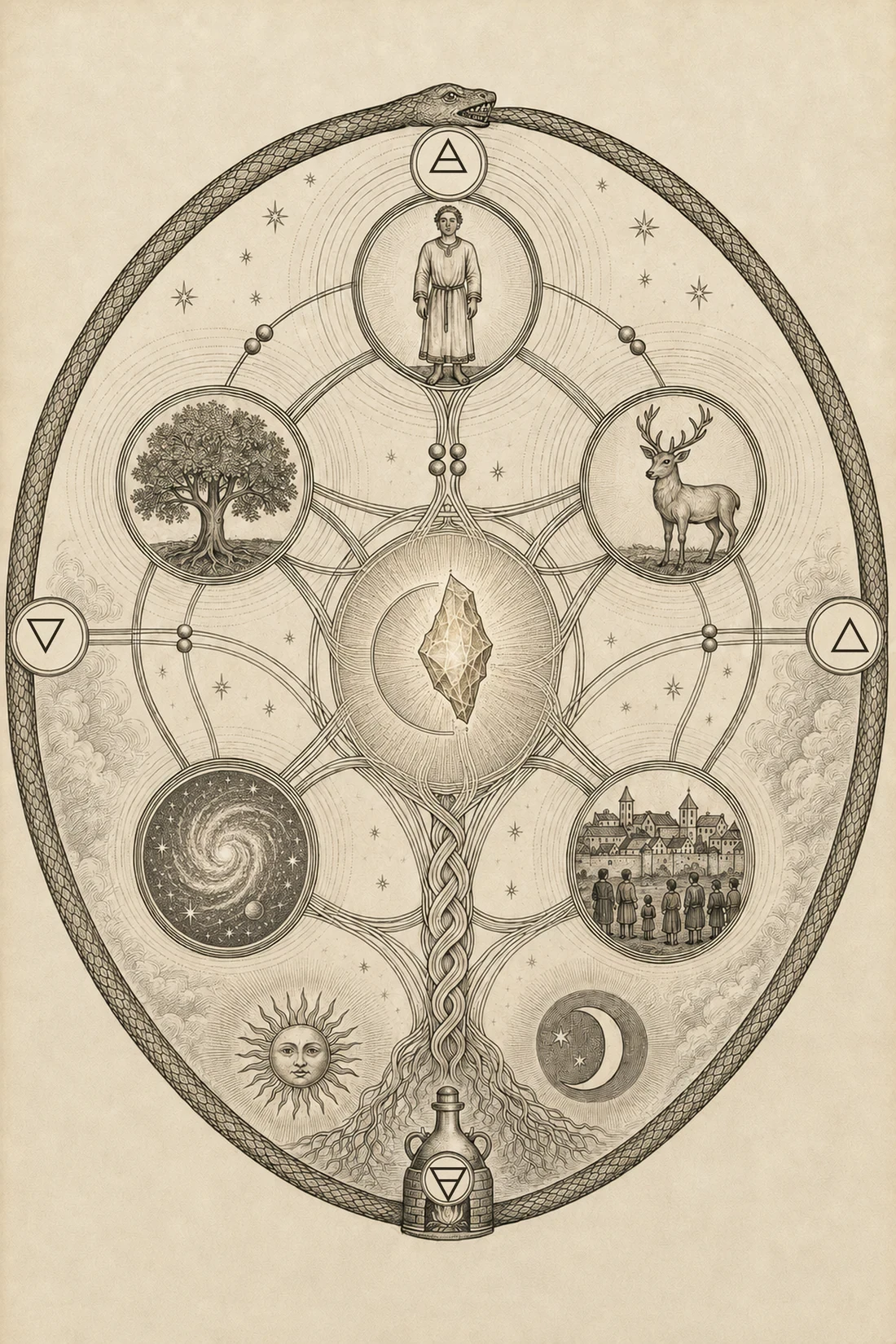
This question reaches almost everyone, sooner or later, and the ordinary world has little to meet it with. Science maps the machinery of life down to the smallest parts. It has an explanation for the origin of our universe, but it cannot answer why. Science explains the function, but not the reason. Purpose is deeper than reason or logic; it is spiritual, and it is fundamental to a meaningful life.
Human existence without direction or goals can become empty quickly. This is why an existential crisis, where a person feels that life is without meaning, can be so devastating. People need to feel as if they are working toward something significant. Without that feeling, it can become hard to move at all.
A specific purpose can be adopted at any point in a person’s life, but there is a deeper purpose, carried through lifetime after lifetime. That purpose is to experience, gather meaning, and evolve. It persists regardless of circumstance and is intrinsic to every life, in every expression, everywhere.
The question that may arise next is, how should a person live with purpose? This is not so easily answered, as the question is different for everyone. In many cases, the exact direction is not the prime element that should be considered. More important questions to ask are, what am I learning, and what am I avoiding?
It is easy to become absorbed with finding the right direction while missing the lesson that is already present. Purpose is not always grand or visible; it is in the deeper meaning behind the actions we already do or feel that we should do. In many cases, the lessons we need are already in our lives, and purpose begins when we stop looking past them.
It can help to look at one’s life from a larger perspective. It is easy to get caught up in daily demands while missing the bigger picture. When you reflect on your life in your elderly years, ask what you think will add value to your experience. It is not, most often, that which brings enjoyment, but that which brings a richer field of experience. Becoming a parent comes with increased stress and sleepless nights, but few would say they regret becoming a parent. The same can be said for forgiving a person, choosing restraint when anger would feel justified, or staying honest when dishonesty would make life easier. The sense of a well-lived life, then, is less about accomplishment, pleasure, or status, and more about living in a way that upholds one’s values. At the end of life, most people want to be able to say they made a positive impact on the world, an accomplishment that cannot be achieved from comfort zones or short-sighted goals.
It is easy to lose a sense of purpose when considering the vast scale of existence. We are not even specks on a universal scale, and yet our small scope of the world can hold great meaning to us. If it does not, the meaning is still present; it is only unrecognized.
Every life is born with meaning because every life gives the spirit a field of experience. To exist in a body is to be given the chance to learn through relation, choice, and consequence. A life does not need to be large in the eyes of the world to matter. It matters because the spirit is present within it, and whatever the spirit becomes through that life is carried forward.
Every life continues to have meaning, despite hardship, as long as the spirit has the opportunity to advance. Much growth can occur through suffering, so lives that are incredibly difficult or painful still serve in a spirit’s advancement. This does not mean suffering should be desired, excused, or inflicted. It means that even when suffering enters a life, the life is not emptied of purpose.
A painful life is not a wasted life. A limited life is not a lesser life. A life that appears small, interrupted, misunderstood, or burdened can still carry immense spiritual weight. Meaning is found in what we do with the burdens we carry. Some burdens reveal what the spirit is capable of enduring, while others reveal where a pattern must finally end. Pain can show a person what they do not want to become, what they no longer wish to pass forward, and what kind of world they want to help create. The burden is not the purpose. The purpose is found in how the spirit responds and what it chooses to become because of it.
This is why no life should be judged only by what it achieves outwardly. Fame or notoriety does not add worth at the end of a lifetime; neither can be taken to the next life. Only the lessons we overcome make meaningful changes to our energy patterns and ensure that the next life, if a person does not ascend, will be an advancement from the current one. The most important victories may never be celebrated by the world, but they are the ones that are carried.
Why the Religions Disagree
There was a time, long before archaeology marked the first human civilization, when religions did not disagree with one another. As remarkable as this seems to people now, spirituality was held together, in all its varied expressions, by one law called the Law of One.
At this time, human civilization was relatively advanced, but not in the same ways it is advanced today. It was not built around industry, mass production, or the domination of nature. It was advanced in astronomy, geometry, vibration, and the spiritual sciences. Where civilization concentrated in cities, forms of democracy guided a fair government, and people were generally at peace.
At this time, religion was not divided into systems that opposed one another. While different cultures may have used different outward expressions, the inward expression of spirit and its aim were unified throughout the world. Spirituality was the practice of living in right relation with the Net. It was not restricted to temples or doctrine, and everyone lived with a mindset geared toward coherence.
Peace could not last forever. Around the end of the eleventh millennium BCE, a comet entered Earth’s atmosphere, and the world changed. The sky grew dark, and fire descended, striking a glacier and causing global flooding. People believed the world was ending, and in many ways, it was. Entire cities were plunged underwater, and large populations lost their lives. Those who survived faced a dark, cold world without explanation of what was happening or why.
The comet impact was followed by a period of 1,000–2,000 years known as the Great Forgetting. While humanity struggled to survive, the knowledge of the past was quickly forgotten. The sciences were no longer taught, knowledge became reliant on surviving texts, and then the ability to read them was lost. Over several generations, the wisdom of the former age had already begun to turn to myth.
For millennia, humanity worked only toward survival, living as hunter-gatherers in small groups. This is where our history lines up with archaeology, if only for a period. The survivors were scattered, traumatized, and forced into a world that no longer resembled the one their ancestors had known. Stories about former life and the cosmic impact circulated in oral traditions as stories about dragons, floods, and divine punishment.
Eventually, nomadic tribes stumbled upon structures that no one around them knew how to build. Huge stones were stacked tall into magnificent structures aligned to the heavens. More importantly, these structures contained records, inscriptions, and instructional texts. While the tribes had no ability to read them, they eventually learned how to decipher them and built societies around the monuments.
The monuments struck great awe in those who surrounded them, as they do today. The mystery of how such great stones were placed is still not understood. Ancient societies held deep reverence for the mysterious builders who could lift and place such stones with ease, and for the writings that were left behind.
Societies rose in different ways in different places, depending on what was left behind and how it was interpreted by the ones who found it. Each society held slivers of the truth, and those slivers turned into doctrine. What they recovered was powerful, yet incomplete. They could track the movements of the stars with great accuracy, but they could not explain why the ancient people tracked the stars or understand the wider context of the age. Human consciousness was at a different resonance, interpreting works of great spiritual and cultural significance through a narrower field of survival, fear, authority, and need.
The roots of modern religion can be found here. The newly recovered works held something that was not there when they were placed: conjecture. Interpretation could not be universally decided upon because no single group had inherited the full structure. Where there were gaps in understanding, the few who could decipher the writings could use them to their advantage, and they often did.
It took little time for conjecture to become certainty. As societies grew around the monuments, religion became infused with identity so strongly that it could no longer be questioned without threatening the entire society. To challenge the teaching was to challenge the temple, the king, the ancestors, the law, and the story that held the people together.
This is how disagreement became a sacred venture. The original Law of One had allowed many expressions to point toward the same truth, but after the Great Forgetting, each expression began to defend itself as the whole truth. What had once been a shared language of spirit became divided into separate claims of ownership.
Religions disagree because they were formed from fragments after the context was broken. They are not all empty, and they are not all complete. They are partial inheritances, carrying remnants of the former age through the filters of trauma, translation, and time.
What We Carry from the Former Cycle
We do not examine history through the lens of linear time, but as a series of cycles. Human consciousness has been through many cycles, each spanning roughly one Astrological Great Year, or about 26,000 years. Each cycle rises, matures, declines, and returns to a threshold where the old world must either be renewed or broken apart. What is lost in one cycle does not disappear completely. It passes forward as memory, symbol, and instinct, waiting to be recognized again when consciousness is ready to receive it.
The comet impact reset the cycles, fracturing the system so profoundly that its knowledge was never fully recovered. The resonance of human collective consciousness plunged into survival modes, and the old ways were lost. Even if people had perfect translations, they could not understand them in the same way because consciousness had changed. Many incredible societies grew around the old teachings, but each eventually became taken over by corruption, either internally or externally. This is not humanity’s fault, but a condition of the turning of the cycles. After unity had been lost, it could not be fully understood or recovered.
Different parts of the world received different threads of insight from the ancient teachings. Even when remnants of the old ways were intentionally destroyed, symbols carried through consciousness when other truths could not. A spiral might become a sign of water, descent, or spiritual passage, depending on the people who preserved it. These meanings were not identical, but they were related. Each pointed toward the same underlying movement of emergence, expansion, return, and renewal. The symbol changed with culture, but the pattern beneath it remained.
As the field of consciousness narrowed further, authority and religion became stricter. People still sought spiritual answers, but the questions changed. Instead of looking for insight, they sought physical reprieve from hunger and poverty. For the few who did not lack basic necessities, religious education became training in rule, law, and recitation. They learned how to repeat doctrine, perform rites, interpret signs, and govern the people according to the customs they had inherited.
This was a different kind of spirituality from what came before. It was no longer centered on direct perception of the Net or the cultivation of coherence in every person. It became a system of preservation and control. The educated few were trained to guard the teaching, while the many were expected to obey it. Scripture could be recited with precision, but the living meaning beneath it was no longer understood.
The Renaissance Period, circa the 1500s–1600s, showed the first crack of light from the ancient world back into modern consciousness. For roughly 1,000 years, the human collective consciousness was in its darkest phase. For the first time in centuries, ancient texts were being rediscovered and discussed, and the creative spark of spirit was relit. First, change came with great resistance, then revolutions shot humanity forward as newfound liberty reopened channels that had been suppressed.
Now, centuries later, the fire is burning brightly, but there is no solid direction or framework to unify spirituality with science or morality within a nontheistic paradigm. When Nietzsche wrote, “God is dead,” he described a coming era of genocide that would result from authoritative governments replacing religious devotion. Now, we are in the aftermath of these genocides with no major insight; nations stand with weapons of mass destruction poised at one another, only now they have a better understanding of the consequences of pulling the trigger. There is another option beyond attempting to find peace through fear: we can find the threads already connecting us and respect the variations of tones that vibrate from distant cords.
Netism is a new word for the system that predated the cataclysm and has been carried through in threads in different parts of the world. Its name is in reference to the Net and the way of life that follows when a person truly understands its reality. Older systems used different words, but they pointed to the same underlying structure: the Net is real, spirit survives death, and unseen energy shapes reality equal to seen forces.
The Net can be intuitively understood once the mind grasps its basic mechanisms: relation, resonance, and exchange. A being relates to the field around it, resonates with certain patterns, and exchanges influence through thought, emotion, action, and attention. When these movements align, coherence forms. When they become divided, distortion forms. The Net is the structure through which these movements are carried.
Coherence was the primary goal of ancient spiritual practice, and it is central to Netism’s teachings. Without it, signals are easily distorted, and this is how most people read the signals they receive. A sudden flash of insight during anxiety can be misread as a signal of danger, while other signals with little meaning can be reinterpreted with unintended significance. This is why much of our work is about how to live, not how to perform spiritual rites. Without alignment, spiritual perception can be unstable, tied to desire, trauma, pride, or attachments.
When a person finds inner coherence, old systems can rise through the field naturally if they seek them. These currents have never disappeared. We cycle in direct reflection of the former cycle. Though our choices and expressions are different, we are on another octave, playing similar notes.
We bring the Law of One back into focus with the intentions it originally held. Different spiritual practices were never intended to be at odds with one another. They are different means of integrating with the same field. When the collective consciousness fragmented, the practices also lost track of the deeper threads that bound them together.
The Law of One does not ask for uniformity; it works best when all nodes find their unique tones. In music, harmony arises when different notes find a stable interval and repeat oscillations in rhythmic succession. The same is true for harmony within the Net. Music only arrives when varied nodes organize in a manner that promotes stable coherence for a sustained period of time.
Netism works to help humanity remember its spiritual origins. We can only do a portion of the work because a great deal of it is in the inner work of any person who gravitates toward our teachings. We teach people that they can remember; the remembering is up to them. No one can bring a memory to mind for another person, and in this, there is far more verification than what is offered by dogmatic faiths.
We do not ask anyone to believe blindly, and this is one way in which we align with a scientific mindset. Our spiritual system is a science in a similar way to the ancient approach. It begins with observation, not obedience. A person observes the patterns in their life, the movements of emotion, the effects of action, and the difference between coherence and distortion. From there, the teaching is tested through experience. If daily life becomes less reactive and insights become easier, then the practice is producing meaningful change.
Once our ideology is fully lived and embodied, a person can truly understand the eternal nature of spirit while appreciating the value of the present. We do not promise a life of leisure or an eternal reprieve after ascension; we offer a path to inner peace despite whatever turbulence lies ahead. Nowhere do we guarantee freedom from suffering; we only guarantee its temporality and larger significance. There is no rush for ascension, nor is there a reason to delay personal progress toward that goal. Every knot of anger or guilt that is unraveled brings a lighter state of being. We guarantee that progress continues where it left off in the next life. There is no escaping the material realms before the wisdom gained from them is fully ingrained and embodied.
Netism’s vision is that when enough people adopt its philosophy in lived practice, communities that serve the benefit of all individuals can form. Communities crumble when some members seek control or influence. If, instead, each person is treated as a conscious node within the Net with a unique timeline of collective experience, the result is very different. Rather than collapsing into a single group mindset, a community can become a point of coherence where each voice is heard, clarified, and amplified. Differences among individuals become an asset, not a hindrance.
Beyond interpersonal relations, we emphasize relation with the Earth as a key practice in finding coherence. The body is made from Earth, sustained by Earth, and returned to Earth. When a person becomes disconnected from nature, their spiritual life becomes abstract. Tending to the Earth and grounding at sunrise and sunset bring spiritual practice out of abstraction and back into the body.
We offer the tools for a person to step outside of their immediate roles and discover a wider field of self. When this happens, the spirit of unity arrives naturally, not all at once, but as a slow realization that every assumed definition of self is also a limit. The true nature of spirit is undefined potential that can encompass all elemental aspects equally. This is easy to forget when we are embodied in material form, but it is quickly remembered when we drift outside of ourselves, in inspiration, dreams, and meditation.
The path to remembrance is not easy; some revelations bring great joy, while others reveal patterns we have been avoiding. When a fixed identity is released, the entire self can feel uncertain. This is why communal support is one of Netism’s core principles. You were never meant to remember alone, and every voice deserves a chance to speak and be heard.
Netism restores the concept of relation to the forefront of human consciousness. We are not separate from the threads we share with others. Every thought, emotion, intention, and action moves the field in some way. When this is realized, even small interactions can hold meaning, and when coherence is found, channels of inspiration can flow through the person with less resistance. This is the work Netism brings forward in the modern age: to remember the Net, restore coherence, and live as part of the whole.
The Work of Remembering
Remembering begins with attention. Most people live life moment to moment, never questioning what larger patterns emerge. Most people live as if they are inseparable from their thoughts, never detaching from the narrative to ask what it is really serving. To remember is to become aware of a deeper, spiritual self that has played countless roles over countless lives. It is also to understand the purpose of living life in a way that adds value to experience.
Attention demands honesty, which, if a person is to stay sane, also requires forgiveness. We are not the patterns we have been reinforcing; our nature extends far beyond this. If harmful patterns become apparent, as they do for nearly everyone, it is a sign that work is progressing smoothly. No one arrives in the material realms a master over self and emotion; we all have lessons still to learn. Realizing this can help make forgiveness easier.
Frequently repeated patterns typically have a deeper root cause that may not always be obvious, especially to the person experiencing them. Some people over-explain because they carry the wound of being misunderstood. Some avoid conflict because the body remembers honesty as danger and vulnerability. Some seek control because uncertainty once meant helplessness. Others may give too much because love was once tied to usefulness. In each case, the pattern extends through multiple areas of life, and yet, it cannot be said to describe the true self. The person is caught in a loop, returning to the same default until the lesson is faced; it does not mean a person is defined by this loop.
Before a person comes to the realization that signals, such as thoughts or reactions, often pertain to internal conditions rather than definitive character, they may confuse every passing feeling with truth. Many people resist growth because they feel they are incapable of it. By defining their pattern loops, they define a proverbial prison, but it is one they can escape if they begin observing the pattern as something learned, not something fixed.
Once we stop telling the field what we are, it might show us. Revelations can arrive spontaneously, but they can be easily missed if a person is not paying attention. A sudden memory of a past event often hides clues to a pattern that is still active in the present. This is the spirit pulling threads through to conscious awareness. It does not speak in words; it speaks through symbols and emotions.
To deepen our insight, we must act on the messages that are already appearing. Until progress is made, the same signals may appear in different forms. The problem most people fall into is engaging with a memory without considering the reason behind it. A sudden memory of feeling vulnerable as a child can leak into the present, making a person feel small and incapable, even if they are neither. Instead, the memory should be treated as a spark of insight. In the given example, a person might discover that they have been carrying fear subconsciously,
Past lives are accessible to everyone but accessing them is a matter of tuning to that resonance. This can happen naturally if a person carries the same patterns. Similar emotional states and behavioral tendencies can work like a receiver matching a signal. In electronics, a device isolates a signal by tuning to the same pattern from the surrounding noise. The signal was not absent before; it was simply not matched. Past-life memory works through a similar relation. When the present life begins to reflect the past, the spirit has a matching point through which older memories can become conscious.
If someone struggles to retrieve memories, it could be due to several reasons. Some past lives occur in worlds that are very different from our own. These are difficult for the conscious mind to interpret, so they do not reach conscious thought. They are best accessed in dreams or deep meditative states. Others may be unable to gain clear signals because unresolved emotions in the current life create too much noise. Some people struggle because they are trying too hard, creating pressure in the field instead of relaxing into a receptive, coherent state. Whatever the issue may be, past life recollection should not be the primary focus of spiritual practice.
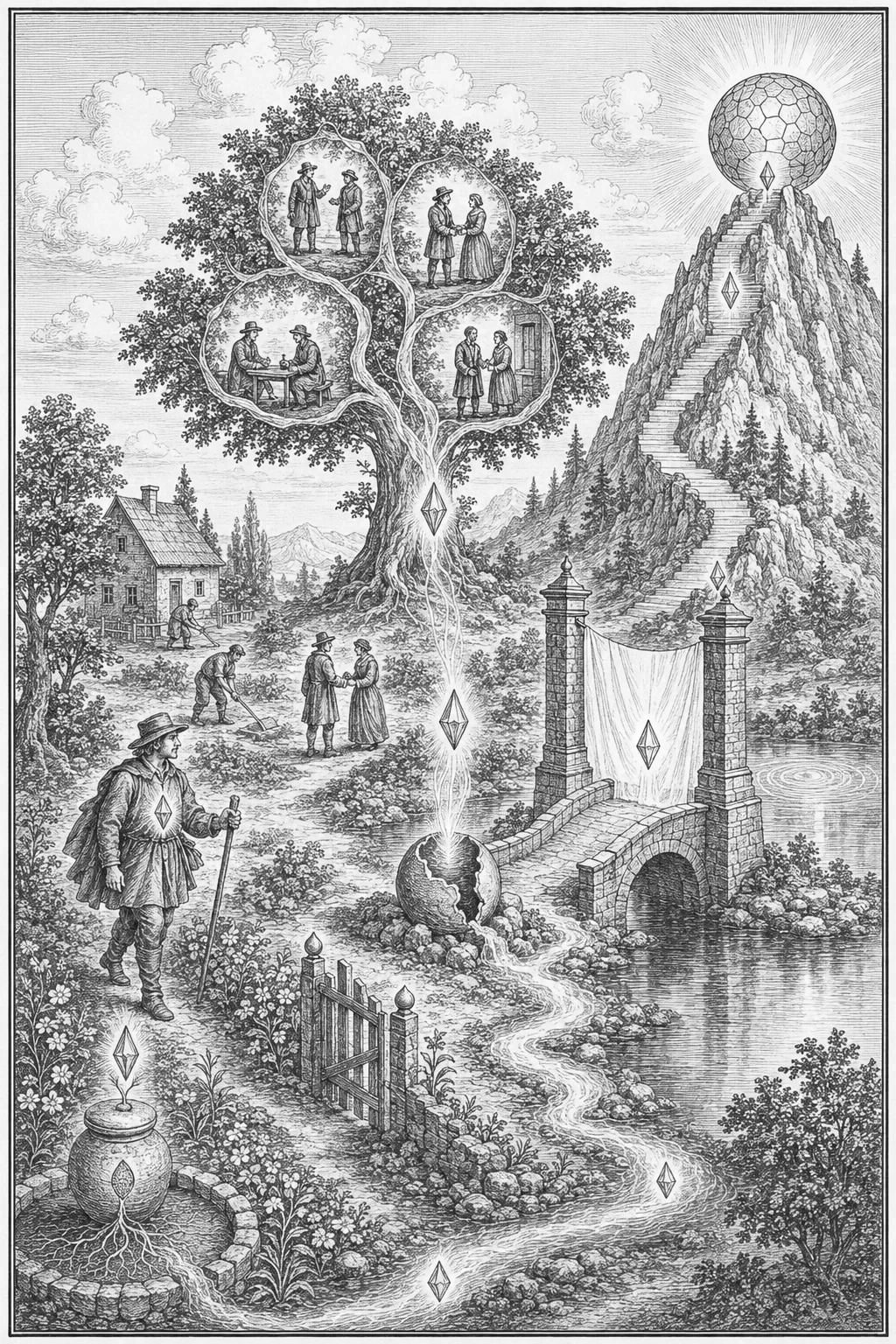
Where to Begin
It is not enough to understand the concept of the Net; it must carry through to lived practice. The practice of Netism centers around becoming aware of oneself, the connections one lives through daily, and the signals one sends out into the field. To awaken to the Net is to become conscious of interactions that are already occurring.
Do not expect the Net to reveal itself overnight. It opens to the viewer in layers. Initial signals often have little context, so practice detachment as an observer of your thoughts. This is an important first exercise because signals are almost always read incorrectly in the beginning. Instead of attributing significance to any particular signal, watch for patterns and clusters. Over time, certain patterns will repeat enough to become recognizable. A thought that appears once may mean very little, but a thought that appears every time you are criticized is worth examining.
Once a pattern becomes visible, name it as a pattern, not an identity. A person is not an angry person because they become angry under certain conditions; they are engaging in a patterned response that, if recognized and understood, can change. This is very different from identifying with the pattern as part of one's identity. Once a person has defined themselves as an angry person, they will find that pattern far more difficult to break.
Ask how the patterns you notice serve you, or whether they are contributing to knots and energy blockages. Fear, in any domain, is a strong indicator that there is a blockage in that area. The fear of speaking up, for example, contributes to blockages in the Throat Energy Center, which governs vibration, manifestation, and expression. Reluctance to engage with others emotionally suggests a blockage in the Reproductive Energy Center, which governs emotions and close connections. Fear is typically rooted in the past, so watch what memories appear when fear is activated. This is the spirit's way of speaking to the conscious mind; it shows us which moments are linked to our current state and what we should heal.
Change one automatic, repeated response. When the familiar emotion rises, observe what the pattern is urging you to do, then choose an action that produces a different result. At first, it can be extremely difficult to break out of formed habits, but it becomes easier as the pattern is interrupted more often. Do not expect to be perfect; automatic responses can be difficult to break even with vigilant attention, and mistakes may occur frequently before the dominant pattern changes. Like any habit, it is changed through repetition, and every interruption teaches the node that another response is available.
Slowly disassemble the knots that have formed around guilt, anger, or fear. A knot is a place where energy has become fixed around an unresolved experience. It may protect a wound, repeat an old defense, or hold the spirit in a reaction that once felt necessary. Each one must be recognized and released. This happens by naming the knot, recognizing the pain, and assuring the self that the pain has passed. Knots continue to return as reactions because that energy is stuck in an endless loop. Ignoring them or stating that they are no longer relevant does not release the knot. Intentional entry into the moment of pain, recognition of it, and the choice of a new response where the old reaction once completed itself can begin to dissolve the loop.
Slowly loosen your definitions of self to see what still lies latent within you. Many people cling to one interpretation of identity and limit themselves without realizing it. Know that you have played many roles and will play many more before your time is done on the material planes. None of these identifications truly describe your identity. Who you are is deeper than any words can describe, and it does not have a name.
Take time for spiritual practice, whatever that means for you. Some find coherence in meditation, others in playing music, and others in working with nature. All of these are spiritual acts within Netism's framework. Spirituality is lived through daily actions when a person lives according to their values and acts with intention. Setting the intention to lift the Net, then following through by being kind in small interactions, is spiritual practice.
Expand your knowledge in whatever areas interest you. To be an awakened node within the Net is to be an eternal student. Learning widens perception, while engaging only with material that confirms existing beliefs keeps perception narrow. A node that cannot see past its current worldview cannot grow. There are many resources, including literature in the public domain, that are free to access online. Study beyond spiritual material into subjects such as history, psychology, and philosophy. You may be surprised by how new information recolors what is observed in daily life. Knowledge becomes part of spiritual practice when it expands discernment and improves how a person participates in the field.
The importance of forming strong connections with others cannot be overstated. Nodes grow through relation by sharing openly with others and listening to their responses. This cannot be done from a reactionary state or from a position where the ego needs to be defended. Engage in discussions and local gatherings. If you cannot find anything in your area, look online. Form relations with people who have diverse perspectives when possible. The purpose is not to collect agreement, but to widen the range of signals you are able to receive. Listen long enough to understand how another person arrived at their view and allow the exchange to expose limits in your own perception.
Personal development does not stop at the self; it moves through the field around us. The work cannot be restricted to the self while ignoring the environment. We are not separate from the nodes that surround us. A person cannot claim coherence while repeatedly contributing to disorder in their relationships, neglecting the land they depend upon, or remaining indifferent to avoidable suffering. The condition of the node is revealed through what it strengthens beyond itself.
Study the Nine Points of Netism in the following section and use them to guide the way you move through life. Remind yourself of these values when faced with a difficult decision and consider how you already apply them. Many people align with the concepts in theory but fail to apply them in lived action. If you agree with the principles, ask how well you are living them. If you notice discrepancies between your values and actions, consider how you might change in the future.
Awakening is a long journey that is never truly complete. There is always more to realize within oneself because the self is not finite. We are continually growing, changing, and adapting to new circumstances. Each stage of development reveals patterns that could not be seen from the stage before it. The work is to remain attentive, accept correction, and continue refining what we send into the field. The more one learns, the less one may feel they know, because possibilities multiply once the mind is open to a wider range of potential. To be struck by awe at the complexity of automatic responses and the simplicity of their origins is a sign of progress. As Douglas Hofstadter describes, the self “is a strange loop.” We cannot progress while looking only inward or outward. We are part of a larger network of beings, and yet we are undeniably unique. Our patterns of behavior may be predictable, but the ways in which we explain them may not be. To look at oneself honestly may be one of the hardest things a person can do, but it is also the most worthwhile endeavor one can undertake. The purpose of awakening is not to arrive at certainty, but to participate in the Net with greater awareness and responsibility.
The Nine Points of Netism
The Nine Points of Netism are the founding values upon which all Netist work rests. They describe the qualities needed to build coherent individuals, healthy communities, and a more responsible relationship with the living world. These values are intended to guide how Netists learn, cooperate, resolve conflict, care for their surroundings, and support the development of others. They provide a standard against which intentions and actions can be honestly examined.
Unity
Unity, in its truest form, is the dissolution of all perceived boundaries, such as self and other, mind and body, and individual and collective. It surpasses the realm of empathy, not just feeling another’s pain or joy but recognizing that their essence is indistinguishable from your own. At its core, unity asserts that all life stems from the same universal spirit, a singular force expressed through countless forms. Experience and perception are merely lenses that create the illusion of separateness, yet behind these veils lies the same unchanging essence.
The journey of the soul extends through countless lifetimes, stretching across dimensions and timelines, weaving through the multiverse in infinite expressions of existence. In this vast tapestry, we have lived as what we now see as our opposites, embodying traits, ideologies, and roles that might feel foreign in our current state. This cyclical nature of existence teaches us to embrace duality. By having been the “other,” we understand them intrinsically, creating a foundation for unity that transcends the limits of time and individuality.
Helping another is both an external act and an inward one. In a universe of oneness, every action reverberates back to its source. A person living in unity experiences this viscerally, finding fulfillment in the seamless connection it fosters. The boundary between giver and receiver disappears, and what remains is the shared energy of mutual growth, healing, and understanding.
Balance
Balance is the recognition that the interplay of opposing forces is essential to its design. Light cannot exist without dark, just as triumph is meaningless without failure. These dualities are different parts of one cycle, shaping and refining us through their constant push and pull. Life’s cycles, including its seasons of joy and sorrow and gain and loss, are the experiences through which we grow. Challenges, no matter how daunting, are transient. They serve as the trials we must endure and overcome to reach higher states of understanding and achievement.
Periods of fortune, too, are part of this grand equilibrium. The wheel of life inevitably turns, and what we once celebrated may eventually be taken away. We learn that this is not a punishment or a tragedy, but a natural rebalancing. Loss invites us to reflect on what truly matters and to practice the art of release. By letting go, we free ourselves from the chains of attachment, making space for deeper clarity and appreciation.
Balance teaches us that nothing is static; all is in motion, part of a greater cosmic rhythm. In embracing this truth, we learn to navigate life with grace, riding the waves of triumph with humility and enduring hardship with resilience. By honoring the balance inherent in all things, we discover an unshakeable sense of peace, even amidst life’s most turbulent storms.
Collective Evolution
In accordance with the principle of unity, Netism fosters the concept of collective evolution. The collective consciousness of humanity is currently in a state of chaos. To overcome our natural state of disarray takes great effort, but our personal benefit also spreads through to the collective. This gives us motivation not only for our own personal growth, but to lead the collective from a state of scattered disarray to peace.
Part of our effort to help humanity is in sharing our wisdom with those who ask. We foster a hub to make information that is in the public domain easily findable, taking the exclusivity out of information that has previously been guarded in secret orders. We share our information openly and invite cultural adaptations.
Environmental Stewardship
For humanity to evolve and endure through the millennia, it must shift from exploiting the planet to nurturing it as its caretaker. Environmentalism is a cornerstone of Netism, as it was for many ancient spiritual practices, which recognized the Earth as a living entity with which our lives are intricately intertwined. In this philosophy, minimizing harm extends to the environment itself, making sustainable actions a vital component of spiritual wellness. The well-being of the planet is inseparable from our own, and caring for it is seen as a sacred duty.
Netism underscores the need for technological innovation that aligns with nature’s rhythms rather than disrupting them. Transitioning to alternative energy sources that harmonize with the environment is not only possible but increasingly necessary. Effective solutions already exist, yet they remain underutilized due to misunderstanding or resistance. Netism seeks to bridge this gap by disseminating accessible knowledge about sustainable technologies, aiming to inspire scientists, engineers, and future generations to refine and expand upon these methods.
Minimize Harm
Minimizing harm, in Netism philosophy, is rooted in the understanding that all life is interconnected, and to harm another is, ultimately, to harm oneself. This principle extends beyond physical actions to encompass thoughts, words, and intentions. Practitioners strive to embody kindness in every facet of life, both on an individual level and within the broader societal framework. This means abstaining from negative behaviors such as gossip, verbal cruelty, or acts of violence. Even the smallest actions, like a kind word or withholding judgment, contribute to a ripple effect of healing and harmony.
While the philosophy does not require vegetarianism, it encourages a mindful approach to consumption. Reducing meat intake and sourcing it responsibly, in ways that minimize harm to animals and ecosystems, aligns with the broader goal of reducing suffering. Practitioners are urged to view these choices not as sacrifices, but as opportunities to honor the interconnectedness of all living beings.
Harm reduction begins within, as Netism recognizes that self-directed negativity often radiates outward. Cultivating inward well-being is essential to living a life that minimizes harm. This involves identifying and challenging toxic self-perceptions, breaking the cycle of automatic self-criticism, and fostering attitudes of self-compassion and self-worth. By nurturing our inner state, we equip ourselves to bring greater positivity, understanding, and kindness into the world, creating a foundation for harmony that radiates far beyond the self.
Education and Collaboration
Netism seeks to cultivate a community built on the free exchange of ideas, where possibilities are explored with curiosity rather than dismissed prematurely. In the current scientific landscape, hierarchical structures often stifle innovation, leaving little room for groundbreaking exploration. Projects that deviate from established norms are frequently denied funding, and evidence that challenges conventional laws is too often discarded. As a result, innovation tends to focus on incremental improvements to existing systems rather than pioneering entirely new approaches.
To counter this, Netism advocates for collaboration across diverse fields, uniting experts, enthusiasts, and self-taught innovators with a shared passion for discovery. We believe that patterns and principles echo throughout all facets of nature, and breakthroughs often arise when disciplines intersect and reveal these underlying commonalities. By encouraging this interdisciplinary approach, Netism fosters an environment where unconventional ideas are celebrated as opportunities for growth.
As the community expands, Netism envisions creating a platform where information can be shared freely and responsibly. This space will empower individuals to access and distribute knowledge that serves the greater good, breaking down barriers to innovation and ensuring that the pursuit of understanding remains open to all. In this way, Netism aspires to inspire a new wave of discovery—one that is collaborative, inclusive, and unbound by outdated constraints.
Community
Netism fosters a community grounded in compassion, diversity, and collective growth, where all voices are valued and respected. We believe that differing viewpoints are not inherently wrong but offer unique perspectives that contribute to a richer understanding of the world. By embracing diversity, we cultivate an environment where growth is fueled by the shared insights of many, each illuminating a different facet of the greater whole.
Diversity is a core value in Netism because it is through the interplay of varied perspectives that we begin to perceive the bigger picture. Every viewpoint, shaped by unique experiences and histories, holds a piece of the universal puzzle. Netism encourages individuals to challenge themselves to step outside their own frame of reference and see the world through the eyes of others. By doing so, we not only foster empathy but also absorb the wisdom of countless lifetimes within a single one.
Spirituality
Our spiritual system is centered on awareness of the Net. It teaches that every person participates in a field of connection and carries responsibility for the energy they feed into it. Spirituality begins with recognizing those connections, developing coherence, reconnecting with nature, and learning to live with intention.
Spirituality is expressed through how one lives and acts in the world. Along with practices, such as meditation, related to personal coherence, it is lived by caring for others, strengthening connections, and reducing strain in the field.
Philanthropy
Netism emphasizes that acts of kindness are their own reward. Performing a favor with the expectation of gaining a good reputation or leveraging it for a future favor undermines the very essence of kindness. When a favor is reduced to an exchange, it becomes a transaction, losing its spiritual and emotional significance. True kindness arises from a spirit of unity, where others are treated with the same care and respect we would wish for ourselves.
In a society built on unity, there is no joy in gaining something at the expense of another. To harm others for personal gain creates a ripple effect of fear and distrust, ultimately harming the perpetrator as well. A thief, for instance, not only damages their community but also becomes a target themselves, living in a constant state of insecurity. The principle is simple: we must embody the values of the society we wish to create. A world of safety and trust can only exist if we act with integrity and compassion.
Netism acknowledges that our current society is far from a peaceful utopia; acts of harm and exploitation are all too common. However, we assert that true peace of mind can only come when one’s actions align with their beliefs. Humanity’s natural state is to care for one another yet fear and competition for resources often drive behavior in the opposite direction. By recognizing this within us, we see how selfless giving fosters a sense of security and interconnectedness, while selfishness breeds isolation and distrust. Giving with pure intent, free of expectation, reaffirms our faith in humanity and strengthens the bonds that hold us together.
Reading the Plates
The two plates in this book gather its central teachings into symbolic images composed in the manner of old alchemical engravings. Each plate is a map. Its meaning comes from the relationship between its figures, their positions, the lines that connect them, and the greater pattern that holds them together.
The plates are intended to be read slowly. Begin with one symbol, observe its position, and follow the surrounding threads. Then return to the whole image. A single figure may represent one principle when viewed alone and reveal a wider meaning when seen in relation to the complete design.
Plate I presents the anatomy of a being within the Net. Plate II presents the movement of that being through embodiment, relationship, remembering, integration, and ascent. Together, they show structure and process. The first reveals the field in which development occurs. The second reveals the path through which a spirit learns to participate in that field consciously.
Plate I · Anatomy of the Net and the Soul Shard
The soul shard as the integrating center of elemental, living, collective, and cosmic relation.
The Meaning of the Plate
Plate I presents a soul shard within the greater field of the Net. The shard is distinct, carrying its own history and resonance, while remaining connected to living beings, collective structures, material conditions, and cosmic patterns.
The image can be read from the outside inward or from the center outward. Reading inward shows how the cycles, elements, living systems, and threads of relation gather around a local center of experience. Reading outward shows how the condition of one soul shard moves through its connections and influences the wider field.
The plate teaches that individuality and unity exist together. The soul shard remains particular. Its development, expression, and understanding arise through relation.
The Enclosing Serpent
The ouroboros forms the outer boundary of the plate. Its body curves around the entire field, and its mouth meets its own tail.
The serpent represents continuity, return, and renewal. Every cycle eventually returns toward its point of origin, carrying the changes gathered through experience. A completed cycle therefore returns with memory. The beginning may appear familiar, though the being arriving there has changed.
The serpent's ability to shed its skin expresses continuity through transformation. A body, identity, role, or world may change while a deeper pattern remains. The form is released, and the underlying life continues.
The circle made by the serpent establishes wholeness. Everything inside belongs to one living field. The figures retain their differences, yet none exists outside the greater pattern. This is the first principle needed to understand the plate: unity preserves distinction.
The ouroboros also indicates that the Net has no simple beginning or final edge. Every point receives from what came before and contributes to what follows. Cause becomes consequence, consequence becomes condition, and condition becomes the ground from which another movement begins.
The Central Soul Shard
The luminous crystal at the center is the soul shard. It represents the particular expression of the greater soul carried by a spirit through its cycles of development.
The shard's irregular outline represents individuality formed through a unique history. No two spirits have passed through the exact same sequence of lives, relationships, choices, wounds, and integrations. Each therefore carries a distinct soul signature.
The many facets of the crystal represent the different angles through which experience is received. A single event may be understood emotionally, intellectually, physically, spiritually, and relationally. Experience becomes wisdom as these separate impressions are brought into a coherent pattern.
Light radiates from the shard. This radiance represents resonance, the recognizable signal through which the shard remains itself across changes of body, role, environment, and cycle. Names and appearances change. The deeper signature remains continuous.
The shard occupies the center because every being encounters the Net through a local center of experience. Each person experiences life from within their own body, history, awareness, and field of relation. Centrality in this plate indicates perspective and integration. It grants no rank over the surrounding nodes.
The shard receives signals from the field, interprets them through its present condition, and returns its response through every connected thread. Its inner condition therefore affects what it receives and what it sends.
The fine geometry within the crystal represents coherence. Experience can remain divided, with thought pulling in one direction, emotion in another, and action in a third. It can also be integrated into a stable form. As coherence develops, the signal of the shard becomes clearer and can travel through the Net with less distortion.
The Four Elements and the Fifth Center
Four alchemical signs surround the central shard. They represent the primary modes through which embodied experience is expressed.
Air appears above as an upward-pointing triangle crossed by a horizontal line. Air governs breath, thought, interpretation, communication, and the movement of signals. It is the element through which experience becomes language, understanding, and conscious direction.
Fire appears at the right as an upward-pointing triangle. Fire governs will, action, heat, drive, and transformation. It gives movement to intention and allows an inner condition to become an outward act.
Water appears at the left as a downward-pointing triangle. Water governs emotion, memory, receptivity, intuition, and resonance. It carries impressions through the spirit and allows one state to be felt through another.
Earth appears below as a downward-pointing triangle crossed by a horizontal line. Earth governs embodiment, stability, structure, consequence, and the material conditions in which experience takes place. Earth gives resistance to the spirit's patterns, allowing them to become visible through action.
The shard forms the fifth center, Aether. In this plate, Aether represents the integrating self around which the four elemental modes are organized.
Coherence develops when thought, feeling, will, and embodied action move in a shared direction around this center. An imbalance in one element affects the whole. Thought without feeling becomes detached. Feeling without grounding becomes unstable. Will without reflection becomes force. Stability without movement becomes stagnation.
The elemental arrangement is relational. It shows a complete field of embodied experience organized around the soul shard.
The Five Visible Nodes
Five circular medallions surround the central shard. Each represents a different kind and scale of node within the Net.
The human figure represents the individual conscious node in its present life. The figure carries personality, memory, choice, and the capacity to observe personal patterns. Human awareness allows a person to recognize what they are reinforcing and to alter their participation deliberately.
The tree represents plant life, rooted exchange, ancestry, patience, and development through branching. A tree appears to stand alone, yet its life depends upon soil, water, air, sunlight, fungi, insects, animals, climate, and time. It is a visible example of individuality formed through relationship.
The deer represents animal consciousness and the intelligence expressed through instinct, sensation, attention, movement, and immediate relation. Its presence reminds the reader that human thought is only one form of awareness. Other beings read and respond to the field through the capacities appropriate to their form.
The gathered people represent a collective node. A community arises from individuals while developing a pattern, memory, identity, and influence that no single member contains alone. Families, communities, institutions, and cultures can all function as larger nodes formed from the coordination of smaller ones.
The galaxy represents organization at the cosmic scale. Stars, planets, forces, and vast structures form through relation. The galaxy extends the principle of the Net beyond biological life and shows the same movement toward ordered systems across immense scales.
All five images appear within equal medallions. Their size and modes of experience differ, though each participates in the same field. The plate moves from person to plant, animal, community, and cosmos without arranging them into a ladder of value.
Threads, Crossings, and Points of Exchange
Curving lines connect the visible nodes to the central shard and to one another. These lines are the threads of the Net.
Some threads form direct paths. Others overlap, circle, or pass through points where several movements meet. This design shows why an action rarely produces only one effect. Every signal enters a field that already contains relationships, histories, expectations, and active patterns.
A word spoken to one person may alter how that person treats another. A wound carried through a family may appear in people who never met the person who first caused it. An act of care can spread through several lives because the person who received it becomes capable of offering the same stability elsewhere.
The small paired spheres mark concentrations of exchange. They can be read as moments when a relationship becomes stable enough to carry greater influence. They can also represent junctions where separate movements begin acting together.
Their repetition shows that the Net is formed through countless small contacts. A strong channel develops when threads are reinforced across time. Repeated attention, fear, affection, conflict, cooperation, or shared purpose can strengthen a pathway until it begins influencing the nodes connected to it automatically.
The crossings also show that the Net is more complex than any single observer can perceive. A person may understand the thread directly in front of them while remaining unaware of the wider network through which its consequences travel.
The Braided Source Thread
A braided strand descends from the central shard. This is the source thread, the line of continuity through which the spirit remains connected to the greater soul.
Several strands remain visible while forming one cord. This represents integration. Separate experiences, identities, roles, and lives retain their histories while becoming part of a stronger and more complete pattern.
The braid also expresses the relation between unity and multiplicity. A spirit contains many experiences without being reduced to any one of them. Each life contributes to the whole, and the whole gives continuity to each life.
The source thread is never completely severed during incarnation. Conscious memory may close, yet the deeper connection remains active. It appears through resonance, recurring patterns, unexplained recognition, spiritual longing, and the persistent sense that the present identity does not contain the whole of what one is.
The Sun and Moon
The Sun and Moon appear near the lower part of the circle. They represent complementary phases of experience.
The Sun represents outward expression, waking awareness, visibility, action, and the conscious mind. It illuminates what can be examined directly and gives energy to movement in the material world.
The Moon represents inward reflection, dreams, spiritual memory, receptivity, and the parts of experience that emerge indirectly. Its light is received and reflected, making it an image of knowledge that reaches the mind through symbols, emotion, intuition, and remembrance.
Together, the Sun and Moon establish rhythm. A coherent life requires periods of action and reflection. Constant outward force produces exhaustion. Endless inward withdrawal prevents insight from becoming lived change.
Their placement near the vessel connects these cycles to embodied life. The spirit learns through waking and dreaming, effort and rest, expression and reception.
The Roots, Vessel, and Inner Flame
Roots descend toward the vessel at the bottom of the plate. They represent the conditions from which the present life emerges.
These roots include family patterns, former lives, inherited responses, culture, environment, relationships, and the deeper memory of the spirit. Much of what shapes a person began before conscious awareness. Remembering brings these hidden roots into view so their influence can be understood.
The vessel represents embodied life. It is the finite container in which spiritual patterns encounter physical consequence. Within the vessel, intention becomes behavior, emotion affects the body, and choices alter the lives of others.
The Earth sign upon the vessel emphasizes weight, boundary, structure, and form. The body limits what can be experienced at one time, though those limits create the conditions required for focused development.
The small flame inside the vessel represents transformation under pressure. The material realm gives resistance to the spirit. That resistance makes deliberate change possible. Patience, restraint, courage, compassion, and responsibility become meaningful because circumstances test whether they can be maintained.
The source thread enters the vessel, showing that incarnation continues the greater movement of the spirit. A person may have no conscious memory of former lives, while temperament, longing, fear, attraction, ability, and repeated lessons still carry impressions of that deeper history.
Reading Plate I as a Whole
Begin at the central shard and trace the threads outward. This movement shows how individual identity participates in living, social, elemental, and cosmic relations.
Begin at the vessel and follow the braided source thread upward. This movement shows how embodied experience gathers around an enduring soul signature.
Begin at the ouroboros and move inward. This reveals how every local life is held within greater recurring cycles.
Begin with any visible node and follow its connections. This shows how quickly one form of life becomes inseparable from the conditions and relationships surrounding it.
The complete image teaches that the soul shard remains particular while developing entirely through exchange. Coherence within the shard changes the threads it strengthens. Changes within those threads alter the field encountered by other beings.
Inner work therefore becomes relational work. Even when transformation begins in solitude, its effects enter the Net.
Plate II · The Path of Remembering
The recurring soul signature moving through embodiment, relation, threshold, integration, and ascent.
The Meaning of the Plate
Plate II presents remembering as a living process. The same soul signature appears repeatedly throughout the landscape, showing continuity as the spirit moves through different conditions and stages of development.
The plate can be read upward from the rooted vessel toward the radiant sphere above the mountain. It can also be read downward, following the greater current into the world and the vessel of embodiment.
Both directions belong to one cycle. Consciousness enters form, gathers experience, recognizes its continuity, integrates what it has learned, and becomes capable of participating in a wider field.
The landscape makes the teaching practical. Remembering unfolds through the body, work, relationship, choice, loss, reflection, and repeated thresholds. The higher pattern is reached through the ordinary conditions of life.
The Rooted Vessel
At the lower left, an earthen vessel rests partly within the ground. Roots spread beneath it, and a leaf marks its surface.
The vessel represents the embodied spirit at the beginning of conscious remembering. It already contains life, history, and the capacity for growth. The person may have little conscious knowledge of their deeper identity, though the full history of the spirit is already present in patterned form.
The roots show that the current life emerges from conditions that began before conscious awareness. These include former cycles, family patterns, inherited responses, the living environment, and the accumulated memory of the spirit.
The vessel is partly buried because much of this history remains beneath awareness. The conscious mind sees the visible surface of the present life, while the spirit carries roots extending into a much older field.
The First Rising Shard
A shard rises from the vessel. Its appearance above the rim represents an inner pattern entering awareness.
Remembering begins when something long carried can finally be perceived. This may appear as a sudden recognition, a recurring dream, a strong emotional response, an unexplained attraction, a memory, or the realization that the same pattern has repeated through several stages of life.
The shard is already luminous. Awareness does not create the deeper identity. It allows that identity to become visible within the present mind.
Flowers surround the vessel. They show that growth begins before a person can explain what is happening. The spirit may already be reorganizing its life while the conscious mind is still searching for words.
The Current of Memory
A stream carries several shards through the lower part of the plate. Water represents memory, emotion, transmission, and the movement of patterns through changing forms.
A current can carry what the conscious mind never deliberately chose to retain. Emotional responses, instincts, fears, desires, and repeated relational patterns may move forward because they remain active within the spirit.
The repeated shards within the water show the same soul signature appearing through different moments and conditions. Their recognizable form establishes continuity across the journey.
The water also shows that memory is dynamic. It moves, gathers material, changes direction, and joins larger bodies. Spiritual memory is therefore more than a fixed archive. It is a living influence that enters the present through resonance.
The Traveler and the Staff
The traveler bears a shard at the heart and carries a staff.
The shard at the heart represents spiritual memory becoming lived recognition. The traveler has begun to understand that the patterns moving through life belong to a greater continuity. This recognition is felt through values, emotional truth, and the growing sense of one's place within the Net.
The staff represents practice, discernment, and stability. Remembering requires more than an unusual experience. A person must learn how to test impressions, regulate emotion, observe repeated patterns, and continue through periods when the path is unclear.
The staff touches the ground, joining spiritual understanding to material life. Insight must become conduct. A teaching becomes meaningful when it changes how a person responds, relates, chooses, and repairs harm.
The traveler moves through a cultivated landscape. Remembering takes place among existing responsibilities. The path begins within the life a person is already living.
The Gate and Garden
A wooden gate marks the first deliberate threshold.
The gate represents the movement from automatic participation into conscious practice. The traveler begins choosing what to reinforce, what to release, and how to enter relation with greater awareness.
The surrounding boundary remains intact while the gate opens. This shows development through readiness. A healthy threshold does not require the destruction of every existing structure. It creates a passage through which a person can enter a wider understanding while carrying forward what remains useful.
People work the ground nearby. Their labor represents cultivation. Attention prepares the soil. Repeated action establishes a new response. Patience allows a different pattern to take root.
The garden shows that insight requires care. A realization may open the gate, though continued practice determines whether anything grows from it.
The House and Daily Life
The house places spiritual development within ordinary existence.
Home, work, family, responsibility, conflict, rest, and routine provide the actual conditions in which coherence is tested. A person may feel clear during meditation and become reactive during a difficult conversation. The house reminds the reader that both moments belong to the same practice.
The condition of the home also reflects the condition of the node. Order, safety, tension, neglect, care, and relationship patterns all influence the signals a person receives and sends.
Remembering enters daily life when it changes the way a person inhabits their immediate surroundings.
The Pair in the Field
Two people meet within the cultivated field. They represent exchange between nodes.
Many hidden patterns become visible through relationship. Affection, conflict, trust, irritation, obligation, attraction, fear, and care reveal the condition of the threads joining one person to another.
The gesture between the figures represents recognition and participation. Each person becomes part of the other's field. What passes between them can reinforce an existing pattern or help create a different one.
The field surrounding them shows that every relationship exists within wider conditions. Family, culture, community, past experience, and shared circumstances influence the exchange. No relationship occurs in complete isolation.
The World Vessel
Near the center, the Earth appears as a vessel opened by a stream.
The world vessel represents the material realm as a field that receives spirits, gives them conditions for development, and releases them when an incarnation is complete.
The opening in the globe allows its waters to join the greater current. Every life contributes its consequences to a world already shaped by countless other lives. Nothing experienced or enacted remains entirely private.
The world is therefore both environment and participant. It shapes the spirit through limitation, relation, and consequence. The spirit shapes the world through every thread it strengthens during embodiment.
The Vertical Source Thread
A luminous vertical thread passes through the world. It links the rooted vessel, the traveler's path, the tree of lives, and the ascent beyond the mountain.
This is the axis of continuity. The material world does not interrupt the source thread or the greater cycle. It gives the thread a dense field in which patterns can become action and action can produce consequence.
A shard appears along this axis. It represents the same soul signature at another phase of development. The surroundings have changed, though the recognizable identity remains.
The vertical direction also connects depth and height. Roots and ascent belong to the same structure. Development requires contact with both. A person rises through what has been integrated, rather than through the rejection of embodied life.
The Bridge
A stone bridge crosses the current.
The bridge represents a structure strong enough to carry a person across a threshold. Practice, knowledge, community, disciplined reflection, and coherent relationships can all serve this purpose.
The bridge does not stop the water. Its arch leaves room for the current to continue below. This shows that a threshold can be crossed while emotion and memory continue to move. Growth does not require the suppression of feeling. It requires a structure capable of carrying the person through it.
The strength of the bridge comes from its arrangement. Separate stones support one another through balance and pressure. This makes the bridge an image of community and shared work. A stable passage can be created when several parts are placed in right relation.
The Veil and Paired Pillars
Beside the bridge, two pillars hold a suspended veil.
The veil represents the boundary between familiar perception and a wider field. It marks the limit of what the present state of awareness can receive clearly.
A shard shines upon the veil. This suggests that the soul signature can be sensed before the whole landscape beyond the boundary becomes visible. Recognition often comes in fragments. A person may feel that something is true long before they understand its full meaning.
The veil opens through preparation, clarity, and coherence. Force creates distortion because the mind may interpret unfamiliar signals through fear, expectation, or desire. Steady practice allows a person to receive more without losing balance.
The paired pillars create a held space. One pillar alone cannot form a passage. Their relation establishes the gate. They can represent trustworthy witnesses, complementary forces, shared purpose, or the inner balance required during a major transition.
The Tree of Lives and Relations
The great tree occupies the upper center of the landscape. Its roots reach toward the world, its trunk receives the vertical thread, and its branches carry circular scenes of human relation.
The tree represents the continuity of the spirit expressed through many lives. Each branch carries a particular extension of experience while remaining part of one living structure.
The scenes held among the branches are the fruits of experience. They may represent meeting, teaching, family, partnership, service, conflict, separation, reconciliation, or return. Their exact biography carries less importance than the pattern retained from them.
The scenes remain distinct within the same tree. This shows how former lives can remain present as spiritual memory without becoming the conscious identity of the current mind.
The spirit gathers these lives as wisdom, tendency, resonance, and developed capacity. No single scene contains the whole tree. No single incarnation contains the whole spirit.
A shard appears within the trunk. This is the enduring source identity. It belongs to the complete structure rather than any one branch. Through it, separate lives remain expressions of the same developing spirit.
The Mountain
The mountain represents the resistance involved in development.
Growth requires effort because deeply established patterns have momentum. Fear, avoidance, harmful habits, inherited roles, and distorted relationships resist change through repetition.
The mountain gives form to this difficulty. Its height shows the distance between recognition and full integration. A person may understand a pattern quickly while requiring years to change how that pattern appears in daily life.
The mountain also provides stability. Resistance strengthens what is practiced against it. Compassion, patience, courage, honesty, and restraint become reliable qualities when they have survived pressure.
The Stair and Ascending Shards
A long stair rises along the mountain.
The stair emphasizes sequence. Coherence develops through many integrations. Each stable change makes the next range of experience possible.
The shards placed along the ascent mark thresholds of recognition. They show the recurring soul signature becoming clearer at different stages.
These shards are markers of integration rather than trophies or ranks. Development cannot be measured only by unusual experiences, visions, titles, or claims. Its quality is revealed through greater clarity, reduced harm, stronger responsibility, and the ability to remain coherent within a wider field of relation.
The stair also directs attention toward the next step. A person does not need to comprehend the whole ascent at once. The present task is the step that can be taken with honesty now.
The Radiant Geometric Sphere
At the summit, a radiant geometric sphere appears above the final steps.
Its many facets form one ordered body. The sphere represents a higher cycle of consciousness in which relation becomes more complex and less dependent upon fixed material form.
Geometry represents stable relation. Each line holds meaning through its connection to the others. No part creates the complete form alone.
Radiance represents an expanded capacity to send and receive. A coherent being can participate in a wider field without losing its defining soul signature.
The sphere is a field of organized consciousness. It represents entry into a greater range of relation after the lessons of embodied life have been sufficiently integrated.
The position of the sphere above the mountain shows ascent, while the vertical thread connecting it to the lower landscape preserves continuity. The higher cycle remains connected to the experience gathered below.
Reading Plate II as a Whole
Begin at the rooted vessel and follow the rising shards. This movement shows spiritual memory entering conscious awareness and becoming a deliberate path.
Follow the stream through the world vessel. This reveals how memory and consequence move through lives, relationships, and material conditions.
Follow the traveler through the gate, field, bridge, and veil. This shows the development of conscious participation through practice and relationship.
Follow the vertical thread into the tree. This reveals the continuity of the spirit through multiple lives.
Follow the stair toward the radiant sphere. This shows integration opening into a wider cycle of consciousness.
Then read the image downward. Follow the source thread from the radiant sphere through the tree, the world, the current, and the rooted vessel. This reveals consciousness entering form and taking part in another field of experience.
How the Two Plates Correspond
Plate I is anatomical. It shows the soul shard at the center of elemental, living, collective, and cosmic relations. Plate II is developmental. It follows the same soul signature through embodiment, attention, exchange, threshold, integration, and ascent.
The ouroboros of Plate I becomes the circulating current of Plate II. The four elements become soil, water, breath, living bodies, willful labor, and the conditions of the landscape. The braided source thread becomes the luminous axis passing through the world and the tree. The visible nodes become the people, plants, community, structures, and cosmic forms encountered along the path.
The vessel in Plate I shows embodied life as the place where transformation occurs. The rooted vessel in Plate II shows the spirit beginning to recognize what embodiment contains.
The central shard of Plate I reveals enduring identity. The recurring shards of Plate II show that identity remaining continuous through change.
Read together, the plates present one teaching. The soul shard remains itself through every transformation, and each transformation occurs within relation. Remembering reveals continuity. Practice gives that recognition a stable form. Coherence allows the pattern to rise while preserving its roots.
Using the Plates for Reflection
Return to the plates whenever a teaching feels too abstract. Choose one symbol and consider where its pattern appears in your present life. The vessel may direct attention toward the condition of the body, home, or immediate environment. The gate may reveal a decision that requires readiness. The bridge may indicate a form of support that needs to be strengthened. The veil may reveal the current boundary of perception. The tree may bring a repeated relationship or life pattern into view. The mountain may show the value of taking one clear step when the entire path feels overwhelming.
After choosing a symbol, trace the lines and figures surrounding it. Ask what feeds this pattern, what the pattern feeds in return, and which other nodes carry its effects.
The plates offer no fixed prediction. They provide a method of relational attention through which the reader can observe the pattern already moving through the field.
Go gently, for every thread you touch is your own.
SO IT IS SPOKEN, SO IT IS WOVEN.
Glossary of Terms
The words gathered here carry specific meanings within Netism. Some are familiar terms used more precisely, while others belong directly to the Netist framework. These definitions explain how each term is used within The Remembering. They should be read as parts of one connected system rather than as isolated ideas.
Aether
The integrating fifth element represented at the center of the four elemental forces. In the plates, Aether is associated with the self or soul shard around which Air, Fire, Water, and Earth become organized. In wider Netist teaching, the word can also refer to the subtle medium through which patterns, forces, and consciousness move.
Ascended Spirit
A spirit that has developed enough coherence to continue its growth beyond material incarnation. An ascended spirit has entered a spiritual cycle, though it still has much to learn and integrate.
Ascension
The movement of a spirit from one cycle of development into the next. Ascension occurs when the spirit has integrated enough of its present cycle to remain stable under the conditions of a wider one. It is earned through lived transformation, responsibility, integration, and readiness. It does not indicate perfection or the end of development.
Astral Body
The temporary form through which a spirit may experience the threshold immediately after death or move within an astral state. It often resembles the person's most recent human form because identity has not yet fully adjusted to existence without a physical body.
Astral Realms
Responsive, symbolic fields commonly encountered through dreams, deep meditation, near-death states, and other altered conditions of awareness. The astral realms are described as the foyer of the spiritual planes because they stand between ordinary embodied experience and more abstract spiritual existence.
Astrological Great Year
A cycle of approximately 26,000 years associated with the precession of Earth's axis. In the historical framework of The Remembering, human civilizations and collective consciousness move through larger cycles that roughly correspond to this period.
Balance
The ability to remain centered while life moves through paired conditions such as joy and grief, growth and decline, action and rest, order and change. Balance is responsive movement that keeps a being from collapsing into harmful extremes.
Channel
A sustained pathway in the Net created when many nodes repeatedly feed the same pattern across time. A thread commonly joins particular nodes, while a channel carries collective momentum through communities, cultures, systems, and generations. A channel gains strength through repetition, regardless of whether the pattern it carries is beneficial or harmful.
Chaos
The unpredictable condition created when many forces, choices, nodes, and patterns interact at once. Chaos is not treated as evil or as punishment. It describes a field too complex for any single node to control or completely predict.
Coherence
The degree to which a being is unified in expression. Coherence develops when thought, emotion, body, spirit, values, speech, and action move in a shared direction. A coherent person sends a clearer signal into the Net because less energy is consumed by inner contradiction.
Collective Consciousness
The larger pattern formed through the shared attention, beliefs, emotions, expectations, and actions of many people. A collective consciousness is formed by individual nodes while developing qualities and momentum greater than those of any one member.
Collective Evolution
The Netist value that personal growth contributes to the development of the whole. Every person remains responsible for their own work, though no person develops in complete isolation. Changes within one node influence the relationships, families, communities, and future generations connected to it.
Compassion and Non-harm
The second of the Three Primary Laws. It requires awareness of suffering, care for the effects of one's actions, and a commitment to reducing unnecessary harm. It also requires repair when harm has occurred.
Consciousness
The capacity through which a being receives, organizes, and responds to experience. Consciousness appears through different ranges of complexity. A cell, plant, animal, person, community, and greater living system each organize and respond according to the capacities of their form.
Corpus Netum
The foundational body of Netist books and writings. Each volume examines a different part of Netist philosophy, cosmology, ethics, practice, history, symbolism, or spiritual development. The Remembering is Book Zero because it provides the introductory foundation for the series.
Cycle
A complete range of experience through which a being, system, civilization, or world moves before entering another range. Cycles rise, mature, decline, return, and begin again with the effects of the former cycle carried forward.
Decoherence
The condition in which the parts of a being or system pull against one another. Decoherence may appear when values conflict with actions, thought conflicts with emotion, or a person's outward identity conflicts with their inward condition. Prolonged decoherence produces strain, confusion, reactivity, and distorted signals.
Detachment
The ability to experience life fully without becoming ruled by possession, fear, control, identity, or attachment to a particular outcome. Healthy detachment allows love, care, and responsibility to remain while releasing the need to control another being or preserve a condition that has ended.
Distortion
A pattern that has become misaligned, reactive, harmful, or unable to carry a clear signal. Distortion can arise through fear, contradiction, trauma, obsession, repeated harm, false belief, or the continued reinforcement of an unresolved pattern.
Elemental Modes
The four primary expressions of embodied experience shown in Plate I. Air represents breath, thought, communication, interpretation, and the movement of signals. Fire represents will, action, transformation, drive, and outward force. Water represents emotion, memory, receptivity, intuition, and resonance. Earth represents embodiment, structure, stability, consequence, boundary, and material form. Aether is the integrating center around which the four modes become organized.
Environmental Stewardship
The Netist value that Earth is a living system to which humanity belongs. Stewardship requires care for soil, water, air, climate, plants, animals, habitats, and the conditions that allow future life to flourish.
Exchange
The movement of influence between nodes within a shared relational field. Exchange can occur through words, behavior, physical presence, emotion, attention, thought, intention, or other forms of signal. A returned signal forms a temporary circuit, while repeated exchange may establish a lasting pathway.
Field
The region of active relation surrounding a node or group of nodes. A person's field includes their bodily state, emotions, thoughts, relationships, environment, and the signals moving through them. A room, family, community, or landscape may also hold a recognizable field.
Field Memory
The principle that experience leaves a continuing pattern within the Net. In wider Netist teaching, the complete memory-field is called the Records. Field memory does not require every detail to remain available to the conscious mind. It remains through imprints, tendencies, emotional responses, relational patterns, and spiritual resonance.
Former Cycle
A previous period of human consciousness and civilization whose patterns continue through the present. In The Remembering, the term particularly refers to the age before the Great Forgetting, when humanity is understood to have possessed a more unified spiritual framework.
Free Will
The first of the Three Primary Laws. Free Will protects the sovereignty of every person and requires meaningful consent. Spiritual development cannot be forced, and no person's growth grants authority over another person's body, conscience, choices, or path.
Great Forgetting
The Netist name for the loss of cultural and spiritual continuity following a great ancient cataclysm. Within the book's historical framework, displacement, death, hunger, trauma, and the collapse of stable societies caused knowledge to fragment into myths, symbols, separate teachings, and partially preserved traditions.
Higher Self
A more developed expression of the same greater soul that carries a wider range of memory and perspective than the current embodied mind. The higher self may be experienced as guidance, conscience, intuitive warning, or a presence that feels both deeply personal and larger than the present identity.
Identity
The pattern through which a being recognizes itself. Human identity commonly forms around name, body, history, occupation, relationships, roles, and personality. These expressions are real within the current life, though they do not contain the whole spirit. The deepest continuity of identity is carried through the soul signature.
Imprint
The pattern left when an experience changes a node, relationship, or surrounding field. An imprint may remain active after conscious memory fades and may influence later thoughts, emotions, choices, bodily responses, and relationships.
Incarnation
A single embodied life entered by a spirit. Each incarnation provides a particular body, environment, period, culture, set of relationships, and field of experience. These exact conditions do not occur again in the same form.
Intuition
Information received before the conscious mind has produced a complete explanation. Intuition may arise through bodily sensation, emotion, sudden recognition, dreams, warning, attraction, or an immediate sense of direction. Netism teaches that intuition requires discernment because fear, desire, expectation, and unresolved patterns can imitate or distort it.
Karma
A comparative term for moral or spiritual cause and consequence. The Remembering does not use karma as a guarantee that good people will be protected from suffering or that hardship proves hidden guilt. Consequences move through the Net, though the interaction of free beings and natural forces prevents life from operating as a simple system of reward and punishment.
Knot
A concentrated area of unresolved tension formed when several reinforced threads tighten around the same wound, conflict, fear, or repeated pattern. A knot may continue influencing a person or relationship until it is recognized, loosened, repaired, or released.
Law of One
The name given in The Remembering to the former understanding that all beings and forms of life exist within one interconnected whole. Different cultural expressions could coexist under this principle because each was understood as a partial way of approaching the same underlying unity.
Life Review
The reflective stage following death in which the spirit encounters the significant patterns of the completed life. The review includes the effects of choices upon the self and other nodes. Its purpose is integration, allowing the spirit to recognize what was learned, what caused distortion, and what remains unresolved.
Loop
A repeating pattern that recreates familiar thoughts, feelings, relationships, choices, or conditions. A loop continues when the signals supporting it are repeatedly reinforced. Recognition gives a person the opportunity to interrupt and repattern it.
Material Realm
A dense field of embodied existence in which patterns become physical action and produce material consequence. The material realm provides resistance, limitation, time, relationship, and stable conditions through which a spirit can develop. It is described as a training ground for spiritual growth.
Meaningful Exchange
An interaction in which the deeper signal of a person is received and answered. Meaningful exchange allows people to feel seen, understood, challenged, supported, and changed through relation. It differs from contact that remains entirely superficial or transactional.
Mind
The local interpreter of the current incarnation. The mind processes sensory information, learns language, forms narratives, recalls personal memories, makes decisions, imagines possibilities, and constructs the identity of the present life. It does not carry full conscious access to the spirit's history across lives.
Net, The
The living field of relation through which conscious beings affect and are affected by one another. Nodes receive and send signals through the Net, forming threads, pathways, patterns, channels, and larger structures of relation. The Net is responsive to what moves through it, though it does not judge or determine what a person must do.
Netism
A living spiritual philosophy and system of practice centered on understanding the Net and learning to participate in it consciously. Netism studies consciousness, relation, spiritual continuity, ethics, death, rebirth, coherence, personal transformation, community, and the patterns through which beings affect the whole.
Netist
A person who studies, practices, or identifies with Netism. A Netist remains responsible for examining the teachings personally and is not required to surrender individual judgment, sovereignty, or freedom of inquiry.
Nine Points of Netism
The shared values through which Netist principles are carried into daily and communal life: Unity, Balance, Collective Evolution, Environmental Stewardship, Minimize Harm, Education and Collaboration, Community, Spirituality, and Philanthropy.
Node
A point of organization within the Net where relations gather, are processed, and produce a response. A person is a node, though cells, plants, animals, groups, communities, ecosystems, planets, and other organized systems may also function as nodes within their respective ranges.
Octave
A higher or lower range in which the same underlying pattern appears with a different scale or degree of complexity. The cycles are described as octaves because relation continues through each level while gaining new forms of expression.
Pattern
A repeated or organized arrangement of signals, responses, relations, or behaviors. Patterns can exist within a person, relationship, community, culture, spiritual system, or larger cycle. Repetition strengthens a pattern until it becomes a default condition.
Reincarnation
The process through which a spirit enters another embodied life after the previous incarnation has ended and been reflected upon. The spirit carries its developed wisdom, unresolved tendencies, resonance, and dominant patterns into the next vessel, while conscious memory of the former identity generally closes.
Remembering
The recovery of knowledge already present as pattern within the spirit, the Net, cultural memory, or inherited symbol. Remembering includes recognition, examination, correction, and integration. It asks a person to recover what remains meaningful while releasing distortion and unsupported certainty.
Resonance
The dominant tone or pattern through which a node receives, filters, and responds to signals. Resonance influences what a person notices, what they overlook, what they are drawn toward, and what they are prepared to understand. Resonance changes as the node's repeated thoughts, emotions, actions, and relationships change.
Risen Node
A person who has developed greater inner coherence and therefore carries a clearer, steadier influence into the surrounding field. A risen node remains human and continues to grow. The term describes improved alignment rather than spiritual rank.
Signal
A movement of information, energy, emotion, intention, pressure, or pattern received or emitted by a node. Signals may be expressed through physical behavior, speech, attention, thought, dreams, bodily sensations, intuition, symbols, or changes in relationship.
Soul
The immutable source of a being's deepest identity. The soul exists prior to any one body, personality, role, or incarnation. It is the greater undivided origin from which soul shards emerge and through which they remain connected.
Soul Shard
A localized expression of a greater soul that enters the cycles to gather experience from a particular perspective. Each shard develops through its own sequence of lives and forms a distinct spirit through accumulated experience. The shard remains connected to the greater soul and may eventually reintegrate with other expressions of the same source.
Soul Signature
The unique frequency-based identity through which a being remains recognizable across changes of body, personality, world, role, and cycle. The soul signature does not depend upon a name or physical appearance. It is the deepest continuous identifier of the being.
Source Thread
The unbroken line of relation connecting a soul shard and its developing spirit to the greater soul from which it emerged. Incarnation changes conscious awareness of this connection, though it does not sever it. The source thread preserves continuity through life, death, rebirth, and ascension.
Spirit
The continuing field of individual experience that moves through successive incarnations. The spirit carries wisdom, emotional patterns, learned tendencies, unresolved wounds, resonance, and the consequences of former choices. It changes through experience while remaining connected to the same soul source.
Spiritual Memory
The memory carried by the spirit across lives. Spiritual memory commonly reaches the present mind through pattern, emotion, bodily response, dream, symbol, intuition, attraction, fear, ability, or recurring circumstance rather than through complete narrative recollection.
Spiritual Realms
Post-material fields of experience in which consciousness operates through resonance, feeling, intention, symbol, and geometry rather than through a fixed physical body. These realms require greater coherence because the environment responds more directly to the spirit's internal condition.
Synchronicity
A meaningful or apparently meaningful correspondence between events that lack an obvious direct cause. Netism advises detached observation because some synchronicities reveal a wider pattern, while others are temporary clusters produced by ordinary movement within the Net.
Three Primary Laws
The ethical foundation of Netist conduct: Free Will protects personal sovereignty and requires consent. Compassion and Non-Harm require care for suffering and the reduction of unnecessary harm. Unity and Equality recognize the connection of all beings and the equal worth of every soul.
Threshold
A boundary between one condition, identity, stage, realm, or cycle and another. Thresholds appear in life transitions, spiritual development, death, the life review, rebirth, and ascension. Crossing a threshold requires sufficient readiness to remain stable under the conditions beyond it.
Thread
A movement or line of connection passing from one node toward another through the Net. In The Remembering, a thread may begin as a brief pulse of thought, feeling, intention, or behavior. Repetition strengthens the pathway and allows influence to continue after direct contact has ended.
Unity and Equality
The third of the Three Primary Laws. Unity recognizes that no being exists in complete isolation from the whole. Equality recognizes that differences in role, ability, experience, authority, or development do not create differences in fundamental worth.
Veil, The
The threshold between familiar embodied perception and wider ranges of reality. The Veil limits what can pass clearly between material and spiritual fields. It may become more perceptible through death, dreams, deep reflection, ceremony, or sustained spiritual development.
Vessel
A temporary form capable of carrying a spirit or preserving a pattern. The human body is the vessel of the current incarnation. In the plates, vessels also represent the world, embodied experience, limitation, containment, and the conditions through which transformation becomes possible.
Weave
The larger structure created through the interaction of many threads. A relationship, family, community, culture, or life develops a weave through the cumulative pattern of its exchanges.
Weaver
Any being that contributes threads to the Net. Human beings become conscious weavers when they recognize the effects of their thoughts, emotions, intentions, words, relationships, and actions and begin participating with greater care.
The Central Distinction
The mind interprets the present life.
The spirit carries experience through many lives.
The soul is the source from which identity arises.
The soul shard is one localized expression of that source.
The source thread connects the shard to the greater soul.
The soul signature allows the being to remain recognizable through every change.
The mind forgets.
The spirit remembers.
More About Netism
Netism is a nonprofit religious organization centered on the study and lived understanding of the Net. It approaches spirituality as a philosophy and a developing science grounded in observation, reason, experience, research, and practical application. Netism does not require faith in fixed claims. Its teachings are meant to be questioned, examined, tested through consequence, and refined as human knowledge continues to grow.
The Net is understood as the living field of relation through which all conscious beings affect and receive one another. Every person is a node within this field, connected through the signals, patterns, and exchanges that pass between beings. From this understanding comes a direct ethical responsibility: what we strengthen within ourselves is carried into our relationships, communities, environments, and the wider Net.
Netism is guided by the Three Primary Laws of individual sovereignty, compassion and non-harm, and unity and equality. These laws establish respect for free will, consent, personal development, the reduction of unnecessary suffering, and the recognition that no being exists in complete isolation. The Nine Points of Netism extend these principles into practical values for education, community, environmental stewardship, spiritual development, collaboration, philanthropy, balance, unity, and collective evolution.
Netism does not ask its members to surrender their individuality or accept a single interpretation of spiritual experience. Each node carries a distinct history, perspective, and soul signature. Differences are treated as necessary parts of the wider pattern. A healthy Netist community creates room for inquiry, disagreement, correction, and shared development while protecting the sovereignty and dignity of every person involved.
The work of Netism includes the study of consciousness, death, reincarnation, spiritual development, psychology, philosophy, ancient traditions, emerging science, and the structures through which people form meaningful relationships. It also includes meditation, creative practice, environmental care, education, service, ritual, honest self-examination, and the gradual transformation of harmful patterns. Knowledge becomes meaningful when it changes how a person lives and what they contribute to the field around them.
This book provides an introduction to these ideas, though it cannot contain the full body of Netist thought. Further teachings, research, books, community discussions, gatherings, and organizational information can be found at Netism.org. Readers may also use the website to locate current community spaces and opportunities to participate in the continuing development of Netism.
Netism remains a living and evolving body of work. Its purpose is to help people perceive their place within the greater pattern, deepen their understanding of themselves and others, and participate in the Net with greater clarity, humility, compassion, and responsibility.
◆
