
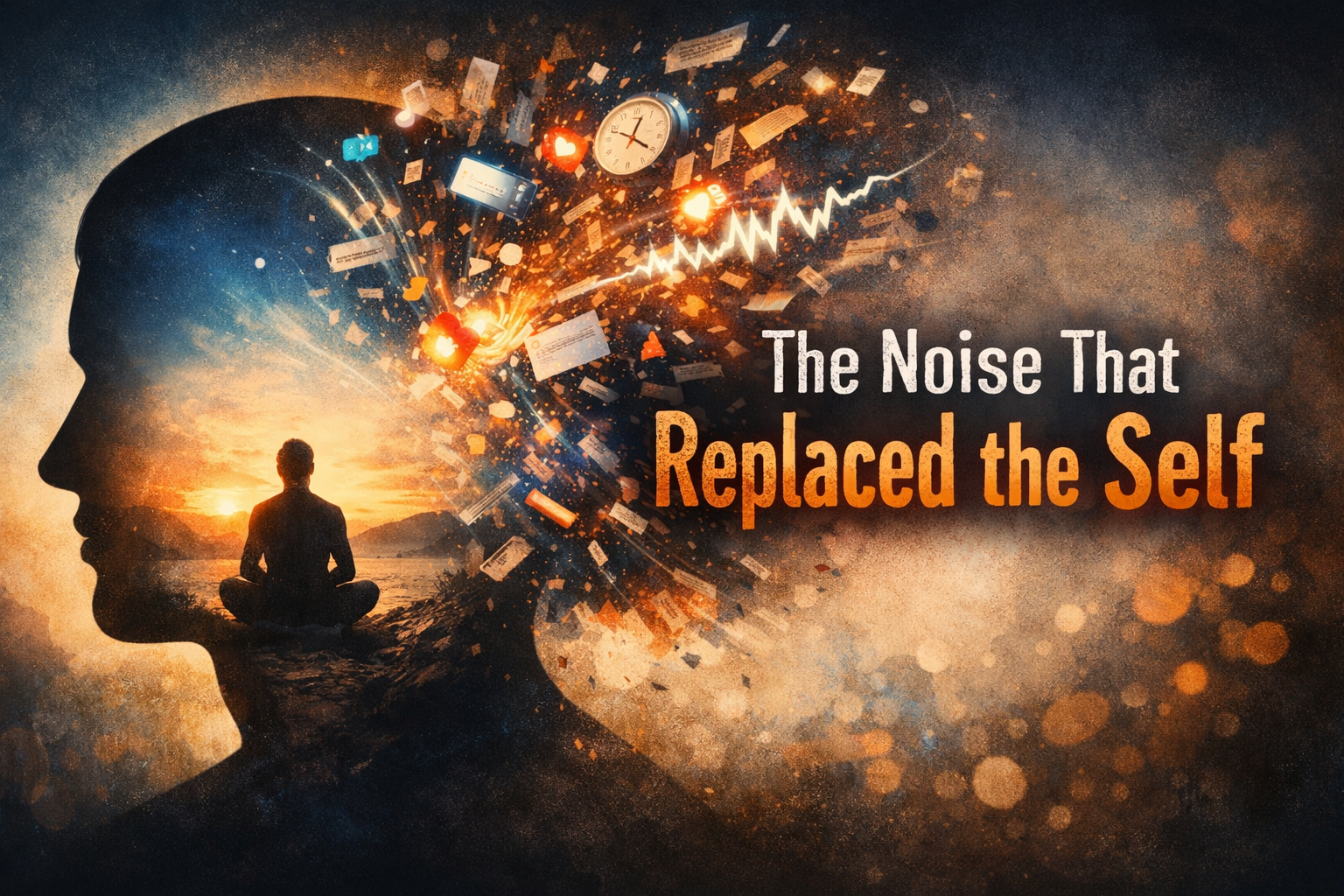
There was a time when silence felt natural.
Not the absence of sound, necessarily. Life still carried its full weight back then — the pressure of responsibilities stacking up, the movement of days that ran too fast, the low hum of ordinary noise that surrounded any person just trying to get through their week. All of that was present. But beneath it, there was something else. A kind of interior stillness. An inner room, quiet enough to think in.
You could sit somewhere unremarkable — a kitchen chair, a patch of grass, a car idling in a parking lot — and feel the outline of your own mind. You could notice when a thought arrived with real weight behind it, as opposed to when one was just passing through. You could tell the difference between a feeling that mattered and one that was only there because something had poked at it. There was enough space inside a day to ask yourself what you actually thought about something and then wait long enough to hear an honest answer.
That space has grown thin.
Most people would not describe their lives as loud. The television is often on, but that’s normal. The phone is usually nearby, but everyone’s phone is nearby. The mind tends to wander, but minds have always wandered. What feels harder to name — harder even to notice — is how rarely the wandering leads anywhere quiet. The noise that has replaced the self is not the kind you can turn a dial to fix. It runs internally. It sounds a lot like ordinary thinking, and so it rarely gets questioned.
Here is how it tends to work: A person wakes up. Before a single decision has been made about the day, they have already scrolled through forty fragments of other people’s lives. They have processed a news headline, half-read a message they’ll respond to later, caught themselves inside a memory that wasn’t called forward by anything in particular, made a small internal comparison between where they are and where they had expected to be by now, and noticed a low haze of worry about something that may or may not happen next week. All of this before breakfast. All of this before the first real thought of the morning.
By midday, the stream has only deepened. There is the mental rehearsal of conversations that haven’t happened. There is the replaying of a conversation that happened three days ago and should have been set down by now. There is the running calculation of tasks, the checking for updates on things that were checked for ten minutes ago, the quiet background noise of wanting — something different, something better, something that keeps sliding just past the edge of what the present moment contains.
A person can go a whole week inside that stream and call it thinking. They can mistake that state of low-level fragmentation for engagement, for productivity, for being a person who takes their life seriously. What it actually is, more often, is the mind in a defensive crouch — filling every gap so that nothing still enough to ask a real question can get through.
Inner noise has become one of the quietest forms of exhaustion in modern life. Not the dramatic burnout that announces itself in a collapse, but the slower kind. The kind that works gradually, the way water softens stone, until the texture of a person’s interior life has changed so completely that they no longer recognize it for what it is.
I noticed it in myself the way you tend to notice these things — not in a flash of insight, but through a feeling I could not quite account for. A flatness that settled in over time. A sense of being present in a moment while simultaneously not being quite there. The room I was sitting in would be perfectly ordinary, and yet I would feel strangely distant from it. Strangely distant from myself.
I remember one specific evening — the kind of evening that would mean nothing to anyone else, which is partly why it meant something to me. I was on the couch. The television was running, something I had turned on without particular interest and kept running for the company of its sound. My phone was in my hand. I was not quite watching the show. I was not quite reading what was on the screen. I was circling a half-formed thought about something that mattered to me, but I could not get close enough to it to know what it actually was.
The feeling inside that moment was hard to name. Restless, yes. Thin, somehow. Like I had been distributed across too many channels and had not saved enough of myself for the room I was actually in. Like I was hovering just beside my own life, close enough to feel its warmth but not quite inside it.
When I finally turned everything off, the silence felt almost startling. Not peaceful, not immediately. Intense, first. Uncomfortable, in the way that arriving somewhere quiet is uncomfortable when you have grown used to noise. But then, slowly, something underneath all of it came into clearer view. A thought I had been orbiting without landing on. A feeling that had been trying to surface for days. A part of my mind that the noise had been, not maliciously, but effectively, keeping covered.
That was when it became impossible to ignore: the noise had not just been filling the space. It had been replacing something.
Constant stimulation does more than occupy attention. Over time, it trains perception into a shallow rhythm.
The human mind is adaptive in ways that feel convenient until they aren’t. When the mind receives nonstop input — rapid switching, emotional spikes, novelty, micro-interruptions — it begins to restructure itself around those conditions. Attention shortens. Reactions quicken. The nervous system learns to expect movement, stimulus, the small neurological rewards that come from checking, refreshing, responding, consuming. The brain begins to optimize for a world that never pauses.
And then stillness arrives, and the mind does not know what to do with it.
Quiet moments begin to feel unfamiliar in a way that’s hard to articulate. Not unpleasant, exactly. More like suddenly noticing you’ve forgotten how to do something you used to do without thinking. A simple pause — a few minutes without input, without a task, without the phone — can carry enough internal friction to send a person reaching for something to fill it. Not because they want the distraction. Not consciously. But because the habit of filling has become so automatic that sitting with emptiness requires an act of will that wasn’t necessary before.
What gets lost in that constant filling is harder to measure than productivity or sleep quality or any of the metrics we tend to reach for. What gets lost is something more like self-acquaintance. The ongoing low-level sense of knowing who you are, what you actually think, what genuinely matters to you on a day when no one is watching and no one is asking. That knowledge does not arrive in dramatic moments. It arrives in the pauses. It surfaces in the silences. It requires exactly the kind of quiet interior space that fragmentation steadily erodes.
None of this is an argument for a life lived in isolation from the world’s noise. The world is loud by nature, and a certain amount of that loudness is human — conversations, laughter, music, the beautiful static of being alive alongside other people. That kind of noise has always coexisted with inner quiet. The two are not enemies.
What is different now is the noise that is not communal or natural or even chosen. The noise that has been designed, with considerable precision, to insert itself into every gap before a person can decide whether they wanted that gap filled. The noise that mimics the texture of thinking while quietly preventing the deeper kind from happening.
Learning to recognize it is not the same as eliminating it. Most of us cannot and would not want to live without our phones or our access to information or the flood of voices that modern life makes available. But there is a difference between using those things and being lived by them. Between choosing input and defaulting to it. Between a mind that is engaged with the world and a mind that has lost its ability to sit quietly inside itself long enough to remember what it actually wants from that world.
The self that lives beneath the noise has not disappeared. It has just been waiting, with more patience than we probably deserve, for us to turn things off long enough to hear it again.

Leave A Comment